


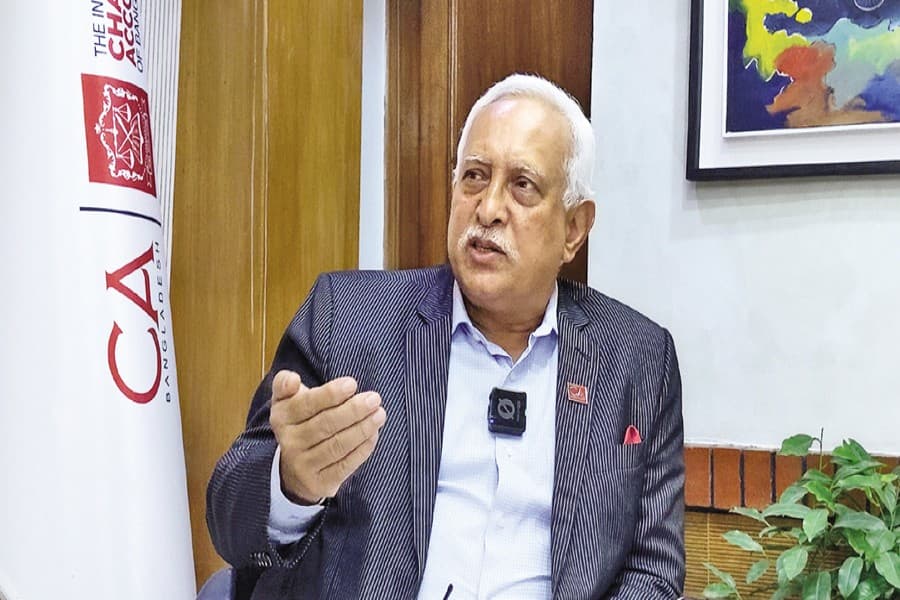
As Bangladesh is going through regulatory transition, banking sector stress, and the journey towards post-LDC graduation, the chartered accountancy profession finds itself at a critical juncture, according to NKA Mobin FCA, President of the Institute of Chartered Accountants of Bangladesh (ICAB). In an exclusive interview with Shiabur Rahman of The Financial Express, he outlined reform priorities, regulatory challenges, and the profession's evolving role in strengthening transparency, audit quality and sustainability reporting.


NKA Mobin said the profession must now look beyond traditional compliance and position itself at the forefront of governance, corporate risk management and international reporting standards.
"We acknowledge that there were issues in certain areas in the past... But the profession has a critical role to play in ensuring transparency, governance, corporate risk management and credible audit opinions. We are working to correct shortcomings and move forward with the entire ecosystem."
LDC graduation
With Bangladesh set to graduate from the Least Developed Country (LDC) category, Mobin identified governance, cost optimisation and risk management as key areas where chartered accountants can add value.
"Post-graduation, we will lose certain duty concessions and preferential benefits. Our products must become more competitive in the international market. That requires structured governance, stronger compliance and adherence to international accounting and auditing standards," he said.
He stressed that greater compliance with globally accepted standards would enhance the credibility and acceptability of Bangladeshi companies in international markets, particularly for export-oriented sectors and financial institutions seeking foreign investment.
Ecosystem weakness
In recent years, corporate governance failures and stress in the financial sector have drawn scrutiny toward auditors. Mobin argued that while accountability is necessary, responsibility must be viewed within the broader regulatory ecosystem.
"I will not say chartered accountants have totally failed… In many private organisations and multinational companies, practitioners have played a strong role. But we must examine the entire ecosystem."
He noted that regulators, particularly in the banking and capital market sectors, bear primary responsibility for day-to-day oversight. If regulatory frameworks are not enforced properly, systemic risks accumulate.
Audits, the ICAB president explained, operate under international standards based on sampling. "In a bank or large corporate house, there are thousands or millions of transactions. No auditor can check 100 per cent of them. Reporting is done based on sampling in accordance with international rules," he said.
However, he admitted that auditor independence has been compromised in certain instances. "We accept that independence was not always maintained. That is why our responsibility has increased. We are working to make sure it improves."
Strengthening audit quality controls
Mobin detailed institutional reforms underway within ICAB to restore confidence in audit reports. "We have undertaken major reforms. Our audit quality review is now a regular phenomenon," he said.
Under international requirements set by the International Federation of Accountants (IFAC), 30 per cent of total audit engagements must be reviewed annually. ICAB has strengthened its Quality Assurance Department, recruited additional personnel and is ensuring strong review by its Quality Assurance Board (QAB).
"We are reviewing processes, checklists and compliance with international auditing standards. We want to make sure such situations do not recur," he said.
Banking sector stress
Mobin attributed the financial sector's current stress largely to asset quality deterioration and weak enforcement of control mechanisms.
"We all know loans were not always given against the right assets. Guidelines of the Bangladesh Bank are clear. Risk factors and provisioning rules are defined. The control mechanisms exist. But they were not properly followed," he explained.
The ICAB president pointed out that non-performing loans had risen to more than Tk 6.0 trillion (Tk 6 lakh crore), reflecting gaps between loan exposure and asset valuation.
On audit independence in banks, he described informal "tri-party" meetings involving management, external auditors and regulators, where provisioning decisions were sometimes influenced.
He alleged that in some cases, auditors were asked to reduce provisioning drastically to facilitate dividend declarations. "If provisioning had been done gradually over the years, today's large shortfalls would not have emerged."
Mobin suggested that political and owners' pressures had undermined strict adherence to prudential standards. However, he sees signs of change.
"In the last two years, we have seen substantial provisioning by banks. Regulators are allowing phased plans but asking banks to identify real provisioning needs. That flexibility is good."
He cited examples of institutions choosing to suspend dividends to clean up balance sheets, calling such decisions "bold and necessary."
IFRS implementation
Mentioning that Bangladesh, as a member of IFAC and IFRS, follows International Financial Reporting Standards (IFRS), the ICAB president said most standards have been implemented, though some complex ones, particularly IFRS 9 (financial instruments), insurance standards (IFRS 18) and new sustainability standards (S1 and S2), are still being phased in.
According to him, the Financial Reporting Council (FRC) now oversees standard setting and enforcement, a responsibility previously held by ICAB.
"We are actively engaged in training and continuing professional development to implement IFRS 9, IFRS 18 and the new sustainability standards S1 and S2," he said.
These standards focus on environmental, social and governance (ESG) disclosures and climate-related financial reporting. Mobin acknowledged that Bangladesh is not yet fully prepared.
"We have a huge data gap. Sustainability reporting requires non-financial data - electricity consumption, carbon footprint, resource use, etc. We have not yet built robust data capture systems for such reporting," he said.
He said banks have begun including sustainability sections in annual reports, but corporate preparedness remains uneven. He expects that Bangladesh Securities and Exchange Commission will provide further guidance for listed companies. FRC should take care of all corporates under PEI (Public Interest Entities) which are approximately 6,000 to 7,000.
"If we fail to comply within global deadlines, it may affect the country's image and foreign investment," he cautioned.
AI and the future of the profession
Mobin admitted that Bangladesh is lagging behind peers such as India in AI-driven audit and automation tools, but said ICAB began incorporating AI and ESG into training programmes and was updating its syllabus in alignment with international institutes.
Examinations are gradually shifting toward computer-based systems, with multiple centres established across the country to reduce geographical barriers.
SMEs and financial reporting weakness
Pointing out that small and medium enterprises (SMEs), which account for more than 80 per cent of businesses, remain weak in financial reporting and auditing capacity, the ICAB chair said, "SMEs cannot afford full-time chartered accountants because of resources constraint."
He proposed leveraging partially qualified CA students - around 40,000 individuals currently in the system - to provide structured financial reporting support. ICAB is exploring intermediate-level certifications aligned with UK and Indian models to create a tier of qualified professionals who can serve SMEs.
"Without awareness, training and ecosystem support - from banks, regulators and industry - SME reporting will not improve," he said.
Reform agenda
Looking ahead, Mobin outlined a strategic roadmap built around 8 reform pillars covering education, audit quality, governance, technology and international collaboration.
According to him, ICAB, established 53 years ago under a parliamentary act as an autonomous body under the Ministry of Commerce, is now led by a council with 20 elected members.
"We have mapped priorities for two, three and five years. If we can implement 60 to 70 per cent of our reform agenda within the next three years, the profession will be in a different place."
Mobin concluded with a call for integrity and independence.
"This is a dignified profession. If you want to work honestly and independently, chartered accountancy remains one of the highest professional qualifications globally," he said.
rahmansrdk@gmail.com