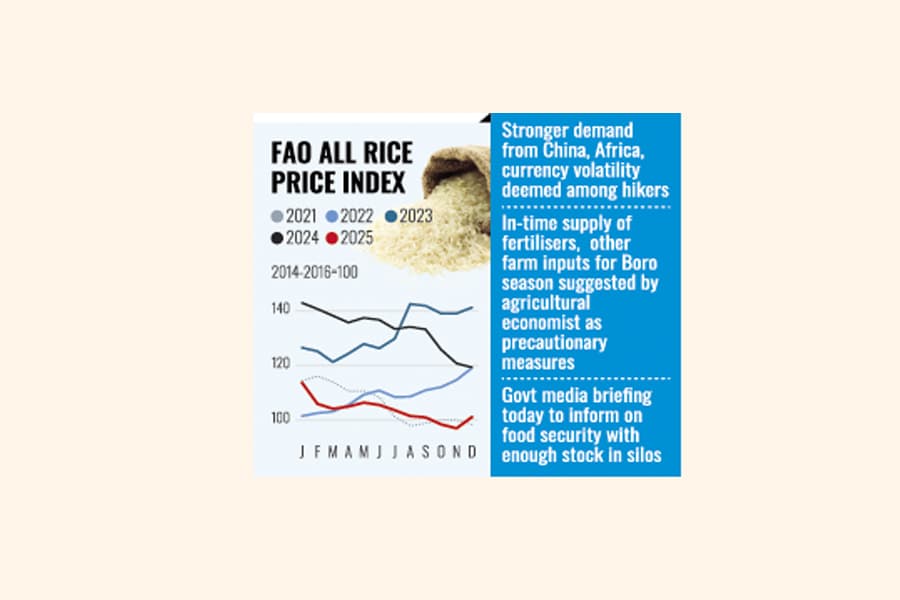
Global rice-price spike in recent months has nudged major rice-consuming countries like Bangladesh into bracing with preparation to fend off any external shocks to food security.
According to the FAO Rice Price Update (January 2026), the FAO All Rice Price Index rose 4.3 per cent month on month in December 2025, mainly driven by higher prices of glutinous and Indica rice-- varieties most consumed in East and South Asian nations.
The Food and Agriculture Organisation (FAO ) data show that Indica rice prices recovered by about 4.3 per cent in December compared to November as prices strengthened in key exporting countries such as Thailand and India.
Indica rice is the staple for countries like Bangladesh, India, Sri Lanka and Pakistan, making any global price movement particularly sensitive for the region.
Parboiled-rice prices, which are important for South Asian markets, also moved up in the last two months.
In Thailand, parboiled-rice prices rose sharply from around US$383 per tonne in November 2025 to about $437 per tonne in December 2025. In India, parboiled-rice prices increased from roughly $350 per tonne in November to around $355 per tonne in December.
Vietnam export rates were relatively stable compared to Thailand and India's, hovering around $360 per tonne in both November and December.
One key factor is reduced -harvest pressure and government-to-government sales, particularly in Thailand, which supported prices.
Another factor is stronger demand from China and Africa and official procurement by importing countries, along with currency movements and logistical challenges in some exporting nations.
Despite the global uptick in prices Bangladesh's domestic rice market remains stable.
Rice prices on the local market have stayed mostly unchanged for the last one month, supported by the ongoing Aman-harvesting season. Currently, coarse rice is selling at Tk 55-56 per kg, medium varieties at Tk 60-65 per kg, and fine rice at Tk 70-92 per kg, according to market sources.
The government is expecting a record Aman harvest of around 17 million tonnes, which is helping ease supply-side pressure.
At the same time, public food stocks are described as "comfortable", standing at about 1.99 million tonnes, of which nearly 1.8 million tonnes are rice, says the food ministry.
Meanwhile, Food and Land Adviser Ali Imam Majumder has called a meeting with the media for Sunday at his office at the Secretariat.
The programme aims to brief journalists on the current food situation, including the stock position of rice and wheat, and the overall outlook for food security.
Agricultural economist Professor Golam Hafeez Kennedy has urged the government to ensure full implementation of public procurement targets, stressing the need to source more rice and paddy from domestic farmers to shore up stock position further.
"Fertiliser and other agricultural inputs must be ensured in time, as farmers are preparing for the Boro season, the country's largest rice-growing season," he suggests as precautionary measures.
tonmoy.wardad@gmail.com