



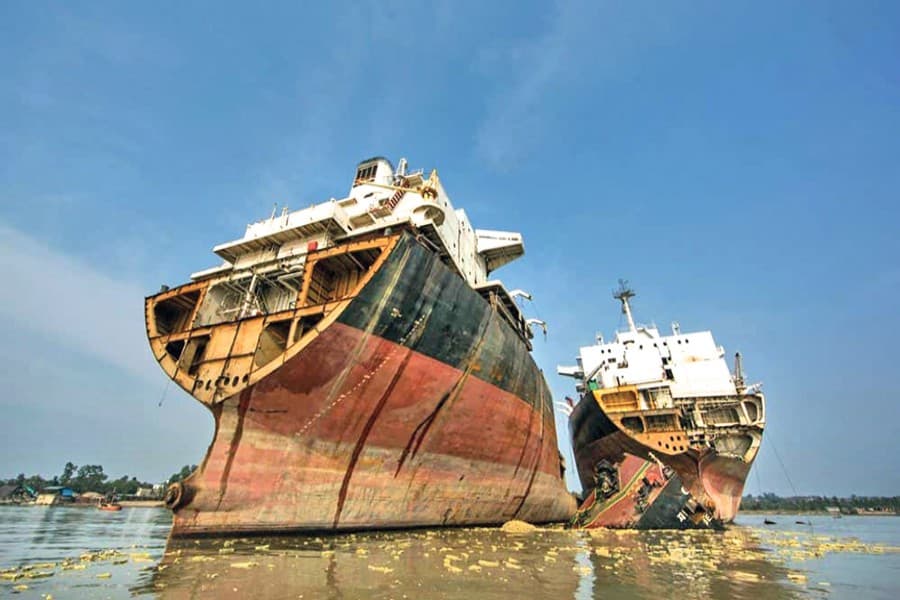
Bangladesh lost its position as the world's top shipbreaking destination in 2025 as imports of scrapped vessels declined by over 32 per cent amid regulatory pressures, economic challenges and stricter international standards.
According to data released by the NGO Shipbreaking Platform (NSP), Bangladesh imported 88 scrapped ships weighing 2.68 million tonnes last year -- a sharp decline from 130 ships in 2024.
Conversely, India emerged as the top shipbreaking destination last year, importing 111 vessels totalling 3.36 million tonnes.
The downturn reflects a volatile trend for the Bangladeshi sector. After peaking at 254 ships in 2021, imports fell to 122 in 2022 before a brief recovery to 170 in 2023. The country brought in 144 ships in 2020.
The 2025 figures represent the lowest intake in recent years.
Local ship-breakers said the decline started in late 2019 due to the Covid-19 pandemic and shutdowns. Although business rebounded in 2021 on pent-up demand, the dollar crisis and high interest rates have again slowed trade, they added.
Industry insiders also blamed the enforcement of the Hong Kong International Convention for the Safe and Environmentally Sound Recycling of Ships (HKC), under which non-compliant yards cannot import ships.
On the other hand, many yards fail to obtain green certification due to funding shortages, as banks remain reluctant to invest in a sector classified as "red" by the environment ministry.
According to the Shipbreaking platform, Turkey imported 49 scrapped ships in 2025, followed by Pakistan with 15, the European Union with 14 and the rest of the world with 44.
When asked, Bangladesh Ship Breakers and Recyclers Association (BSBRA) president Amzad Hossain Chowdhury said that to become HKC-compliant, yards require an investment of Tk 300 million to Tk 1.0 billion, depending on size, to upgrade facilities and obtain green certification.
Banks provide loans to import ships but avoid financing yard upgrades because of the 'red' categorisation, he added, reiterating his call to reclassify the sector from "red" to "orange".
He also sought support from the government in this regard.
Hossainul Arefin, an executive committee member of the BSBRA, said the 'red' categorisation has created various bottlenecks. Obtaining the numerous required certifications and approvals now take months, during which time shipbreakers accrue significant bank interest, he added.
On safety issue, Amzad Hossain Chowdhury said that 23 yards are now compliant -- 17 fully under the HKC and six provisionally certified -- while another 20 are in the process of getting certification.
Despite industry assurances of improved safety and fewer accidents, rights groups remain concerned about worker safety and environmental hazards linked to shipbreaking.
The platform said 321 ocean-going commercial vessels were sold for scrap globally in 2025, of which 214 large ships were dismantled on the beaches of Bangladesh, India and Pakistan -- accounting for more than 85 per cent of global tonnage dismantled.
"Bangladesh and India remain the shipping industry's first choices for scrapping, despite the documented grave consequences beaching ships has on workers, local communities and fragile coastal ecosystems," said the platform.
At least 11 workers died and 62 were injured in South Asia in 2025 due to unsafe practices, it added.
One major incident occurred at Ziri Subedar yard in Chattogram, where an oil-tank explosion injured eight workers during dismantling of the Banglar Jyoti, a vessel owned by the government of Bangladesh, said the platform in a statement.
Bangladesh has approved 17 yards under the HKC, which entered into force in June 2025, but serious accidents still occur and reporting remains opaque, the group said.
In India, no yards are officially authorised under the convention, though more than 100 shipbreaking plots in Alang-Sosiya hold private Statements of Compliance, it added.
The platform warned that the low number of ships that have been scrapped these past years due to favourable operating rates hides a growing backlog of aging tonnage that is expected to head for the breaking yards in the coming years.
"The many vessels that will be heading for scrap, including the dark fleet, must be recycled at safe, transparent, and fully regulated facilities -- away from beaching practices," said Nicola Mulinaris, Senior Communication and Policy Advisor, NGO Shipbreaking Platform.
Existing facilities that already meet these standards, including ship recycling yards in the European Union, continue to operate at significant under-capacity, underscoring that safe alternatives do exist but remain systematically overlooked by the shipping sector, he noted.