
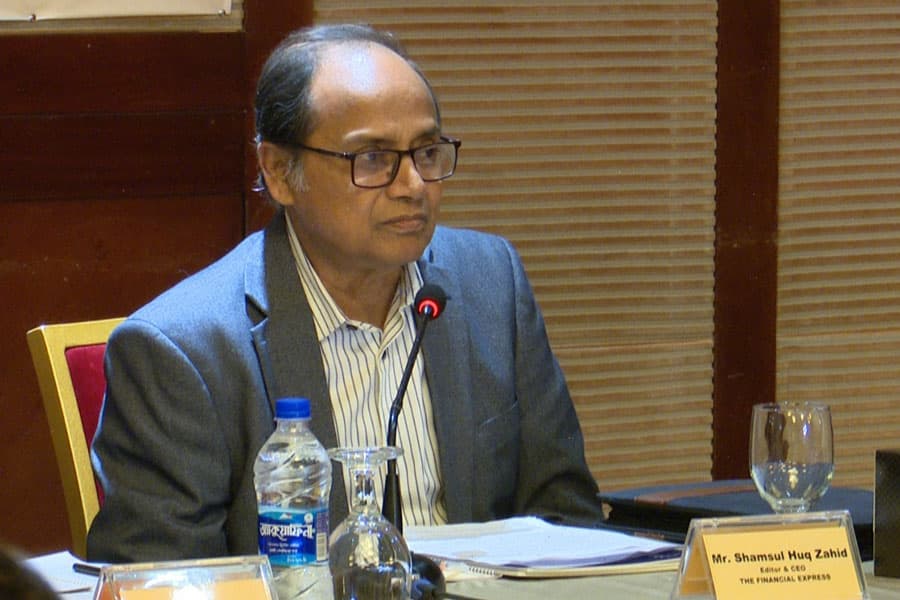
Shamsul Huq Zahid, Editor and CEO of The Financial Express, on Saturday emphasised the urgent need to stabilise the country’s banking sector to support economic recovery and put growth back on an upward trajectory.
Speaking at the MTB–FE roundtable titled “Banking Sector Reforms” at Six Seasons in Dhaka city, organised by The Financial Express, he said reforms are often talked about when things go wrong, but are usually avoided as they tend to be painful. However, given the current condition of the banking sector, he noted that comprehensive reforms have now become unavoidable.
Mr Zahid said that although problems in the sector had long been suspected, the true picture remained concealed as some banks resorted to manipulating their financial statements. Recent disclosures, however, have revealed the fragile health of the industry.
He pointed out that many banks and non-banking financial institutions were established over the past one and a half decades on political considerations, resulting in far more institutions than the economy actually needs.
Political interference in the sanction and disbursement of loans—particularly large loans—frequent amendments to the Bank Company Act to benefit certain families and groups close to the then ruling quarters, and regulatory indulgence were cited as key factors behind the sector’s deterioration.
According to Mr Zahid, bank boards, along with some former top officials of Bangladesh Bank and the Financial Institution Division (FID), made it easier for a select group to siphon off banks’ funds, causing massive losses of depositors’ money.
Referring to recent corrective measures, he said Bangladesh Bank, with support from the Ministry of Finance, has taken steps to protect depositors’ interests following the fall of the autocratic regime. These include the merger of five Islami banks into a single entity and ongoing efforts to merge nine non-banking financial institutions, which have helped restore confidence in the financial sector.
Despite these initiatives, he warned that non-performing loans remain alarmingly high, with nearly one-third of total outstanding loans now classified. While the central bank initially adopted a tough stance against large defaulters, it has recently softened its approach to allow major manufacturing units to continue operations and protect thousands of jobs, creating a dilemma for Bangladesh Bank.
Mr Zahid also highlighted the issue of Bangladesh Bank’s autonomy, noting that a proposal to amend the Bangladesh Bank Order is awaiting government approval. He stressed that while legislation is necessary to ensure independence, ending the culture of political interference in the central bank’s affairs is equally important, though difficult to guarantee in the country’s context.
Dr Salehuddin Ahmed, Adviser, Ministry of Finance, attended the discussion event as the chief guest, while Dr Ahsan H Mansur, Governor, Bangladesh Bank, as the special guest.
Dr Shah Md Ahsan Habib, Professor, BIBM, delivered the keynote speech.
The event was chaired and moderated by Mr Shamsul Huq Zahid, Editor and CEO of The Financial Express.
Mutual Trust Bank PLC was the title sponsor of the roundtable, while BRAC Bank PLC and NCC Bank PLC were gold sponsors. Trust Bank PLC, Shahjalal Islami Bank PLC, Eastern Bank PLC, and Mercantile Bank PLC joined as co-sponsors.
newsmanjasi@gmail.com