

BGMEA, BKMEA slam ‘unilateral’ move to withdraw bonded facility on yarn imports
Published :
Updated :
 For all latest news, follow The Financial Express Google News channel.
Leaders of the Bangladesh Garment Manufacturers and Exporters Association (BGMEA) and the Bangladesh Knitwear Manufacturers and Exporters Association (BKMEA) on Monday alleged that the Ministry of Commerce has made a unilateral recommendation to withdraw the bonded warehouse facility on yarn imports in an effort to curb imports.
Demanding immediate withdrawal of the move, they warned that implementing such a one-sided decision would push the readymade garment (RMG) industry into a serious crisis.
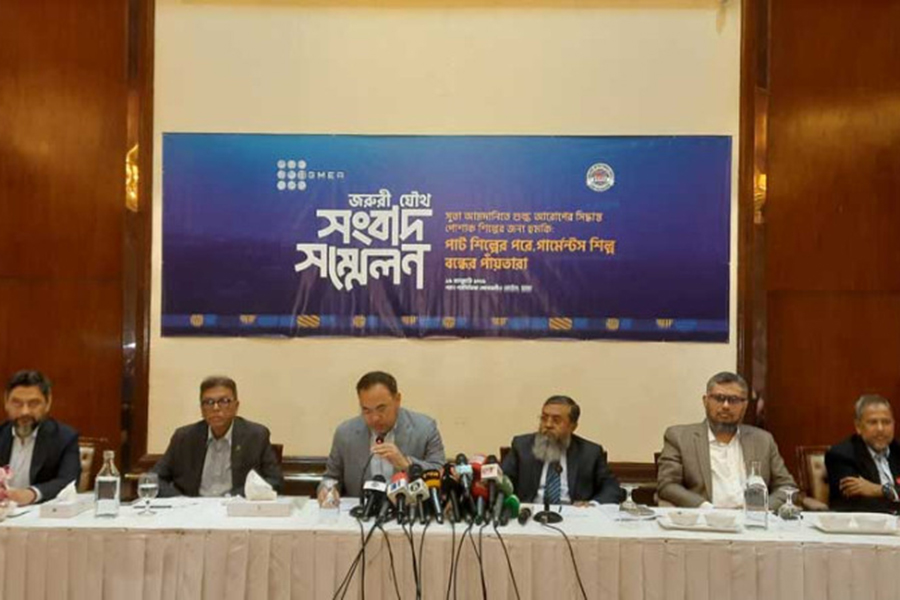
The remarks came at a joint press conference organised by BGMEA and BKMEA at a city hotel in Dhaka. The briefing was still underway at the time of filing this report.
In a written statement, BGMEA Acting President Selim Rahman said that although garment exporters are the sole buyers of yarn produced by local spinning mills, the interests of the apparel industry were completely ignored while taking such a sensitive and far-reaching decision.
“During discussions with the Tariff Commission, our views were sidelined, and the commission took the decision unilaterally,” he said.
Selim Rahman further said the move directly violates Articles 3 and 4 of the World Trade Organization’s Safeguards Agreement. Under international rules, any protective duty on imports must be preceded by a transparent and impartial investigation proving serious injury to local industry, which, he alleged, was not conducted in this case.
“Such an attempt to impose a unilateral decision is not only undesirable but also highly questionable from a policy perspective,” he added.
The government has taken the decision mainly to protect local spinning mills. However, Selim Rahman said the sector needs capacity enhancement and productivity modernisation rather than artificial tariff protection.
“To support the textile sector, the government can provide direct incentives, ensure uninterrupted energy supply, or take measures to improve efficiency,” he said.
He also expressed concern that imposing duties on yarn imports would negatively affect exports. Garment exports declined by 2.63 per cent during July–December of FY26 compared to the same period of the previous fiscal year, while exports fell sharply by 14.23 per cent in December alone.
“If exporters are forced to buy higher-priced yarn, buyers will reduce orders. This will also hurt deemed exporters,” he warned.
From the joint press conference, BGMEA and BKMEA demanded immediate withdrawal of the decision to impose duties on yarn imports. They also proposed alternative measures to protect the textile sector, including direct cash support or special incentives, ensuring adequate gas and electricity supply, rationalising energy prices, offering corporate tax rebates for export-oriented spinners, and ensuring easier access to low-interest loans to reduce production costs.
Industry leaders noted that since the 1980s the government has been providing duty-free bonded facilities for yarn imports to encourage export-oriented garment production and maintain global competitiveness. Local mill owners, however, have long demanded withdrawal of the facility, claiming that neighbouring countries export yarn to Bangladesh at lower prices, threatening their survival.
The Bangladesh Trade and Tariff Commission (BTTC) has supported this argument, and in this context the Ministry of Commerce decided to withdraw the bonded facility for cotton yarn imports from India.
BKMEA President Mohammad Hatem questioned why the Commerce Ministry and the Tariff Commission failed to investigate the reasons behind rising yarn imports from India, saying the increase was largely due to cuts in cash incentives for local spinners.
“If yarn imports are restricted, it will trigger increased fabric imports from China, which are still cheaper than those produced in Bangladesh,” he added.
He also alleged that the Indian government provides various incentives in ways that bypass WTO rules, while Bangladesh is reducing incentives for its own exporters.
BGMEA Director Faisal Samad said local spinners receive cash incentives as deemed exporters, but incentive payments amounting to thousands of crores of taka remain stuck.
BKMEA Executive President Fazlee Shamim Ehsan said local spinners have failed to supply yarn of the quality required by international buyers.
“Buyers will not pay higher prices simply because exporters are Bangladeshi. Higher costs may push buyers to relocate business to other countries,” he said.
BGMEA Director Abdus Salam questioned how a facility used by the apparel industry for the last 40 years could face tariff imposition within just 40 days.
Mohammad Hatem also raised concerns over whether additional duties would be refunded to exporters after shipment. “If duties are refunded, what about the investment required to pay them upfront? It involves huge capital and long waiting periods, which are not feasible,” he said.
He further noted that duty drawback processes often take up to two years, creating significant financing and miscellaneous costs.
“The government has a responsibility to ensure a win-win situation for all stakeholders,” he added.
Citing ASYCUDA World data, Fazlee Shamim Ehsan said Bangladesh’s yarn imports under bond declined by 8.11 per cent to 345,577.82 tonnes during July–December of FY26 from 376,060.40 tonnes in the same period of the previous fiscal year.
Imports from India also fell by 7.33 per cent year-on-year to 333,854.49 tonnes from 365,563.24 tonnes during the same period.
Overall, year-on-year yarn imports declined, indicating subdued demand and efforts to curb bonded imports to protect local spinning mills, while Indian yarn remains competitive due to lower production costs.
Ehsan said the yarn import duty rates are ranging from 33.63 percent to 39.75 percent.
He said export-oriented industries worldwide enjoy duty-free access to raw materials. “If Bangladesh restricts this facility, buyers will shift orders to other countries to secure competitive prices,” he added.
Among others BGMEA Senior Vice President Inamul Haque Khan, Vice Presidents Rezwan Selim, Mijanur Rahman, Md Shehab Uddouza Chowdhury were present at the press conference.
newsmanjasi@gmail.com