

Published :
Updated :
 For all latest news, follow The Financial Express Google News channel.
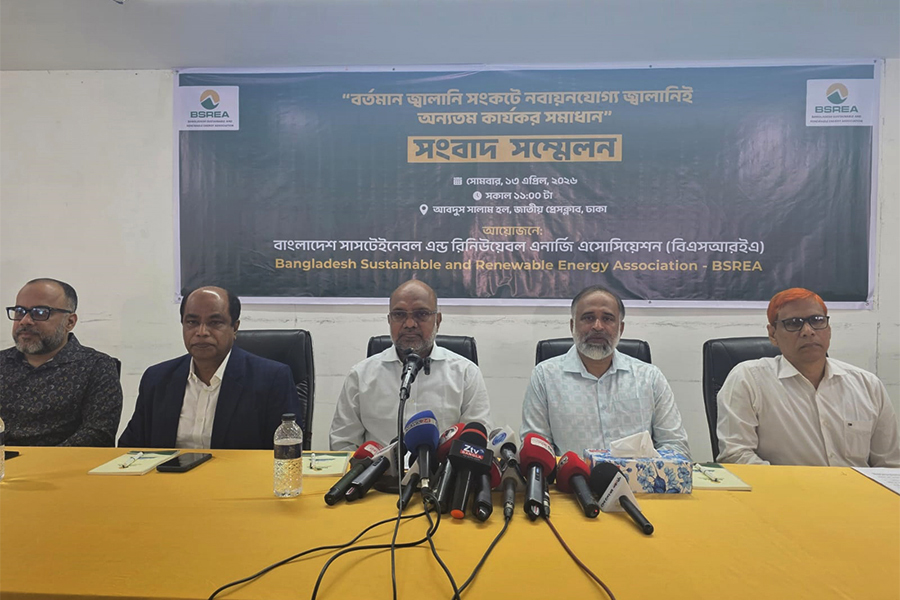
Amid the ongoing energy crunch, the Bangladesh Sustainable and Renewable Energy Association (BSREA) has called for prioritising renewable energy to ensure long-term energy security.
At a press conference held on Monday at the National Press Club in Dhaka, BSREA leaders highlighted that Bangladesh is currently facing a deepening energy crisis, driven largely by its heavy dependence on imported fuels, rising global energy prices, and mounting pressure on foreign exchange reserves.
They noted that the high cost of LNG, coal, and oil used in power generation is forcing the government to provide subsidies exceeding Tk 2.0 billion per day, posing significant long-term risks to the economy.
In a written statement, BSREA President Mostafa Al Mahmud said that renewable energy, particularly solar power, offers the most cost-effective and environmentally sustainable solution in the long run. However, the sector is not receiving adequate policy support.
He pointed out that import duties and taxes on renewable energy equipment currently range between 50 per cent and 60 per cent, creating a major barrier to investment. In contrast, conventional energy sectors continue to receive subsidies and policy advantages, leading to structural imbalances.
Citing international examples, BSREA said countries like Pakistan, India, Vietnam, and China have made significant progress by offering tax exemptions, lower duties, and easier financing. In Bangladesh, however, high tariffs on lithium-ion batteries and energy storage systems are further hindering the sector’s growth.
The association also flagged global geopolitical tensions, including those involving the US and Iran, as a key factor behind volatility in energy markets. Brent crude prices have surged to $115-$120 per barrel, while risks surrounding the Strait of Hormuz threaten global energy supply routes.
Bangladesh’s energy security has become increasingly vulnerable, as more than 60 per cent of its energy demand is import-dependent. LNG imports, around 70 per cent of which come from Qatar, are also at risk of disruption, raising concerns over power generation capacity.
According to BSREA, daily gas demand in the power sector exceeds 2,500 MMCFD, while supply has dropped to 850-900 MMCFD, potentially leading to a shortfall of 1,500 to 1,800 MW in electricity generation. Strategic fuel reserves are also limited, sufficient for only 35-40 days, far below the international standards.
The crisis is already impacting industries, particularly the ready-made garments (RMG) sector, where production has declined by 30-40 per cent due to gas shortages and load shedding. This could adversely affect export earnings and foreign exchange reserves.
Speakers at the event stressed that the current crisis is not temporary but reflects deeper structural weaknesses in the country’s energy framework. They emphasised that a rapid transition to renewable energy is essential for a sustainable solution.
BSREA placed several recommendations, including reducing duties and taxes on renewable energy equipment, setting zero tariffs on lithium-ion batteries, ensuring long-term low-interest financing, and expediting stalled solar projects.
Additional proposals included relaunching rooftop solar programmes, simplifying net metering processes, expanding solar-powered irrigation, and offering tax holidays for renewable energy investments.
The association believes that, with proper policy support and investment, renewable energy can play a transformative role in strengthening Bangladesh’s energy security.
sajibur@gmail.com