

Published :
Updated :
 For all latest news, follow The Financial Express Google News channel.
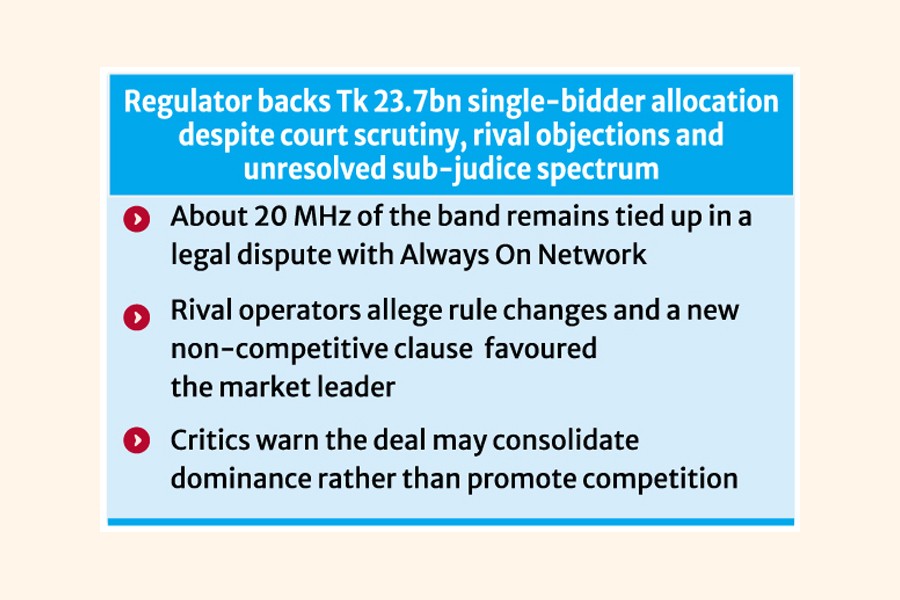
Bangladesh's telecom regulator has moved forward with a controversial allocation of 700 MHz spectrum to Grameenphone (GP), despite unresolved legal disputes, objections from rival operators and mounting accusations of regulatory bias that critics warn could further entrench market imbalance.
The Bangladesh Telecommunication Regulatory Commission (BTRC) has in principle decided to award Grameenphone 10 MHz of the prized low-band spectrum at the reserve price, generating Tk 23.70 billion for the government.
The decision was taken by the Spectrum Auction Committee and the Spectrum Management Committee, marking the country's first commercial assignment of the 700 MHz band.
However, a BTRC commissioner confirmed that final regulatory approval has not yet been granted and will require endorsement at the commission's next meeting.
The move has nonetheless triggered sharp criticism from industry stakeholders, who argue that BTRC has effectively reshaped auction rules to favour the dominant operator, while sidelining competition, transparency and long-term sector sustainability.
Hurried allocation despite sub-judice status
The allocation proceeds even though a significant portion of the 700 MHz band-around 20 MHz-remains tied up in a long-running legal dispute between BTRC and broadband service provider Always On Network.
Industry insiders question how the regulator justified the partial release of a band that is still sub-judice, and why urgency appeared to apply only to GP.
"The regulator's haste is difficult to explain," said a senior telecom executive. "If the band is legally clean enough for GP, why is the remainder still stuck in court?"
The High Court has issued a rule questioning the legality and constitutionality of proceeding with the 700 MHz auction when only one operator remains in contention. While allowing the auction process to continue for now, the court asked why such an auction should not be declared illegal, citing concerns over competition, equality and public interest.
In its order, the court specifically questioned whether the auction structure risks undermining fair competition in the telecom market and whether proceeding without safeguarding the interests of state-owned Teletalk and other operators violates Article 27 of the Constitution, which guarantees equality before the law.
The court directed the Posts and Telecommunications Secretary, the BTRC chairman, the Finance Secretary and the Director General of the Spectrum Division to respond within four weeks.
Petitioners also invoked the public trust doctrine, arguing that radio spectrum is a finite natural resource and that the state, as custodian, cannot take decisions that lead to monopolisation. The court's intervention comes amid criticism that the auction was hurriedly arranged during the tenure of an interim government, without adequate market analysis, potentially locking in long-term competitive distortions in exchange for short-term fiscal gains.
Single-bidder auction after rule changes
Grameenphone emerged as the sole participant after Robi Axiata withdrew and Banglalink and Teletalk stayed away. Anticipating a single-bidder outcome, BTRC amended its auction rules shortly beforehand, reducing the maximum spectrum acquisition cap per operator from 15 MHz to 10 MHz.
While the regulator described the move as a competition safeguard, rival operators argue that the more consequential change lay elsewhere: the introduction of a new provision-Clause 16.03.12-allowing spectrum to be assigned at the base price if there is no competitive bidding.
Robi Axiata, in a formal letter to BTRC dated December 23, 2025, said the clause was introduced "without transparent consultation with all mobile network operators" and lacked precedent in previous spectrum auctions.
The operator warned that the provision enables a financially stronger bidder to acquire scarce low-band spectrum through a non-competitive process, reinforcing existing asymmetries rather than correcting them.
Ignoring calls for coordinated low-band release
Robi and other operators have repeatedly urged BTRC to auction all available low-band spectrum-including the EGSM band-together, in line with international best practice. Such coordinated releases, they argue, enable more balanced spectrum portfolios and prevent piecemeal allocations that favour incumbents.
Instead, BTRC proceeded with a standalone 700 MHz auction, despite Robi formally requesting affordable pricing, removal of Clause 16.03.12 and adoption of a holistic low-band release strategy.
"The current approach overlooks differences in operators' financial capacity," Robi wrote, noting that uniform pricing places a disproportionately higher spectrum-cost-to-revenue burden on smaller operators than on the market leader.
Risk of deepening market imbalance
Critics warn that allocating premium low-band spectrum to a single operator-particularly one that already dominates subscriber numbers and revenues-risks widening disparities in coverage quality, network performance and investment capacity.
Robi has cautioned that high upfront spectrum costs crowd out investment in rural expansion, fibre backhaul and 4G and 5G deployment, ultimately harming consumers and contradicting BTRC's statutory obligation under the Bangladesh Telecommunication Act 2001 to promote effective competition.
Although BTRC later revised the acquisition cap to 10 MHz, rival operators argue that the adjustment does not address the core concern: the unprecedented introduction of a non-competitive allocation clause, which they insist should have been scrapped entirely.
Questions over regulatory neutrality
BTRC maintains that the auction is necessary to improve nationwide coverage and service quality, and that spectrum remains available for future assignments. However, industry observers say the episode reinforces perceptions that regulatory decisions are being shaped around Grameenphone's needs rather than a level-playing-field framework.
"With one operator accommodated and others priced or designed out, this cannot be called a competitive auction in any meaningful sense," said a former BTRC commissioner.
As Bangladesh begins commercial use of the 700 MHz band, the controversy raises deeper questions about transparency, consultation and whether spectrum policy is being deployed to rebalance the telecom market-or quietly consolidate it.
However, Tanveer Mohammad, Chief Corporate Affairs Officer of Grameenphone, said the operator has received an acknowledgment letter from BTRC confirming its eligibility to acquire the 700 MHz spectrum upon completion of all applicable regulatory requirements.
"This reinforces our commitment to strengthening network quality and delivering a superior, reliable experience for customers across Bangladesh," he said.
"We appreciate BTRC's continued support in enabling a future-ready telecom ecosystem. The 700 MHz spectrum will allow us to enhance coverage-particularly in underserved and indoor environments-while improving network efficiency and resilience," he added.
Grameenphone said it looks forward to responsibly utilising the spectrum to elevate service quality and deliver secure, innovative digital services to its more than 85.6 million customers, reinforcing its role as a key enabler of Bangladesh's digital progress.
bdsmile@gmail.com