

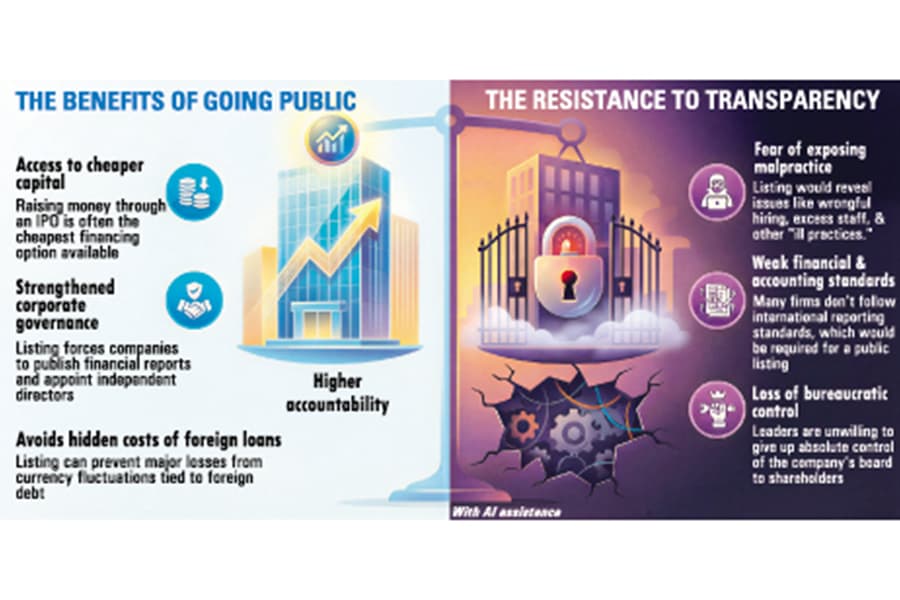
State-run fuel and energy companies could reduce their dependence on government and foreign funds as well as bank loans by listing on the stock market, but political and bureaucratic resistance persists -- largely to avoid heightened scrutiny of corrupt practices.
Government and foreign funds are generally considered cheaper than bank credit. However, money raised through an initial public offering (IPO) can be the cheapest source of financing of all -- unless company boards factor in the cost of exposing business operations and the resulting regulatory actions.
Take the case of BR Power Generation, for example.
The company reported aggregate liabilities of Tk 14.75 billion, including foreign debts and government loans, in FY25. According to its financial statements, interest payments amounted to Tk 829.52 million during the year.
Of the current liabilities, government loans accounted for Tk 3.66 billion, against which BR Power Generation pays an annual interest rate of 3.0 per cent -- the lowest -- amounting to Tk 109.80 million.
Suppose the company raised the same amount of Tk 3.66 billion by issuing primary shares in the stock market. Being a profitable entity, it could issue shares at an offer price of Tk 50, including a premium of Tk 40 per share, for example.
In that case, the premium would amount to Tk 2.92 billion. As a result, BR Power Generation would need to pay dividends on capital worth only Tk 732 million -- the equivalent of the free float. If the company paid a 10 per cent cash dividend in the listing year, the payout would amount to Tk 73.2 million.
There would be additional listing and IPO management fees, but these are one-off costs and would not recur in subsequent years.
Apart from government funds, the power company also took foreign loans worth $5.85 million at an interest rate of about 3.19 per cent. These loans carry hidden costs as well. At the time of receiving the loan, the exchange rate was below Tk 80, which rose to Tk 122 by 2025 -- resulting in a foreign exchange loss of more than 52 per cent.
Since domestic banks lend at market-driven interest rates, bank borrowing is even more expensive.
Abul Kalam, spokesperson of the Bangladesh Securities and Exchange Commission (BSEC), said the cost of funds raised through an IPO is almost negligible compared to local and foreign debt.
Nevertheless, state-run fuel and power companies, including BR Power Generation, have remained reluctant to go public.
Asked why the company has not floated an IPO yet, its independent director Al-Amin said the organisation previously lacked the accounting standards required for listing, but had recently adopted them.
However, there are more reasons that remain undisclosed.
Based on audit experience, an official of Rahman Rahman Huq, an audit firm, said on condition of anonymity that many multinational companies achieve targets with fewer employees. In contrast, local state-run companies often employ excess and unqualified personnel.
"Companies refrain from going public due to the fear that ill practices will be exposed," said the representative of Rahman Rahman Huq, referring to listing obligations that require disclosure of all price-sensitive information.
Non-listed companies are not mandated to appoint independent directors, and many state-run energy producers therefore do not have such positions on their boards. For example, the board of Bakhrabad Gas Distribution Company consists solely of bureaucrats. Northwest Power Generation Company and Jalalabad Gas Transmission and Distribution System also lack independent directors.
Reviewing the financial statements of Bakhrabad Gas Distribution Company for FY24, auditors noted that the inventory management software did not display key transactional data, including opening balances, issue dates, and inventory movements.
As a result, the auditors could not verify inventory valuations due to the absence of supporting evidence.
Sk Ashikh Iqbal, a local partner of global audit firm Deloitte, said most state-run companies do not follow International Financial Reporting Standards (IFRS) in preparing financial statements.
He added that auditors' qualified opinions -- highlighting financial and material mismatches -- are far more common in state-run companies than in private entities.
"That reflects weak financial management capacity, including a shortage of professionally qualified accountants," Iqbal said.
Malpractices in state-run companies are rarely come to light. One such instance occurred in 2019, when a probe -- initiated following complaints over recruitment -- revealed the wrongful appointment of 13 executive engineers at Northern Electricity Supply Company (NESCO) in violation of eligibility criteria stated in the job circular.
The investigation committee recommended cancelling the appointments. However, only two engineers were issued warnings, while a departmental case was filed against another.
On the actions taken, NESCO executive director Abu Hayat Md. Rahmatullah said the board made its decision after reviewing the probe report and consulting the energy ministry.
"Those who are beneficiaries would not want to lose undue advantages through company listing," said Minhaz Mannan Emon, a director of the Dhaka Stock Exchange (DSE).
Companies can avoid listing because there is no legal mandate, he added.
Apart from mandatory publication of quarterly and annual reports, listed companies must seek shareholder approval of financial statements and major investment decisions through annual general meetings (AGMs) and extraordinary general meetings (EGMs).
The BSEC spokesperson said mandatory disclosure of price-sensitive information (PSI) also helps protect the interests of companies and shareholders.
For instance, the board of a leading private commercial bank could not proceed with its plan to purchase a 21.5-storey commercial building in Motijheel after regulatory intervention. Following a PSI disclosure, the BSEC found that the building belonged to the parents of the bank's incumbent chairman.
"A company comes under extra layers of regulation when listed," said Mohammed Helal Uddin, a professor in the Department of Economics at Dhaka University.
"But bureaucrats do not want to lose control of the boards," he added.
Speaking to The FE, Ashuganj Power Station Company Secretary MA Mansur said the biggest advantage of state-run power companies is guaranteed demand, as the government itself is the customer.
"It enhances the valuation of state-run companies," he said.
Asked why Ashuganj Power Station has not yet floated an IPO, Mansur said the energy ministry had instead allowed the company to raise funds through bond issuance. Any future IPO, he said, would depend on decisions by the company's board and the Ministry of Power, Energy and Mineral Resources.
Despite long-standing demands to list state-run companies to improve solvency, governance, and market depth, none have gone public over the past two decades due to bureaucratic complications and political reluctance.
Several initiatives -- beginning with a 2005 decision under then finance minister M. Saifur Rahman, followed by efforts by successive finance ministers and a 2024 directive from the previous prime minister -- failed to yield results.
Even after the incumbent non-political interim government ordered the listing of profitable state-run companies following a meeting with ministries and regulators in May last year, no tangible progress has been made, largely due to the absence of board approvals.
"We went door to door of the companies. We have continued our efforts to facilitate the listing of the companies," said Mazeda Khatun, chief executive officer of the ICB Capital Management.
mufazzal.fe@gmail.com