

Climate-resilient digital lifeline planned for remote islands
$99.8m project aims to connect disaster-prone coastal communities
Published :
Updated :
 For all latest news, follow The Financial Express Google News channel.
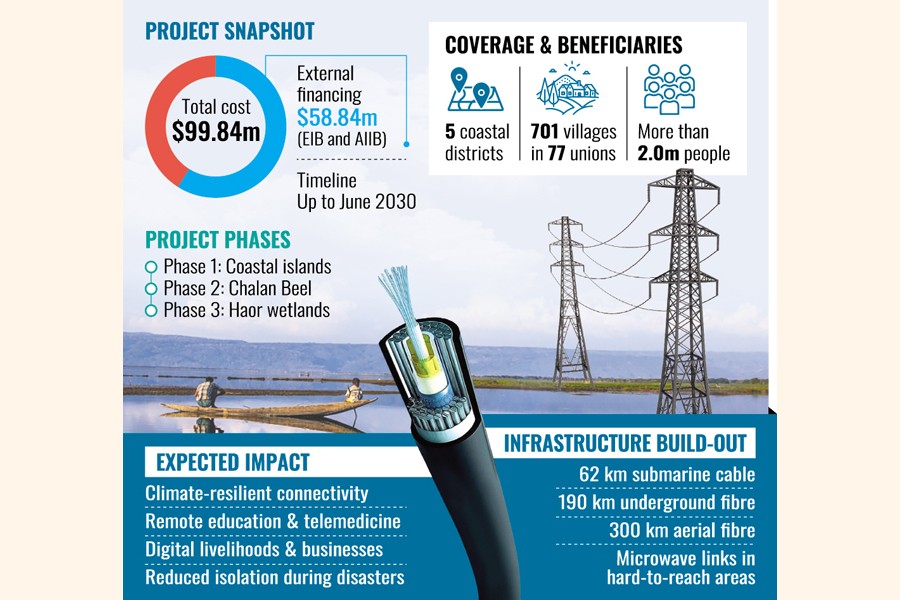
The ICT Division has proposed a $99.84-million project to build climate-resilient digital infrastructure across some of most remote and disaster-prone islands, targeting 77 unions and 701 villages in five coastal districts.
The initiative is expected to benefit more than two million people by expanding reliable, high-speed internet access to areas that are routinely cut off during cyclones and floods.
Backed by $58.84 million in financing from the European Investment Bank (EIB) and the Asian Infrastructure Investment Bank (AIIB), the project seeks to ensure uninterrupted connectivity for households, schools, health facilities, government offices and businesses, even during extreme weather events.
The ICT Division has submitted the Preliminary Development Project Proposal (PDPP) for the "Digitalisation of Islands Along the Bay of Bengal Project (i-Land)" to the Planning Commission, seeking fast-track appraisal and final approval by the Executive Committee of the National Economic Council (ECNEC), a senior Planning Commission official said.
Subject to approval, the Department of Information and Communication Technology (DoICT) under the ICT Division will implement the project by June 2030, according to the proposal.
Despite the expansion of more than 100,000 kilometres of optical fibre connecting around 4,500 unions nationwide, the proposal notes that most remote and disaster-prone regions, including southern coastal islands, the Chalan Beel area and the Haor wetlands, remain largely unconnected at the middle- and last-mile levels.
To address this gap, the project will be implemented in three phases. The first phase will focus on strengthening digital infrastructure in coastal island areas.
The second phase will extend coverage to the Chalan Beel region in the west-central zone, followed by a third phase targeting the Haor wetlands in the north-east.
Together, the three phases, requiring a combined investment of more than $170 million, aim to promote sustainable socio-economic development and enhance climate resilience for an estimated 6-7 million people.
Under the first phase, the project plans to lay 62 kilometres of composite submarine cable, 190 kilometres of underground optical fibre and 300 kilometres of aerial optical fibre to deliver high-speed internet to the islands.
All schools, health clinics and major medical centres will be connected, supported by point-to-point microwave links in locations where fibre installation is constrained by geography or environmental conditions.
The project also includes the establishment of 40 Technical Resource Centres (TRCs) in selected unions. These centres will manage ICT operations, support network maintenance and provide community access to digital services, with adequate space, reliable power supply and secure equipment storage.
In addition, 100 digital smart labs and service centres will be set up in educational institutions. These facilities will feature solar-powered ICT infrastructure designed to withstand cyclones and prolonged power disruptions, supporting remote education, telemedicine and digital business development.
However, officials at the Planning Commission have raised concerns that around 70 per cent of the proposed project cost is allocated to physical infrastructure, with comparatively limited funding for training, local capacity-building and the long-term operation of the TRCs and smart labs.
Without strong local ownership, community readiness and sustained investment in digital literacy, equitable access and the intended socio-economic benefits may fall short of expectations, an official cautioned, underscoring the need for careful planning to ensure the project meets its ambitious goals on digital inclusion and climate resilience.
jahid.rn@gmail.com