

Climate stress, rising input costs slow Bangladesh's farm output: BIDS study
Published :
Updated :
 For all latest news, follow The Financial Express Google News channel.
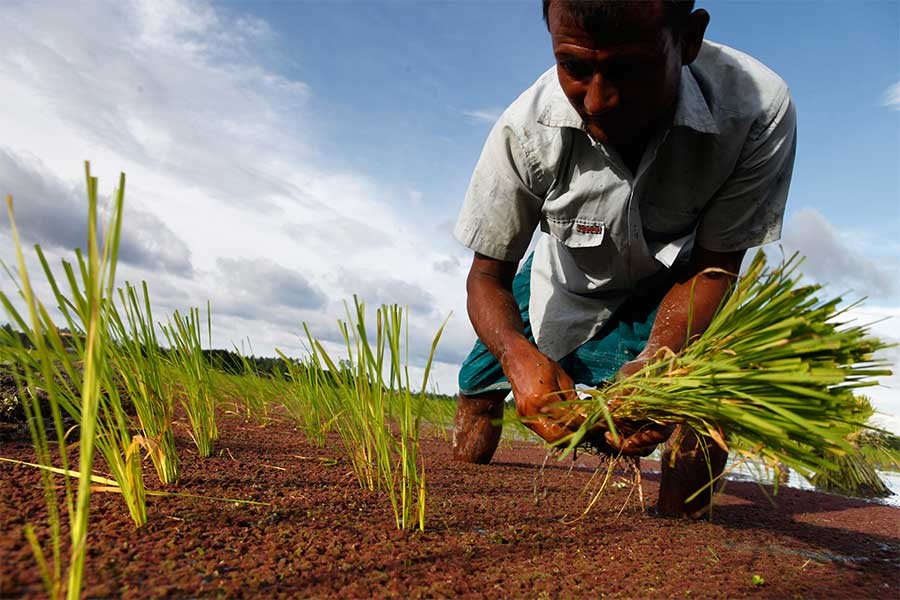
Agricultural productivity in Bangladesh is losing momentum as climate pressures, rising input costs, land constraints and weak diversification weigh on the sector after years of robust gains, according to a new study by the Bangladesh Institute of Development Studies (BIDS).
The study, titled “Perspectives on the Agrifood System in Bangladesh,” finds that growth in the country’s agrifood system—which still employs nearly half of the labour force and contributes close to one-fourth of GDP—has begun to slow as total factor productivity (TFP) levels off.
Dr Mohammad Yunus, Research Director at BIDS, presented the key findings at a dissemination seminar held at the institute’s auditorium on Tuesday, where SM Shakil Akhter, Secretary of the Planning Division, attended as the chief guest.
Experts, agricultural economists, academics and researchers from BIDS and other think tanks also addressed the event, which was chaired by Professor AK Enamul Haque, PhD, Director General of BIDS.
Dr Yunus said the cost of producing rice increased by 3.45 per cent annually between 2012 and 2018, while output prices rose only 1.31 per cent per year, eroding profitability.
He pointed to an oligopolistic rice market—where millers and traders capture a disproportionate share of returns—as a major factor behind farmers’ weak price realisation.
TFP growth declined between 2016 and 2021 as input use rose faster than output, indicating diminishing returns to conventional intensification, he said.
Although a modest recovery occurred in 2019–21, researchers warned that the sector is becoming increasingly dependent on input-heavy production practices that are not sustainable in the long run.
The paper noted that Bangladesh achieved rapid land and labour productivity gains in the 2000s, but the momentum has tapered due to weaker yield growth, shrinking arable land and rising production costs. Climate variability is emerging as one of the strongest headwinds.
Long-term modelling presented at the event shows that rising temperatures and erratic rainfall are already affecting crop performance, while yields of rice, wheat, vegetables, pulses and oilseeds are projected to decline steadily through 2050.
Heat stress is now a major constraint on agricultural labour, contributing to an estimated 11 per cent drop in labour productivity and up to a 20 per cent decline in labour income in some regions, the study added.
Dr Yunus identified structural weaknesses in the production system as a major constraint on growth and said rice continues to dominate agricultural land use, occupying more than 80 per cent of the gross cropped area, leaving limited scope for diversification into higher-value crops.
The study finds that diversification is constrained by inadequate technologies for non-rice crops, gaps in water management and limited post-harvest support.
Meanwhile, output in livestock, poultry and aquaculture has expanded significantly, with sharp increases in fish, milk, meat and egg production.
Total fish output reached 4.76 million tonnes in 2021–22, driven mainly by inland aquaculture. Despite these gains, Bangladesh remains heavily dependent on imports of wheat, pulses, edible oil, dairy and several other food items, exposing the food system to global market volatility.
jahid.rn@gmail.com