

Published :
Updated :
 For all latest news, follow The Financial Express Google News channel.
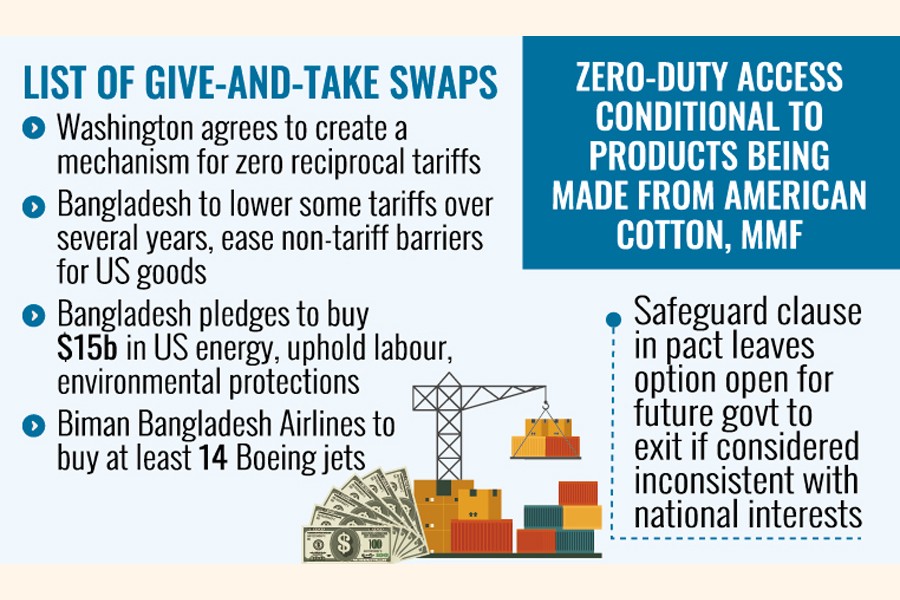
Around 85-86 per cent of Bangladeshi exports can access the US market duty-free while the rest be charged 19-percent tariffs under a hard-bargained bilateral trade arrangement between the two countries.
The zero-duty market access is, however, conditional to products being made from imported American cotton and man-made fibres, the interim government's commerce ministry Tuesday explained what comes out of the deal.
A summary of the deal shows Bangladesh agrees to lower some tariffs over several years, ease non-tariff barriers for US goods.
The country also pledges to by US$15b in US energy products, uphold labour and environmental protections.
The national flag-carrier Biman Bangladesh Airlines will buy at least 14 Boeing airplanes from the United States.
"The interim government has achieved significant progress in securing greater market access for Bangladeshi products in the United States," Commerce Adviser Sk Bashir Uddin told journalists at a press meet secretariat.
The 'Agreement on Reciprocal Trade (ART)' between Bangladesh and the United States was signed Monday in Washington, DC.
The adviser described the US market as "highly sensitive and crucial" for Bangladesh's export growth.
Under the deal, the United States has reduced the reciprocal tariffs on Bangladeshi goods to 19 per cent from the previous 20 per cent, while garments produced in Bangladesh using cotton and man-made fibres imported from the US will enjoy duty-free access to the US market, the commerce ministry's press note confirmed.
The commerce adviser mentioned that as part of the first-phase negotiations, the government had succeeded in reducing the reciprocal-tariff rate from 37 per cent to 20 per cent. "Through further discussions, we have now managed to bring it down to 19 per cent, which is a major achievement," he said.
According to the adviser, the agreement has delivered two key outcomes. First, the tariff reduction to 19 per cent will ease pressure on a segment of exports. Second, garments manufactured in Bangladesh using US cotton will enjoy zero-rated reciprocal tariffs, covering nearly 86 per cent of the country's total exports to the USA market.
He notes that although a growing share of apparel is made from synthetic fibres, the duty-free facility would primarily apply to garments produced with US-origin cotton. "The use of American cotton and man-made fibres received special importance during the negotiations."
Bangladesh is one of world's largest importers of cotton, with only about 2.0 per cent of its requirement produced domestically and the remaining 98 per cent sourced from international sources. Increased use of US cotton would therefore be beneficial to Bangladesh's textile sector while also helping narrow the trade deficit with Washington, the adviser observed.
Mr. Uddin said the government was pursuing structural reforms and import liberalisation to reduce Bangladesh's trade gap with the US, which exceeds $6.0 billion. Consideration is also being given to increasing imports of US agricultural goods, energy products and traditional metal scrap as part of the balancing strategy.
Under the ART framework, 85-86 per cent of Bangladeshi exports will enter the US market at zero duty, while the remaining 14-15 per cent will be subject to 19-percent tariffs, he explains.
A safeguard clause has been incorporated into the agreement allowing Bangladesh to withdraw from the deal with due notice if any future government considers it inconsistent with national interests.
"This success is not the achievement of a single office. It reflects the collective efforts of the commerce ministry, all relevant ministries and agencies, and the Chief Adviser's Office," he added.
Commerce Secretary Mahbubur Rahman said at the briefing that the US offered an additional facility titled "Potential Tariff Adjustment for Partner Countries" alongside the agreement. "From the day the agreement becomes effective, more than 2,500 items will receive duty-free benefits," he noted.
"The facility will cover a wide range of products, including plastic goods, aircraft components and plywood boards," he said, adding that the incentive is being extended to all countries that have entered similar arrangements with the United States.
Commerce Adviser Sk Bashir Uddin and National Security Adviser Khalilur Rahman took part in the singing event virtually from Bangladesh. On behalf of the US, United States Trade Representative (USTR) Jamieson Greer inked the document.
Chief Adviser's Special Assistant for International Affairs Lutfey Siddiqi and the Commerce Secretary of Bangladesh also joined the event virtually.
During the signing, Assistant US trade Representative Mr. Brendan Lynch was present at the event.
Negotiations on the agreement spanned over nine months since April last year, according to the Press release issued by the Chief adviser (CA) office.
According CA office press statement, Ambassador Greer lauded Chief Adviser Muhammad Yunus for his overarching leadership of the negotiations process and praised the Bangladesh negotiating team for its "incredible efforts".
The agreement will be operational once notifications are issued by the two sides.
Earlier, US President Donald Trump announced on April 2, 2025 the imposition of reciprocal tariffs at varying rates on 100 countries exporting goods to the United States.
Initially, the rate for Bangladesh was set at 37 per cent. The United States later deferred the implementation of the tariffs by three months. Exactly three months later, on July 7, 2025, Trump announced a reduction in the tariffs imposed on Bangladesh from 37 per cent to 35 per cent.
Following further negotiations, the rate was brought down to 20 per cent on August 2 last year. The reciprocal tariffs came into effect on August 7 last year.
Apart from the reciprocal tariff, Bangladeshi products were already subject to a 15-percent duty on exports to the US. After the imposition of the reciprocal tariffs, the overall duty on Bangladeshi goods stood at 34 per cent.
rezamumu@gmail.com