

Published :
Updated :
 For all latest news, follow The Financial Express Google News channel.
Rampant extortion, deteriorating law and order and an opaque trade agreement with the United States are threatening to suffocate Bangladesh's fragile economic recovery, the Dhaka Chamber of Commerce & Industry (DCCI) has warned.
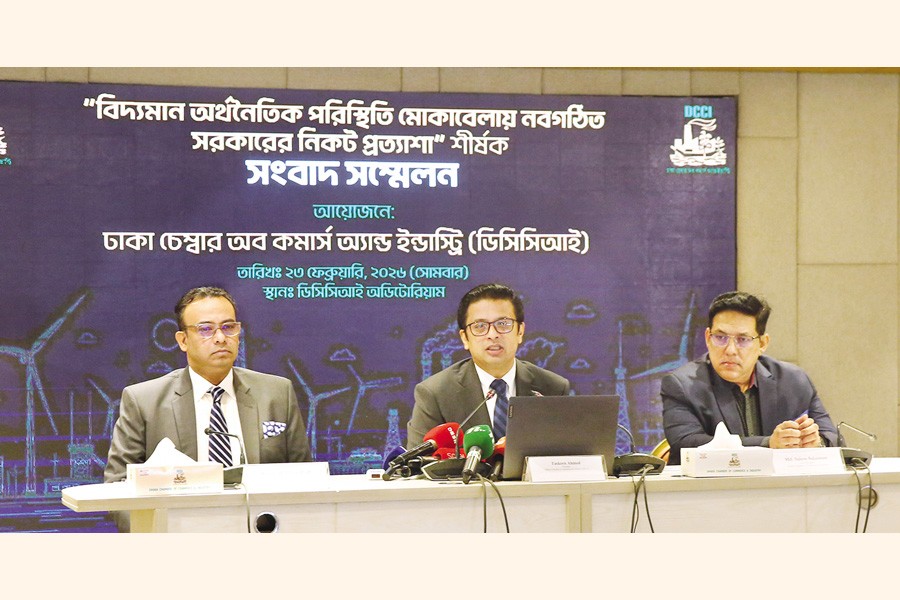
Speaking at a press conference on Monday titled "Expectations from the new government to address the current economic situation" at the DCCI auditorium in Motijheel, DCCI President Taskeen Ahmed said businesses were being pushed to the brink by what he described as "unbearable extortion" across the supply chain.
He alleged that extortion had risen by between 20 and 40 per cent in recent months, affecting everything from factory gate deliveries to transportation by road and river.
"Trucks entering or leaving factories must pay illegal tolls. Even small boats are reportedly being stopped mid-route," he said, adding that such informal payments were embedded not only on highways but also within public service offices, including trade licensing, income tax and VAT departments.
According to the chamber, the cumulative effect has been a sharp increase in the cost of doing business, with producers and consumers ultimately bearing the burden.
Ahmed warned that unless extortion and corruption were decisively curbed, some businesses might be forced to shut down.
Concerns over US trade agreement
The chamber also urged the newly-elected government to renegotiate the recently-signed trade agreement with the United States, arguing that it lacked transparency and may undermine economic sovereignty.
Ahmed slammed the previous interim administration for signing the agreement under a non-disclosure arrangement without broader stakeholder consultation or parliamentary scrutiny.
He questioned provisions relating to reciprocal tariff reductions, noting that it remained unclear what percentage of cotton usage would qualify Bangladeshi garments for duty concessions.
There were also concerns that, even if reciprocal tariffs were reduced to zero, a standard tariff of around 16.5 per cent could remain in place.
The DCCI president further pointed to reports suggesting that Bangladesh might be required to import up to USD 15 billion worth of liquefied natural gas (LNG) from the US over 15 years, though pricing and other conditions were not clearly disclosed.
He cautioned that importing LNG from distant suppliers could increase lead times and costs compared with sourcing from countries such as Oman or Qatar.
He also raised concerns about possible restrictions on state subsidies for state-owned enterprises, warning that any limitation could affect agricultural support measures, including fertiliser and fuel subsidies.
In addition, he cautioned that clauses restricting trade with countries facing US sanctions could complicate Bangladesh's future free trade or preferential trade agreements with other major partners.
Calling for a "win-win" outcome, Ahmed urged the new government to reopen negotiations to safeguard national interests.
Financial sector strain and high borrowing costs
Beyond extortion and trade policy, the chamber outlined a series of structural economic challenges.
With the policy rate unchanged, businesses are borrowing at interest rates of 16-17 per cent, the DCCI said.
A high volume of non-performing loans and the reduction of the loan classification period from nine months to three months have further destabilised the financial and industrial sectors.
The chamber called for rationalising lending rates and supporting non-wilful defaulters with working capital to help them return to business.
Energy crisis and rising costs
Industrial output has also been hampered by inadequate gas supply.
Recent increases in gas prices - Tk 40 per unit for new industries and Tk 42 per unit for captive power plants - have disrupted production, making it difficult to meet domestic demand and export targets.
The chamber said delays in land acquisition, high land prices, a 41 per cent average increase in service charges by the Chattogram Port Authority, and underutilisation of inland waterways had compounded logistics costs.
These pressures, combined with higher production and distribution expenses, have contributed significantly to inflation.
Revenue reform and investment climate
Mr Ahmed lambasted a lack of automation in the national revenue management system, arguing that it left taxpayers vulnerable to harassment while allowing many to remain outside the tax net.
He called for swift automation and structural reforms at the National Board of Revenue, suggesting that meaningful progress could be achieved within eight months.
The DCCI also pressed for effective implementation of the Bangladesh Investment Development Authority's single-window system to ease business procedures.
Employment and LDC Graduation
With more than 2 million educated young people unemployed, the chamber warned of growing social risks if job creation does not accelerate.
It advocated expanding skills development initiatives and easing access to finance for start-ups and young entrepreneurs.
On Bangladesh's impending graduation from the least developed country (LDC) status, Ahmed cited UNCTAD estimates suggesting exports could fall by 5.5-7 per cent, or approximately USD 2.7 billion.
Given global economic uncertainty, he urged the government to seek a three-year deferral to cushion the transition.
Senior Vice President Razeev H Chowdhury, Vice President Md. Salem Sulaiman and members of the DCCI board were also present at the briefing.
The chamber concluded that restoring law and order, eliminating extortion, ensuring transparent trade diplomacy and stabilising macroeconomic policies would be essential if the new government is to rebuild investor confidence and steer the economy back onto a sustainable growth path.
bdsmile@gmail.com