

Demand slowdown pushes farm products to the ground, farmers in peril
Published :
Updated :
 For all latest news, follow The Financial Express Google News channel.
A broad-based slowdown in demand has dragged down prices of key farm products---potatoes, onions and eggs---pushing thousands of farmers into losses for a second straight year.
This raises concerns among economists about a possible ripple effect on employment, real wages and overall economic growth.
From the potato fields of Nilphamari to onion farms in Pabna and poultry sheds in Rajshahi, growers say the current market prices are far below production costs, leaving them unable to repay loans or recover investments.
Potato growers across northern and central districts are selling their produce at Tk 300-350 per maund (37.32 kg), compared to Tk 500-550 at the same time last year.
According to the Department of Agricultural Extension (DAE), the production cost for high-yielding varieties such as Asterix, Diamond and Granola stands at Tk 16.6 per kg.
However, field-level prices have hovered at Tk 8.0-9.0 per kg over the past month while it is Tk 15-22 a kg in Dhaka now, a five-year low price, according to the department of agricultural marketing.
"We are selling at Tk 9-10 per kg. If this continues, our losses will be bigger than last year," said Ragibul Islam, a farmer from Ramnagar area in Nilphamari Sadar.
He cultivated potatoes on 10 bighas this year, down from 15 bighas last season after suffering heavy losses.
The crisis is not limited to potatoes. In Pabna, early variety Murikata (seed onion) prices fell to Tk 1,400 per maund from Tk 2,000 just at the same time last year ---the lowest in a decade.
Md Ebadot Hossain, onion farmer from Sathia in Pabna, said he has spent nearly Tk 0.2 million for two bighas this year due to higher bulb, labour and land lease costs.
"But I can sell produce worth only Tk 70,000-80,000 per bigha, resulting in a loss" he said.
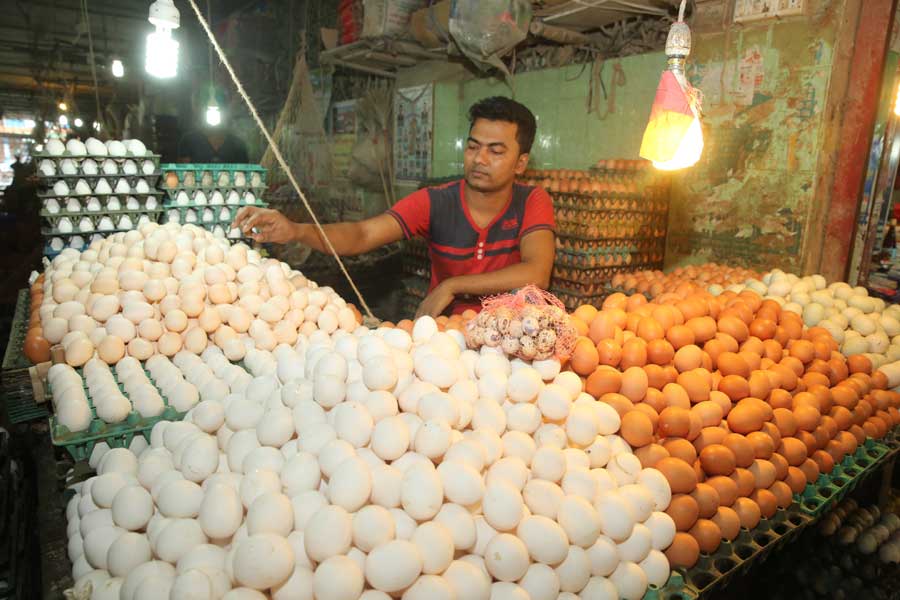
Egg producers are also selling below cost as demand from the city shrinks.
In Sirajganj, Tangail, Gazipur, and Cumilla, farmers sold white eggs at Tk 7.10 each and brown eggs at Tk 8.10 - about Tk 1.5-2.0 below production cost.
Pratap Chandra Nath, who runs a 5000-layer farm, said he incurred Tk 0.1 million in losses in January alone.
Julhas Ali, a poultry farm owner at Sreepur in Gazipur, said that many small farms are on the brink of closure. "Most took bank loans. This price crash is a serious burden."
Meanwhile, vegetable prices increased for Ramadan hype, but it started declining as seasonal cauliflower, cabbage, radish, turnip, and country bean prices declined by half in the village level in the last one week, according to the Department of Marketing.
Value chain expert and farm economist Prof Golam Hafeez Kennedy, said the first reason for the decline could be surplus production with nominal facility of storage.
"When supply exceeds demand for a perishable item, prices fall rapidly. This is basic market behaviour," he said.
But egg and onion production is not surplus as import is needed for onion in the later part of the year.
He said egg production is hardly 40 million pieces a day against a demand for 5.2 million.
Potato has a 1.0 million tonnes of surplus but such low rate in the farms could hardly be seen, he said, adding that big traders and storage owners might have a role in the market while purchasing capability might also have declined.
Policy Exchange Chairman Dr Mashrur Reaz said reduced household purchasing power, lower rural income circulation, possible liquidity stress in the market and weak consumption demand could lead to such condition.
Meanwhile, Bangladesh's point-to-point inflation stood at 8.58 per cent recently, while nominal real wage growth was recorded at 8.04 percent. In previous three years, the gap between inflation and wage growth was typically 1.5-2.0 percentage points in favour of wages.
"The narrowing gap means households have very limited real income gains," said Reaz.
"When real wage growth slows, demand for many food items weakens."
He said that the manufacturing sector struggled with energy shortages, high import costs, subdued export orders and political uncertainty during the interim government.
"When factories struggle, employment expansion slows. That squeezes wage income and reduces consumption demand. Farmers feel the impact directly," he said.
He said rural income instability could create a negative multiplier effect.
"If farmers repeatedly incur losses, they cut future investment. That reduces rural purchasing power, affecting local markets, transporters, retailers and small manufacturers," he said.
He warned that a prolonged mismatch between supply growth and demand slowdown could drag the economy towards stagnation.
"When agriculture, which employs a large share of the workforce, suffers income compression while manufacturing is not generating robust employment, overall demand weakens. Investment then slows, and growth momentum declines," he said.
Bangladesh Agricultural Economist Association President Md Ahsanuzzaman said that while lower food prices benefit consumers in the short term, prolonged below-cost pricing discourages farmers from producing in the next season.
"Farmers are already reducing acreage. If this trend spreads, we may face supply shocks later, leading to price volatility," he said.
He also pointed out that rice consumption might increase if the purchasing capability of low income generation declines.
He noted that most commodity prices decline but rice prices have increased in recent times.
He suggested targeted procurement of surplus crops, export diversification, reduction in transport costs, expansion of cold storage facilities for small farmers, and support for agro-processing industries to absorb excess supply.
tonmoy.wardad@gmail.com