


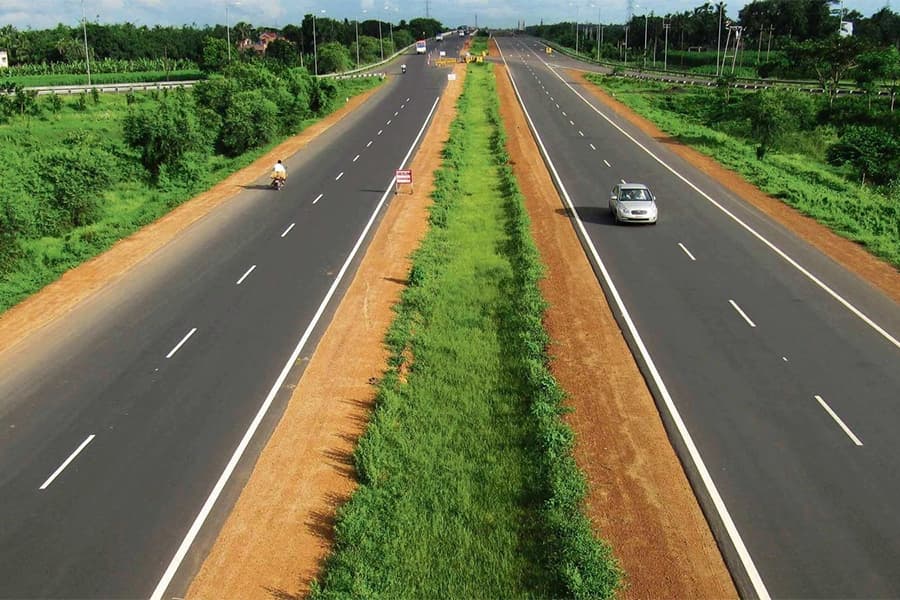
The government has decided to abandon its plan to expand the Dhaka–Chattogram Highway into a 10-lane road, shifting focus instead to upgrading the country’s railway network.
The decision comes in response to growing land constraints and the need for a sustainable transport system, said Sheikh Moinuddin, Chief Adviser on matters relating to the Ministry of Road Transport and Bridges and the Ministry of Railways, in an interview with UNB.
“There has been extensive discussion about expanding the Dhaka–Chattogram Highway to six or 10 lanes. However, no final decision has been made yet. The maximum expansion may be up to six lanes. Beyond that, it is more important to focus on rail travel rather than further widening the road,” he said.
Moinuddin emphasised that trains are a fast, safe, and punctual mode of transport, and improving the railway system could encourage more people to switch from road to rail. “That is why we are prioritising the modernisation of the rail line. At present, plans are underway to renovate and upgrade the Dhaka–Chattogram railway,” he added.
He also pointed out that expanding roads would consume more land, a critical concern given Bangladesh’s limited land resources.
“Currently, only 2 per cent of goods are transported by rail, which contributes to around 2 per cent of GDP. My focus is on developing the railway to ease pressure on the roads, as rail is safe, cost-effective, and environmentally friendly,” Moinuddin said.
Comparing Bangladesh with international standards, he added, “In many countries, 25 to 30 per cent of goods are transported by rail, whereas in Bangladesh the figure is just 2 per cent. We aim to raise this share to at least 25 per cent. This will make rail freight profitable and reduce congestion on the roads.”
Moinuddin also highlighted a shortage of locomotives as a major challenge. “We have already invited tenders for new locomotives. This will improve both speed and efficiency without the need to lay new tracks,” he said.
Plans are also in place to dedicate certain trains exclusively for freight, ensuring direct transport to Chattogram Port. “This will reduce both time and costs,” he added.
If implemented, these initiatives are expected to ease road congestion and inject new momentum into Bangladesh’s rail transport system.
The Dhaka–Chattogram Highway is Bangladesh's main artery, connecting the capital with the port city of Chattogram and extending to Teknaf. However, the highway is frequently plagued by severe traffic jams due to poor traffic management and road conditions. A 10-lane expansion had been planned to alleviate congestion and improve safety.
Daily traffic on the highway rose from 35,482 vehicles in 2019 to 46,501 in 2024, according to Roads and Highways Department (RHD) data. Another official from the Highway Police said overloaded vehicles also cause serious damage to the roads, forcing the government to spend over Tk 861 crore annually on repairs.
Congestion-Prone Points
The highway’s congestion hotspots include Daudkandi Toll Plaza, Gouripur Bazar, Chandina Bus Stand, Madhaiya Bazar, Nimsar Bazar, the Cantonment area, Alekharchar (Bishwa Road U-turn), Suagazi Bazar, Mia Bazar, and Chauddagram Bazar in Cumilla district. In Feni, Lalpol, Bhatiari Point, Faujdarhat U-turn, Barbakunda Bazar, Chhota Kumira, KDS Intersection, and Sitakunda Bus Stand are also notorious for traffic jams.
Padua Bazar Problem
Padua Bazar, where the Dhaka–Chattogram and Cumilla–Noakhali highways intersect, serves as a critical bypass for traffic moving through six southeastern districts. However, with construction of the planned loop stalled, vehicles rely on risky crossings, as the U-turn needed to access connecting routes remains incomplete.
UNB’s Cumilla correspondent reported that a 105-kilometre stretch from Chauddagram to Daudkandi is in an alarming state, with key sections in Chauddagram upazila, including Noapara, caving in. Experts warn that since about 80% of Bangladesh’s international trade flows through this route, authorities must prioritise the Dhaka–Chattogram Highway without further delay.