

Published :
Updated :
 For all latest news, follow The Financial Express Google News channel.
Speakers at a seminar Saturday said technological advancement, access to finance, marketing facility, research and innovation, product diversification, facilitated cluster base, infrastructure were some of the important issues concerning overall development of the SME (small and medium enterprise) sector in Bangladesh.
The speakers called for policy support from the government, including revision of the definition of SMEs, introduction of an export development fund, and the provision of training for enhancing technological know-how.
They also stressed the importance of IT-based capacity building and the use of e-commerce and social media platforms to reach international markets.
They said easy financing was a key towards improvement of SMEs and there was a need for development of specialized financing programmes, simplified loan application processes, and credit guarantee schemes to mitigate risks for lenders.
The speakers said there was also a need for reform in tax and trade policies and better implementation of the policies for developing SMEs.
The speakers also called for a sustainable and long-term solution to utility services such as gas and electricity not only for SMEs but also for the overall industry.
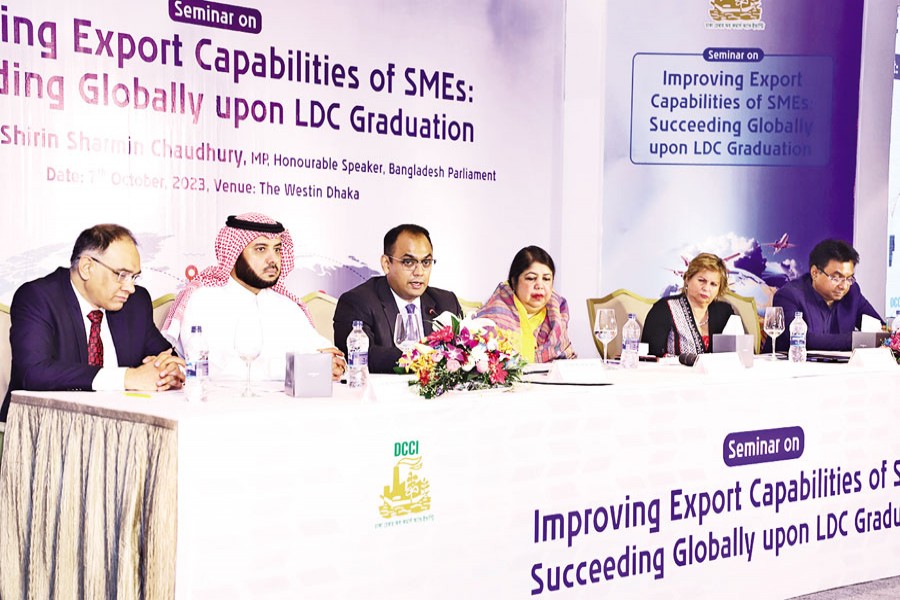
The seminar on "Improving export capabilities of SMEs: Succeeding globally upon LDC graduation" was organised by Dhaka Chamber of Commerce & Industry (DCCI) at a city hotel.
Dr Shirin Sharmin Chaudhury, Speaker of the Bangladesh Parliament, was present as the chief guest.
Speaking at the event, she said the SMEs in Bangladesh were resilient enough and contributed more than 30 per cent to the GDP (gross domestic product).
Still the sector had various challenges and she hoped that the policymakers would try to address the issues to solve the existing problems.
Despite the Covid-19 pandemic and the Russia-Ukraine war, Bangladesh was able to continue its commendable progress securing 6.5 per cent GDP growth, she said.
She urged the SME entrepreneurs to utilize technology for access to the virtual market. She requested them to use the platform of Joyeeta Foundation to sell their products.
"We can also give them One Stop Services so that they can enjoy all required services from one place and for that we need to make coordinated efforts," she observed.
Ms Choudhury said women entrepreneurs could take up to Tk 1.0 million (10 lakh) loan free of collateral.
Policy makers should think about how to lessen the customs duty for import of raw materials needed for SMEs, she added.
Speaking at the event, DCCI President Barrister Md Sameer Sattar said that the businesses needed to take preparation as the exporters including SMEs would face tariff ranging from 8.0 per cent to 16 per cent on their export later in 2026.
However, he said Bangladesh had a very strong SME base that contributed 28 per cent to the country's GDP and accounted for 45 per cent of manufacturing value addition and 90 per cent of the jobs in the private sector.
To facilitate export capabilities of the SME sector, he suggested redefining SME by excluding 'medium' as medium businesses were largely privileged.
He also recommended that banks give SMEs tailored export financing like credit insurance, export development fund and working capital loan to address export-related financial challenges.
He underscored the importance of having a central SME database with updated information.
He suggested foreign investment, easy technology transfer and cluster development for export-oriented SMEs.
Ambassador of Canada to Bangladesh Dr Lilly Nicholes said that Canada was working with Bangladesh in the technology and vocational sector. She underscored signing of FTAs with potential trading partners.
"SMEs face various challenges like access to finance, technical barriers, skills gap, etc." She emphasized more research so that SMEs could add value to their products and enhance their capacity in the export market.
"Canada is happy to work with Bangladesh in terms of capacity building, research, collaboration and skills development."
Ambassador of Saudi Arabia in Bangladesh Essa Yousef Alduhailan said Saudi Arabia put more emphasis on SMEs.
In the post-pandemic time, Saudi Arabia facilitated their SMEs by supporting their revival.
"These supports include implementation of new regulations, reform measures and financial assistance by the Saudi government."
He said Bangladesh had a strong and diversified export market.
He said Bangladesh was going to graduate into a middle income country and the transition needed more investment in education, technology and innovation.
Dr Selim Raihan, Executive Director, SANEM, made the keynote presentation.
He said that Bangladesh's SMEs faced few challenges like capacity constraints, lack of policies and regulatory issues, financing, infrastructure and skills gap.
He also said that import tariff for SMEs in Bangladesh was a bit high.
He emphasized faster customs and trade regulations.
He also urged a conducive and investment-friendly tariff regime, consistent tax rates, predictable policy regime and stable macro-economic situation.
"We have to address the high rate of NPLs, weak capital market, high operational cost of SME financing and weak integration with financial system," he said.
Kohinoor Yeasmin, CEO of Tarango, Rezbin Begum, MD, People's Leather Industry, AFM Asif, CEO of Bengal Meat Processing Industries Ltd, and Executive Director of Bangladesh Bank Dr Md Kabir Ahmed were also present as panel discussants.
DCCI senior vice president SM Golam Faruk Alamgir Arman and vice president Md Junaed Ibna Ali were also present on the occasion.
bdsmile@gmail.com