


Bangladesh should focus on signing trade agreements to offset the impact of the global crisis, saying geopolitical tensions and structural weaknesses could further deepen financial pressure, disrupt supply chains, and reduce future orders from key export destinations.


The country’s ready-made garment sector has been facing difficulties in sustaining long-term competitiveness due to the global crises, shifting trade rules and rising costs.
To address these challenges, Bangladesh should go for long-term trade agreements, strengthen energy security through renewable solutions, improving access to affordable finance.
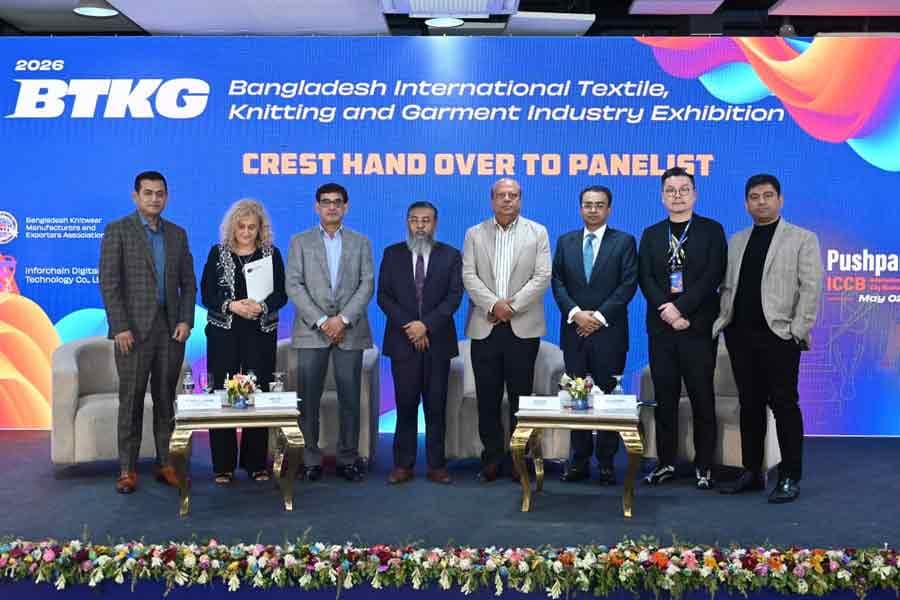
The observations and recommendations came at a seminar titled ‘Geopolitical Conflicts and Global Supply Chain Disruptions: Implications for the RMG Industry’ organised at the closing ceremony of the Bangladesh International Textile, Knitting and Garment Industry Exhibition (BTKG) 2026, according to a statement.
Bangladesh Knitwear Manufacturers and Exporters Association and Inforchain Digital Technology Co Ltd jointly organised the BTKG at International Convention City, Bangladesh in the city, it added.
Speaking at the seminar, EuroCham Bangladesh chairperson Nuria Lopez called for immediate negotiations on a Free Trade Agreement with the European Union.
Bangladesh’s graduation from least developed country status without a durable alternative to preferential market access would be a major setback, she said, adding, “An FTA with the EU would offer a permanent and predictable framework, unlike complex and uncertain schemes such as GSP+, and should be treated as a national priority.”
European regulations are reshaping global supply chains, particularly the Corporate Sustainability Due Diligence framework, which has been in force since 2024 and will extend to suppliers by 2027–2028, she noted.
Though the legal obligation lies with buyers, the operational burden will fall on manufacturers, she said, stressing that non-compliance is not optional and that lagging countries risk losing competitiveness.
“This is no longer about ticking boxes. Due diligence requires full corporate governance, with owners and managing directors directly involved,” she said, adding that traceability, environmental and chemical management, and digital systems are becoming integral.
She called manufacturers to prepare early, warning that factories cannot bear compliance costs alone as the requirements originate in buyer markets.
Calling for shared responsibility among buyers, government, and producers, she noted that small and medium enterprises are particularly vulnerable.
Highlighting a key contradiction, she said buyers continue to demand lower prices despite rising wages, energy costs and compliance expenses and urged stronger, more data-driven negotiations.
She further pointed to gaps in renewable energy policy, stressing the need for affordable storage and supportive fiscal measures.
Riad Mahmud, president of National Polymer Industries Ltd, said the sector is facing interconnected macroeconomic and structural challenges.
Heavy dependence on imported raw materials and global disruptions are causing production gaps, halting operations, and affecting a large labour-intensive workforce, he said.
The Middle East crisis could reduce future export orders, leading to underutilised factories and rising financial stress, he warned.
“We cannot ignore this reality. The cumulative impact could weaken both industry and banks and raise the risk of broader economic instability,” he said.
Repeated reliance on government support is not sustainable, and suggested targeted mechanisms, such as dedicated funds linked to specific disruptions, instead of blanket incentives, he said, emphasising long-term resilience depends on strengthening infrastructure and addressing widespread undercapitalisation in the manufacturing sector.
He requested policymakers to consider tax incentives, lower-cost economic zones and financial restructuring tools, including bonds or equity participation, to ease pressure on balance sheets.
He also called for a shift towards capital market financing, noting that high bank interest rates and limited long-term lending capacity are constraining growth.
Bangladesh Employers’ Federation director Akhter Hossain Apurbo said the current disruptions represent a permanent structural shift rather than a temporary challenge, requiring changes in sourcing, inventory, and energy management.
“To remain competitive, manufacturers must maintain higher levels of raw material stock to ensure uninterrupted production and timely delivery,” he added.
Borrowing costs have surged from around 9.0 per cent to as high as 14 per cent to 15 per cent within a short period, with hidden charges pushing effective rates to 16 per cent to 17 per cent.
Terming energy security a ‘critical concern’, he said an uninterrupted electricity and gas supply is essential for production, particularly in processes like dyeing.
He called on the government to prioritise both short- and long-term energy solutions, including accelerating solar and other renewable energy adoptions, adding that solar panels are duty-free, key components such as lithium batteries remain heavily taxed, limiting wider use.
Some 900 exhibitors from nearly 28 countries displayed a wide range of innovations in the textile and garment sector, including advanced machinery, dyes and chemicals, knitting and weaving technologies, embroidery, cutting and sewing equipment, and washing and dry-cleaning solutions.
munni_fe@yahoo.com