

Published :
Updated :
 For all latest news, follow The Financial Express Google News channel.
Economists, physicians and public health experts have called for reforms to Bangladesh’s tobacco tax structure, saying the measures could improve public health and significantly increase government revenue.
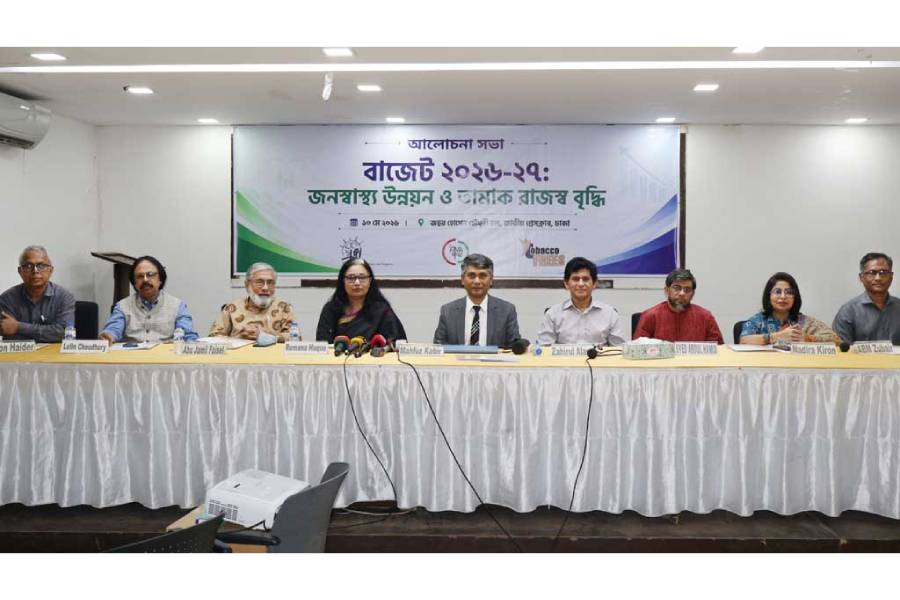
The recommendations came at a discussion titled “Budget 2026-27: Advancing Public Health and Increasing Tobacco Revenue” held at the National Press Club in Dhaka on Sunday.
The event was jointly organised by PROGGA (Knowledge for Progress) and the Anti-Tobacco Media Alliance (ATMA).
Speakers proposed reducing the number of cigarette price tiers, introducing a specific tax system and increasing the prices of all tobacco products.
They said implementing the proposals could generate nearly Tk 440bn in additional revenue from the cigarette sector alone and help prevent around 400,000 premature deaths in the long term.
The recommendations included merging the low and medium cigarette tiers and setting the retail price at Tk 100 for a pack of 10 sticks.
They also proposed fixing prices at Tk 150 for the high tier and Tk 200 or more for the premium tier.
The speakers suggested retaining the existing 67 percent supplementary duty on all cigarette tiers and introducing a specific tax of Tk 4 per 10 sticks.
Dr Mahfuz Kabir, research director at the Bangladesh Institute of International and Strategic Studies (BIISS), said consumers of low and medium-tier cigarettes account for around 90 percent of all smokers in the country.
“Merging these two tiers and fixing the price at Tk 100 for 10 sticks could increase government revenue and discourage tobacco use, particularly among low-income groups and young people,” he said.
Rumana Huque, a professor at the University of Dhaka, said tobacco products in Bangladesh remain cheaper than many essential commodities.
“Effective measures must be taken to make tobacco products unaffordable,” she said.
Syed Abdul Hamid, a professor at the university’s Institute of Health Economics, said introducing a specific tax system would simplify tax collection.
Channel24 Executive Director Zahirul Alam stressed the need for continued media attention on tobacco taxation, while public health expert Dr Lelin Choudhury urged policymakers to implement the proposed reforms.
Dr Abu Jamil Faisel, president of the Public Health Association of Bangladesh, said higher tobacco taxes and prices were essential to building a tobacco-free Bangladesh.
The proposals also covered Bidi, a local handmade cigarette, and smokeless tobacco products such as Zarda and Gul.
Experts recommended setting a uniform retail price of Tk 30 for 20 sticks of Bidi, followed by a 50 percent supplementary duty.
For smokeless tobacco, they proposed fixing the retail price at Tk 60 for 10g of Zarda and Tk 30 for Gul, with a 60 percent supplementary duty.
The proposals also suggested retaining the existing 15 percent VAT on tobacco products and the 1 percent health development surcharge.
According to the organisers, tobacco use prevalence among people aged 15 and above stands at 35.3 percent in Bangladesh, while tobacco-related illnesses kill nearly 200,000 people every year.
They also cited a 2025 study by the World Health Organization saying cigarette prices in Bangladesh remain lower than in several South Asian countries, including India, Nepal, Bhutan, Sri Lanka and the Maldives.