

Published :
Updated :
 For all latest news, follow The Financial Express Google News channel.
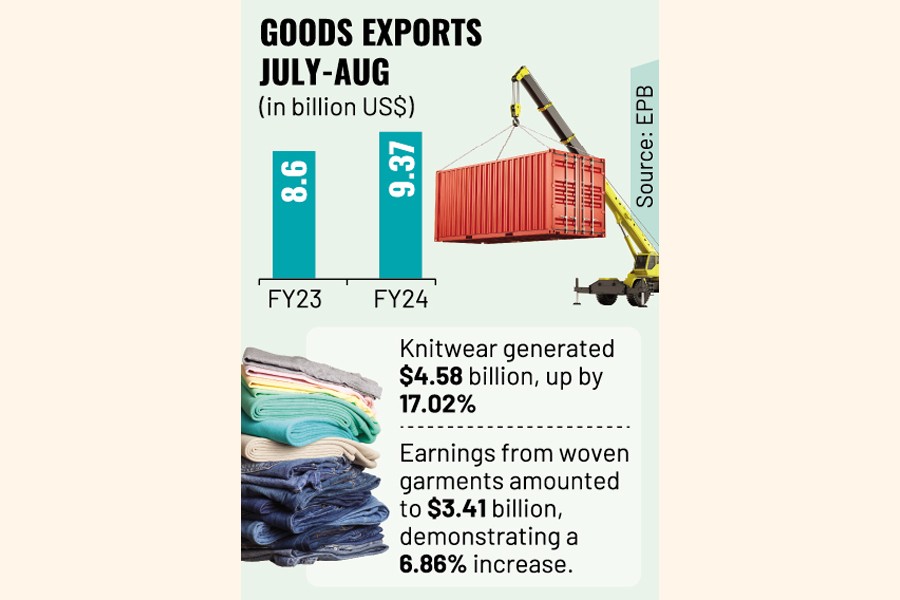
Bangladesh's goods exports fetched $9.37 billion in the first two months of the current fiscal year, according to data released by the Export Promotion Bureau (EPB) Monday, propelled mostly by the apparel-manufacturing might of the country.
The July-August export income marks a notable increase from the $8.59 billion earned during the same period in the previous fiscal year.
In August alone, exports continued to perform well, with earnings of $4.78 billion, reflecting a 3.80-percent growth. However, the single-month earnings fell slightly short of the target by 1.81 per cent.
The growth momentum, which saw a remarkable 15.26-percent increase in merchandise shipments in July, somewhat slowed down in August.
The ready-made garments (RMG) sector remained a key driver of the export growth in the first two months, fetching the country $7.99 billion and marking a double-digit growth figure of 12.46 per cent.
In the first two months of fiscal year 2023-24, the knitwear subsector within the RMG category generated $4.58 billion, up by 17.02 per cent. Meanwhile, earnings from woven garments amounted to $3.41 billion, demonstrating a 6.86 per cent increase.
On the downside, the home textiles sector experienced a serious decline of around 53.40 per cent, with earnings amounting to $125.14 million.
Asked about the export performance as per official reckonings, Bangladesh Garment Manufacturers and Exporters Association (BGMEA) President Faruque Hassan hailed the growth as "positive", saying that despite a fall in imports by major markets, Bangladesh's RMG industry sustained positive growth.
He, however, said that although apparel exports from Bangladesh decreased in quantity, the shipments of high-value-added products have been on the rise, as reflected in the export data.
"Value-added items helped in obtaining better prices, while earnings from non-traditional and new markets like Australia, Japan and Korea are also increasing," Mr Hassan added.
The BGMEA president called for reducing dependency on a single product and boosting non-RMG export profiles.
While talking to the FE, Saiful Islam, former president of Bangladesh Leather and Leathergoods Manufacturers and Exporters Association, attributed the demand fall in the western markets to high inflation, resulting in negative growth for the sector.
According to EPB data, the jute sector, which experienced negative growth during the last fiscal year, showed a recovery in the last month with a 2.75 per cent growth. However, during the July-August period, the jute sector again entered into negative territory.
Exports of jute and jute goods stood at $140.46 million, recording a 10.31 per cent fall.
Earnings from agricultural items like vegetables, fruits and dry foods also registered a decline of less than one per cent to $174.49 million.
According to official statistics, engineering-product shipments declined by 16.28 per cent to $83.63 million. Export earnings from frozen and live fish decreased by 25.26 per cent to $61 million in the same period. Pharmaceutical exports fetched $31.64 million, registering a 14.68 per cent growth.
Bangladesh received $194.82 million from the export of leather and leather goods in July-August, marking a negative growth of 12.73 per cent. Earnings from footwear other than leather items, however, grew by 6.52 per cent to $79.88 million during the period.
The EPB data also show that exports of plastic products witnessed a 5.36 per cent growth, reaching $35.16 million.
In a much-anticipated relief amid a forex crunch, Bangladesh in the last fiscal year bagged a record-high $55.55 billion in earnings from merchandise export, riding on double-digit growth for readymade garments.
munni_fe@yahoo.com