


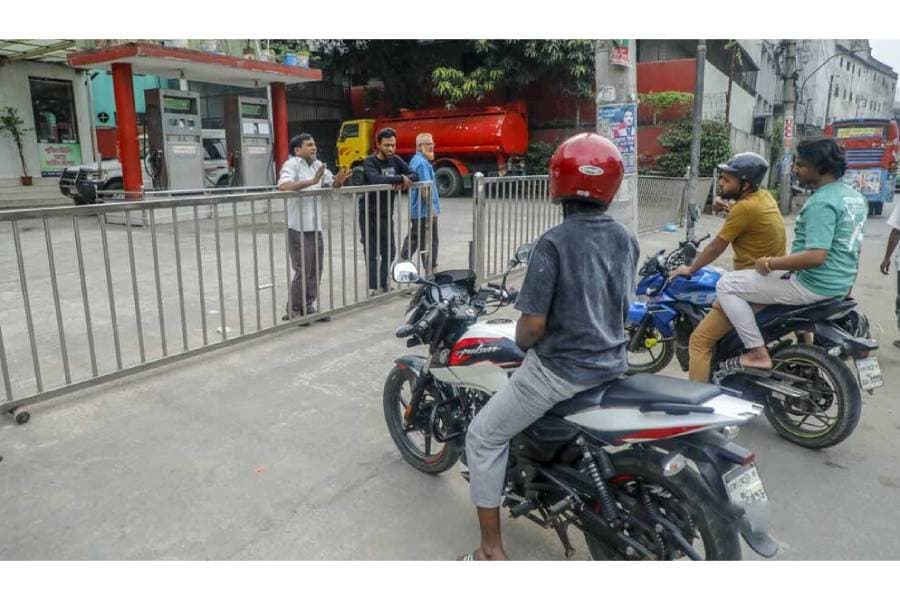
Dhaka’s petrol pumps are struggling to meet growing demand, with long queues forming day and night as many drivers leave empty-handed.
Staff at the stations are reportedly overwhelmed, and arguments have broken out among frustrated customers.
On Monday, two days after Eid-ul-Fitr, the capital’s pumps continued to witness long lines of motorcycles and cars.
Some stations, including Purnima near Bangabhaban, remained closed, while Navana CNG near Dainik Bangla Mor supplied only diesel.
Despite the government lifting rationing ahead of Eid, the situation has turned critical since Sunday night.
Pump managers cited a two-day closure of depots during the Eid holidays as a primary reason for the shortage.
However, panic-buying among customers fearing a prolonged crisis has further widened the gap between supply and demand.
Mizanur Rahman Ratan, joint convenor of the Bangladesh Petrol Pump Owners Association, told bdnews24.com: “My pump’s tank capacity is 4,500 litres. The dealer gives only 3,000 litres of petrol and octane. If I received the full amount, I could supply it all. Now we are running short.”
He added that managing impatient drivers has become a major challenge: “Many do not follow the queue. Arguments sometimes escalate to scuffles. If petrol is unavailable, we have to open the tanks to show them. The government must deploy police and Ansar for security, otherwise our staff cannot operate the pumps safely.”
Following earlier global concerns over Iran’s conflict, the government had imposed rationing on petrol, octane, and diesel.
Although rationing has been lifted, owners say depot deliveries remain 10 percent lower than their allocated supply.
The Bangladesh Petroleum Corporation (BPC), responsible for fuel supply and management, said most petrol and octane are produced domestically.
Officials said production can be increased if demand rises further, and the country is not facing a long-term shortage despite temporary supply gaps.
Fuel Queues Spilling into Alleys
As the crisis deepens, vehicle queues are no longer confined to main roads, frequently spilling into narrow side alleys across Motijheel, Jatrabari, Satrasta, and Mohakhali.
Pump officials say customers are buying more than usual over several days, while depot deliveries remain insufficient.
The Eid holidays, during which depots were closed, have further aggravated the shortage.
At Crescent Petrol Pump on the Amtoli-Gulshan link road, queues of vehicles stretched nearly 457m to Titumir College, spilling from footpaths into narrow alleys.
Motorcycle rider Mohammad Jabed told bdnews24.com: “Ride-sharing demand is high during Eid, so fuel runs out faster. But we have to wait for hours just to fill up.”
Habibur Rahman, a minibus driver from Gulshan, said: “I was sent to the pump to fill my tank fully, because owners want tanks topped up immediately rather than risk running dry.”
At Karim & Sons Petrol Pump in Motijheel, driver Abdul Malek Mridha said he used to fill his tank once and it would last 7–10 days, but now drivers refill whenever they get a chance, fearing shortages.
Owner Abdus Salam said their octane stock ran out by 4pm, leaving only diesel for customers.
Daily demand at the station is normally 30,000–35,000 litres, but supplies have dropped to 9,000 litres.
He added the next delivery may not arrive until midday Tuesday, leaving staff idle in the meantime, while costs continue.
Abu Taiyeb Patwari, president of the Bangladesh Petroleum Dealers, Distributors, Agents and Pump Owners Association, said depot rationing prevents pumps from stockpiling fuel before long holidays or weekends.
He noted that while annual demand usually rises about 10 percent, supplies are currently 10 percent below requests, causing persistent shortages.
Abu Taiyeb added that diesel shortages have been less severe, as fewer trucks and lorries operated during the Eid holidays.
"The real situation will become clear next week when heavy transport resumes full operations," he added.
BPC Response
Repeated attempts to reach BPC Chairman Rezanur Rahman for comment on the current crisis went unanswered.
However, a senior official of the BPC, speaking on condition of anonymity, told bdnews24.com that supply for petrol and octane had been stable until a sudden surge in consumer demand.
"Following the outbreak of war [in the Middle East], a contingency plan was submitted to the ministry as a precaution. While no final decision was made, demand suddenly spiked everywhere," the official said.
He attributed the shortage to "artificial demand", explaining that motorists who previously refuelled only when necessary are now rushing to keep their tanks full.
"Every vehicle, large or small -- even those that rarely hit the road -- is topping up. You can increase production, but you cannot suddenly expand the entire supply and transport infrastructure to meet such an abrupt peak."
The official also noted that increasing production presents logistical challenges, as there is limited storage capacity at depots for a surplus.
"Petrol and octane are by-products; we can't simply halt or double production overnight without affecting the entire system. If this level of demand persists, it would take about a month to recalibrate the supply chain, which requires a policy-level government decision."
Addressing claims from pump owners that allocations have been slashed by 10 percent, the official described it as a "management tactic".
He added, "Once government offices reopen [after the Eid break], a new decision may be reached based on the evolving war situation. As of now, there is no inherent crisis in production or supply."