

Non-traditional markets
H1 apparel exports slide amid weak demand, trade frictions
High living costs, US tariffs and geopolitical tensions are weighing on diversification, industry insiders say
Published :
Updated :
 For all latest news, follow The Financial Express Google News channel.
Bangladesh's readymade garment (RMG) exports to non-traditional markets posted negative growth in the first half of the current fiscal year, reflecting prolonged weakness in global demand amid economic uncertainty across key economies.
Rising living costs, sluggish growth, shifting trade regimes and geopolitical tensions have continued to dampen consumer spending on apparel worldwide, industry insiders said.
Official figures show that shipments to newer destinations fell year-on-year during July-December of FY2025-26, underscoring the challenges exporters face in diversifying beyond traditional markets at a time of heightened global volatility.
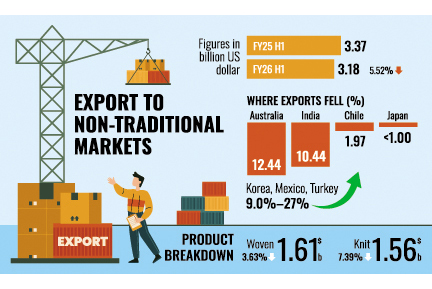
Exports to non-traditional markets like Japan, Australia, India, Korea, Mexico, New Zealand and Turkey declined by 5.52 per cent year-on-year to US$3.18 billion during the period, according to data from the Export Promotion Bureau (EPB).
The figure stood at $3.37 billion in the corresponding period of the previous fiscal year.
Industry insiders attributed the slowdown to weak consumer demand across both advanced and emerging markets, driven by high living costs, sluggish global growth, new US tariff regimes and ongoing geopolitical tensions.
Both woven garments and knitwear recorded declines during the period. Woven garment exports fell by 3.63 per cent to $1.61 billion, while knitwear shipments dropped by 7.39 per cent to $1.56 billion.
Among major emerging markets, exports to Australia declined by 12.44 per cent, Chile by 1.97 per cent and India by 10.44 per cent. Shipments to Japan edged down by less than one per cent during the July-December period of the current fiscal year.
Korea, Mexico, New Zealand, Russia and Turkey also witnessed negative growth, ranging from 9.32 per cent to as high as 26.63 per cent, EPB data show.
In contrast, only a handful of destinations - China, Brazil, Malaysia, Saudi Arabia, South Africa and the United Arab Emirates - posted growth, with RMG exports rising by around 7.0 per cent to nearly 29.79 per cent during the first half of the fiscal year.
Fazlul Hoque, former president of the Bangladesh Knitwear Manufacturers and Exporters Association (BKMEA), told The Financial Express that the muted performance reflected a broader slowdown in the global apparel market.
"Demand in major traditional markets such as the European Union and the United States has weakened due to sluggish economic conditions, and the same trend is evident in non-traditional markets," he said.
"Uncertainty and disruptions, including the impact of new US tariff regimes, have dampened demand."
Mr Hoque, who is also managing director of Plummy Fashions, said his recent experience in Western markets showed that rising living costs had forced consumers to prioritise essential spending over discretionary purchases such as clothing.
Commenting on the sharp decline in shipments to India, Mohiuddin Rubel, additional managing director of Denim Expert Ltd, said the global economic slowdown and higher US tariffs had pushed Indian buyers to sell more garments in their domestic market.
He also pointed to political tensions and restrictive border measures as additional factors weighing on exports.
"Bangladesh's exports to India have fallen over the past six months mainly due to bilateral political tensions and certain restrictive measures at the border," he said.
According to him, RMG exports to India dropped sharply from October, when shipments stood at $48.54 million, followed by $33.34 million in November and $38.48 million in December.
In contrast, exports in September were valued at $72.39 million, after $82.29 million in August and $62.91 million in July.
Overall, RMG exports to India amounted to $336.95 million during July-December of FY2025-26, down 10.44 per cent from $376.21 million in the corresponding period of the previous fiscal year.
Mr Rubel noted that Japan, one of Bangladesh's major non-traditional markets, may have reached a plateau unless exporters move up the value chain through diversified, higher value-added products, improved productivity and shorter lead times.
Japanese buyers, he added, remain particularly sensitive to quality and compliance requirements.
During the period, Bangladesh earned $597.95 million from Japan, $376.65 million from Australia, $145.82 million from China, $94.23 million from Brazil and $201.04 million from Korea.
Meanwhile, exports to the US - Bangladesh's single largest apparel market - fell marginally by 0.10 per cent to $3.83 billion in the first half under review, compared with $3.84 billion a year earlier.
Shipments to the EU declined by 4.14 per cent to $9.45 billion, while exports to the UK rose by 2.13 per cent to US$2.21 billion. Canada imported apparel worth $671.47 million, marking a 4.66 per cent increase.
Overall, Bangladesh's total RMG exports declined by 2.63 per cent year-on-year to $19.36 billion in the first half of FY2025-26, compared with $19.88 billion in the same period of the previous fiscal year.
munni_fe@yahoo.com