


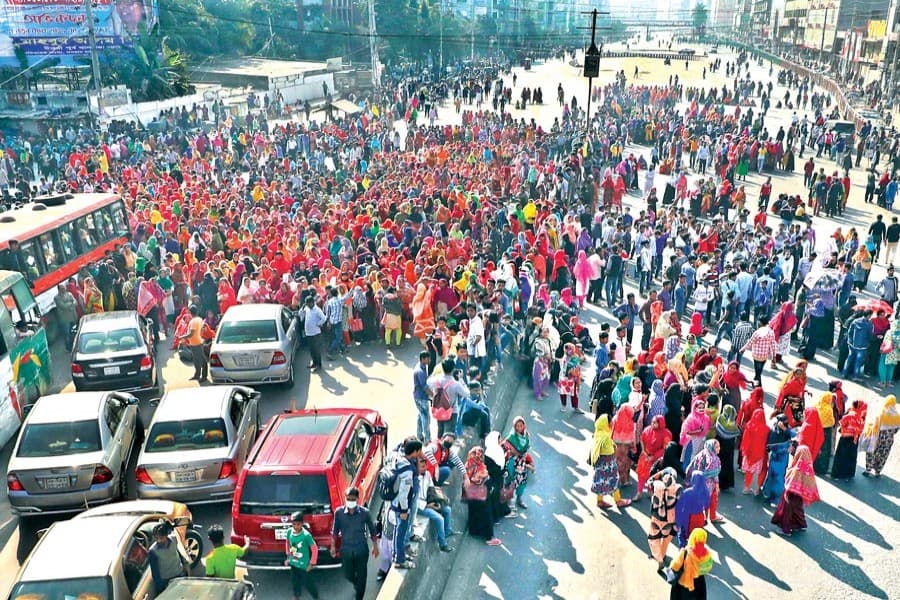
The International Labour Organization (ILO) has identified five areas including the reformation of wage structure and policy, and labour law amendments to address the ongoing labour unrest in the country’s readymade garment sector.


In a statement on Sunday, the ILO Dhaka country office said it is closely monitoring the labour unrest in Ready-Made Garment (RMG) and other sectors arising from a range of worker grievances, highlighting significant systemic issues that demand urgent attention and resolution.
At least, 65 factories suspended operation on Sunday in Savar, Ashulia and Zirani area until noon, according to the sources.
Out of the 65, some 14 garment factories are closed in line with labour law provision of 13(1) that states no work no pay.
The rest of the 51 factories announced a holiday because workers either did not work or left factories after joining in the morning, they added.
One factory in Gazipur remained closed on the day.
Meanwhile, the ILO has identified several key areas where action is required and suggested developing an evidence-based, gender-responsive national wage policy which is vital for regular and fair wage setting.
Reforming the minimum wage mechanism and ensuring inclusive consultations between employers and workers will help address wage-related grievances including the move towards providing living wages, it said adding sectoral wage boards and strong collective bargaining mechanisms must be established to prevent and de-escalate unrest related to wages and working conditions.
It also called for amendments to the Bangladesh Labour Act, aligned with international labour standards to expand coverage to all workers, including those in the informal sector and export processing zones (EPZs).
The reform should strengthen mechanisms for resolving labour disputes, enhance wage protections, and simplify the processes for trade union registration.
A robust and transparent national industrial relations system is essential for addressing disputes early and preventing them from escalating into violence, the ILO said adding this should include the introduction of an independent alternative dispute resolution institution and reforms to the labour court system to improve case management.
"Addressing anti-union discrimination cases is also a vital step toward promoting industrial peace."
The Employment Injury Scheme, currently piloted for garment workers, should be institutionalized, legislated, and gradually extended to other sectors.
Establishing a comprehensive social protection system, aligned with ILO conventions, will boost workers' safety and well-being while enhancing Bangladesh’s global competitiveness.
The ILO also called the government of Bangladesh to ratify OSH conventions No. 155 and No. 187 and to develop a comprehensive national OSH system adding that this will promote a culture of safety across all sectors of the economy.
Acknowledges the complexities surrounding the challenges, it underscoresd the importance of constructive dialogue among employers and factory owners, workers, and government representatives.
It is essential for all parties to engage in good faith, working collaboratively towards fair and equitable solutions that uphold workers' rights while ensuring the economic sustainability of the factories.
The ILO commends the RMG industry for the landmark agreement reached between workers and employers in Bangladesh’s Ashulia area, on the outskirts of Dhaka, reached on 24 September, after days of escalating labour unrest, that has raised hopes for harmonious industrial relations and long-term peace in the sector.
Social dialogue, which involves collaboration among different stakeholders to find solutions and resolve disputes, is a crucial tool for good governance.
"It not only supports sustainable business practices and better working conditions but also contributes to advancing social justice and decent work for all," ILO said.
The ILO called on all stakeholders to work for improvement of the industrial relations system through constructive social dialogue for both the stability of the RMG sector and the broader economic and social well-being of Bangladesh.
Workers in Ashulia anf Gazipur industrial belts have been protesting since August 29 over demands of increasing different allowances, timely wage payments, arrears and wage hike forcing several units to suspend production.
Munni_fe@yahoo.com