The Centre for Policy Dialogue (CPD) has come down heavily on the draft Energy and Power Sector Master Plan (EPSMP) 2026-2050, describing it as 'fundamentally flawed, non-participatory and backward-looking'
The private think tank also urged the interim government not to finalise it before the ensuing national election.
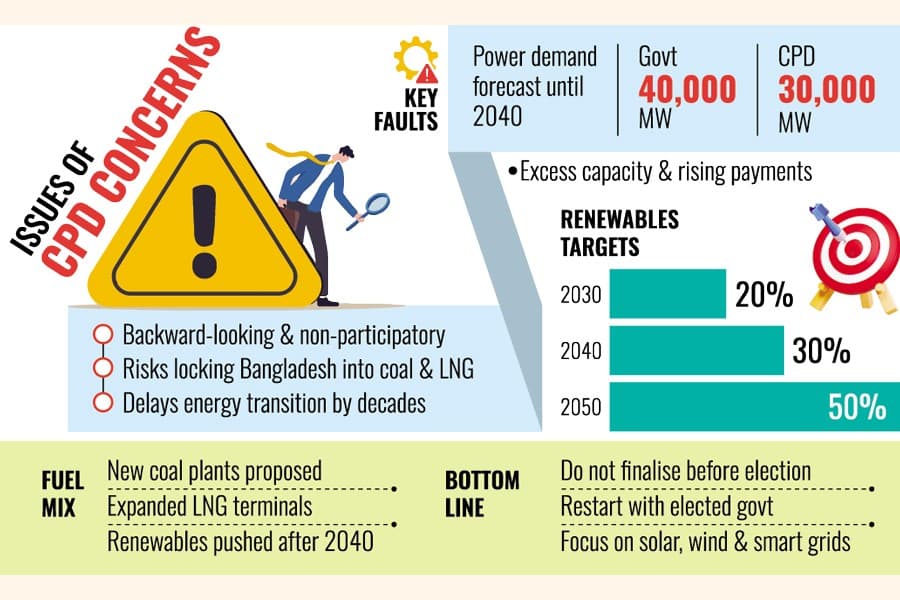
It also warned that approving the master plan in its present form would lock Bangladesh into costly and carbon-intensive fossil fuel infrastructure, deepen excess power capacity and delay the country's energy transition by years.
The CPD's concerns and warnings came on Thursday at a media briefing titled "Interim Government's Energy & Power Sector Master Plan (EPSMP): 2026-2050" in the city.
The press conference was moderated by CPD Research Director Khondaker Golam Moazzem while the keynote paper was presented by CPD Senior Research Associate Helen Mashiyat Preoty. Researchers and programme associates from CPD were also present there.
The CPD said the draft EPSMP largely echoes the previous Integrated Energy and Power Master Plan, prepared by the ousted Awami League government, and fails to address the criticisms, concerns and questions that have long surrounded Bangladesh's power and energy planning.
Instead of correcting the past mistakes, the new draft, CPD argued, carries them forward and in some cases intensifies the existing debates.
The draft proposes adding new coal-fired power plants to the grid and revives discussion on exploiting domestic coal resources under the banner of "resource optimisation", according to the CPD.
At the same time, it outlines an expansion of LNG infrastructure, including a new floating storage and regasification unit and a land-based terminal, raising questions about how the interim government intends to escape the sector's growing debt burden while claiming to move away from fossil fuels.
The CPD highlighted faulty power demand forecasting as another key area of concerns. The draft EPSMP projects electricity demand of more than 40,000 megawatts by 2040, while CPD's own analysis suggests that demand is unlikely to exceed 30,000 megawatts by that time.
Mr. Moazzem warned that overestimating the demand would only perpetuate excess capacity, inflate capacity payments and exacerbate the sector's financial stress, as Bangladesh's future economic growth is expected to be more service-oriented and less energy-intensive.
The draft also introduces zone-wise peak demand projections and generation planning, a technically sophisticated exercise that could have been beneficial, CPD acknowledged,
The CPD, however, said inconsistencies between zonal demand estimates, and renewable energy potential and generation plans risk creating additional and unnecessary generation burdens.
Although the EPSMP sets headline targets of 20 per cent renewable energy by 2030, 30 per cent by 2040 and 50 per cent by 2050, CPD questioned the credibility of such goals.
The master plan's definition of renewable energy includes large utility-scale and rooftop solar, onshore and offshore wind, waste-to-energy, geothermal, as well as hydrogen and ammonia co-firing.
The CPD argued that it remains unclear how much of the projected renewable share would come from proven sources such as solar and wind, and warned against "camouflaging" unproven or fossil-linked technologies as renewable solutions.
More critically, the plan places major renewable energy expansion and smart grid development in the post-2040 period, even though the renewable target for 2040 is 30 per cent, according to the CPD.
Mentioning that the existing grid can accommodate not more than about 20 per cent of variable renewable energy, it stressed the need for early investment in grid modernisation.
Delaying smart grid implementation until 2040, it said, is incompatible with the plan's own targets.
Grid upgradation emerged as one of the most overlooked aspects of the draft EPSMP. CPD noted the draft lacks detailed regional power mapping and also the urgency in preparing the grid to integrate higher shares of renewable energy.
It also highlighted weak provisions for institutional reform, including the need to strengthen the autonomy and enforcement powers of sector regulators and to reform the Power Grid Company of Bangladesh to ensure independent and efficient system planning.
The financial strategy outlined in the draft drew sharp criticism, according to the CPD.
It said the plan proposes investment allocations of tens of billions of dollars for electricity generation and LNG infrastructure, alongside billions for hydrogen and ammonia, while allocating negligible resources for renewable energy expansion, domestic gas exploration and transmission and distribution modernisation.
Such priorities, CPD argued, contradict the stated goals of energy security and transition.
Mr. Moazzem also questioned the timing and process of the plan's formulation, noting that it was presented to the advisory council just weeks before national elections.
He alleged excessive bureaucratic dominance in drafting the plan and raised concerns about pressure from vested domestic interests and foreign partners, particularly in relation to LNG expansion and potential commitments linked to international trade and economic agreements.
In response to questions from journalists on LNG costs, renewable integration, institutional reforms and the repetition of past planning mistakes, the CPD researchers reiterated the need for a fresh, inclusive and research-based planning process.
The CPD strongly recommended that the interim government suspend the proposed EPSMP and leave the task to an elected government.
It also called for scrapping plans for new coal-fired power plants, initiating a time-bound phase-out of existing coal capacity, halting new LNG terminal projects, accelerating smart grid development from the earliest phase, redefining renewable energy around proven sources such as solar and wind, and integrating regional renewable energy trade, including cross-border imports from Nepal and Bhutan.
bdsmile@gmail.com