


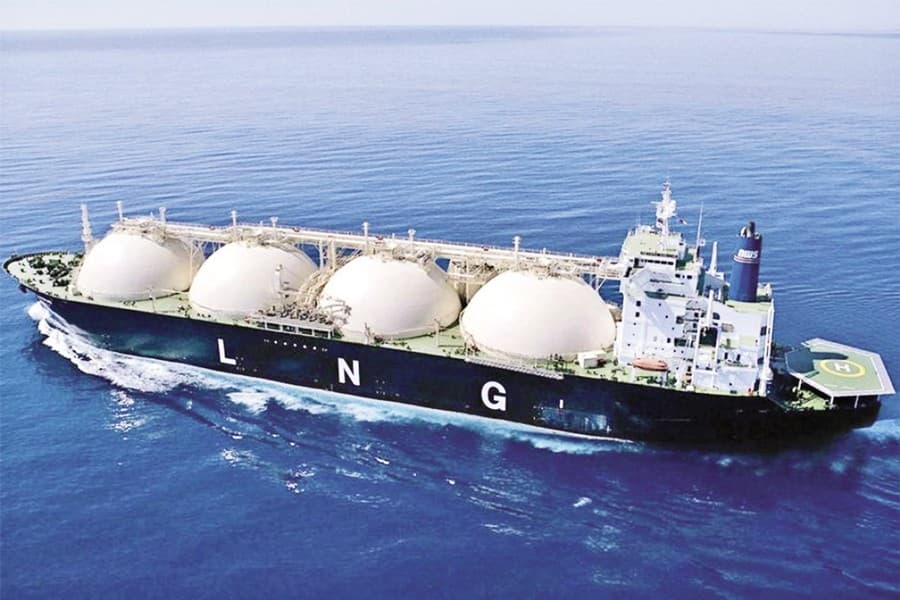
Bangladesh's liquefied natural gas (LNG) imports from long-term suppliers will surge to 86 cargoes, up by 53.57 per cent, in 2026 as three long-term sales and purchase agreements (SPAs) become effective from January, sources said.


In 2025, state-run Petrobangla imported a total of 56 LNG cargoes from two long-term suppliers, according to official data from Rupantarita Prakritik Gas Company Ltd (RPGCL).
In the new year, the country will import 56 LNG cargoes from its existing two long-term suppliers -- QatarEnergy and OQ Trading -- and 30 additional cargoes under three new SPAs: two with QatarEnergy and OQ Trading and one with US-based Excelerate Energy, a senior Petrobangla official told The Financial Express on Thursday.
OQ Trading will also supply 12 LNG cargoes under a short-term deal in 2026, he said.
Altogether, Bangladesh will import around 115 LNG cargoes in 2026, about 5.50 per cent higher than last year's imports, from global suppliers to meet mounting natural gas demand from industries, power plants and other gas-intensive consumers.
Of the total imports, Bangladesh will source 86 LNG cargoes from long-term suppliers, 12 from short-term suppliers and the remaining 17 from the spot market, the Petrobangla official said.
Bangladesh imported a total of 109 LNG cargoes in 2025 -- 56 from long-term suppliers, 49 from the spot market and four from short-term suppliers -- according to RPGCL data.
None of the three companies -- QatarEnergy, OQ Trading and Excelerate Energy -- responded to emailed queries regarding the LNG import issues.
Petrobangla will also source 17 LNG cargoes from the spot market through competitive bidding among shortlisted suppliers in 2026, the official said.
All imported LNG will be re-gasified at Bangladesh's two operational floating storage and regasification units (FSRUs) located off Moheshkhali Island in the Bay of Bengal.
"Industrial consumers will receive top priority in gas supply as the government prepares a fuel allocation plan aimed at supporting economic growth," Petrobangla Chairman Md Rezanur Rahman said. "Industry will be on top of our priority, and we want industrial consumers to get as much gas as possible next year to run their industries."
Currently, Petrobangla is supplying natural gas to industries at near-maximum capacity. Fertiliser factories are also receiving increased volumes of gas, Mr Rahman said. "Industrial consumers will receive sufficient additional gas even if demand from other consumer categories rises," he added.
In 2025, natural gas supply to Bangladeshi industries increased by 21 per cent during the first four months up to April compared to the same period of 2024, according to data from the Ministry of Power, Energy and Mineral Resources.
Average gas supply to industries during the first four months stood at 997 million cubic feet per day (mmcfd), compared to 823 mmcfd in the corresponding period of the previous year, the data showed.
Petrobangla increased gas supply to industries by around 150 mmcfd from late May 2025 following a government decision to import six additional LNG cargoes. It reduced gas allocations to gas-fired power plants to 1,050 mmcfd from 1,200 mmcfd to divert an additional 150 mmcfd to industries.
About 100 mmcfd of additional gas was supplied to industries from extra LNG imports, ensuring around 250 mmcfd of additional gas for industries from June to October ahead of winter.
"Like previous years, Bangladesh will have to ration gas supplies to consumers to cope with natural gas shortages," the Petrobangla chairman said.
Since LNG imports began in 2018, Bangladesh has imported around 34.34 million tonnes of LNG through 554 cargoes as of November 2025, according to RPGCL data.
Bangladesh's overall natural gas output is currently hovering around 2,440 mmcfd, of which about 702 mmcfd is re-gasified LNG, while the remaining 1,740 mmcfd comes from local gas fields, according to Petrobangla data as of December 30.
azizjst@yahoo.com