


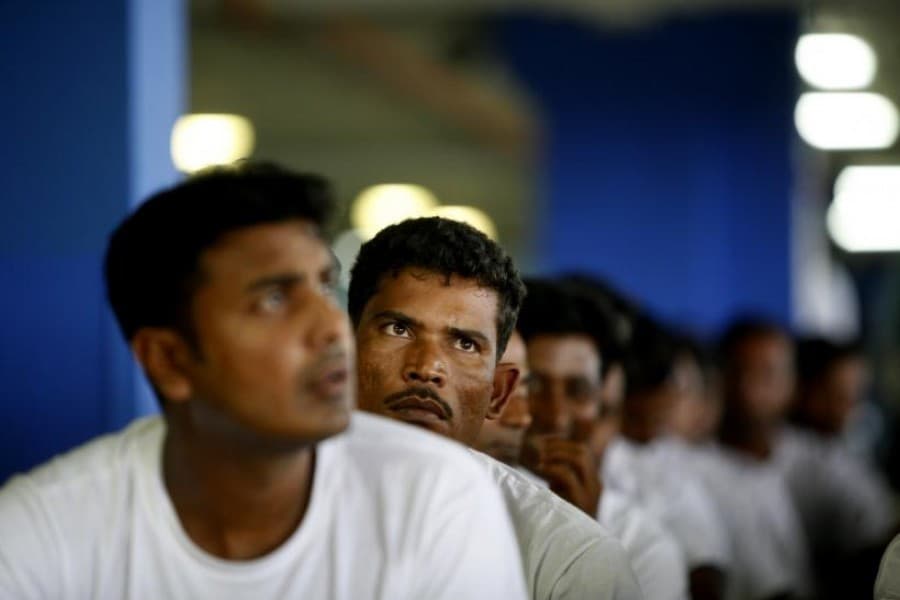
Bangladesh's heavy dependence on overseas employment in the Middle East has come under serious threat amid the escalating war in the region, exposing the vulnerability of millions of migrant workers, particularly those engaged in low-skilled jobs.


Migrants and experts warn that if the conflict persists, new overseas employment opportunities could shrink while existing jobs may be lost, potentially slowing remittance inflows that are vital to Bangladesh's economy.
According to the International Organization for Migration (IOM), Bangladesh is the sixth-largest migrant-sending country, with over 11 million Bangladeshi migrants working worldwide.
Of the total, around 70 to 74 per cent are semi- or low-skilled workers, according to an analysis by the Refugee and Migratory Movements Research Unit (RMMRU).
Remittance inflows are one of the driving forces of the country's economy. Bangladesh received US$32.82 billion in remittances in 2025, marking a 22 per cent rise from the previous year.
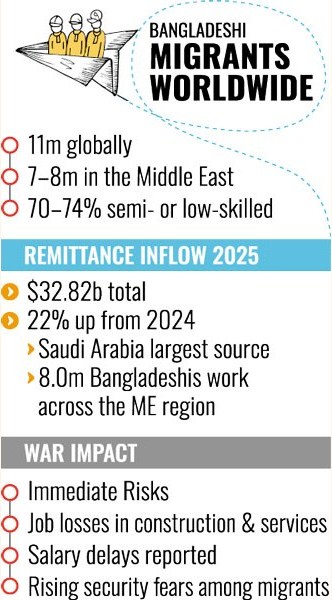
The highest amount came from Saudi Arabia, according to official data, with an estimated 8.0 million migrants working across the Middle East.
Bangladeshi migrant Kawshik (not his real name) has been working in Kuwait for the past couple of years.
"The situation over the last two days seems calm, but there are fears among residents. We no longer feel safe," he told the FE over the phone, urging the Bangladesh government to arrange food and shelter for migrants in coordination with the Kuwaiti authorities.
Requesting not to be identified, he said that revealing the ground reality to outsiders could result in at least three years in jail along with the loss of employment.
He described an atmosphere of fear and a lack of personal security currently prevailing in the Middle East.
He suggested shifting the country's focus to other destinations, noting that the economies of many countries in the region are themselves vulnerable because they depend heavily on oil revenues.
"Both government and private companies are oil-based enterprises in the Middle East. If they cannot sell oil, they cannot pay salaries," he said.
Abdul Mannan, another Bangladeshi worker from Lakshmipur employed by a construction company operating at several sites across Saudi Arabia, said the company's Egyptian owner left the country soon after the start of the US-Israel offensive against Iran.
Mannan told the FE over the phone that he and his three brothers, who also work for the same company, did not receive their salaries for February.
"We don't know what lies ahead for us as the looming war has created deep uncertainty," he said.
In response to the US-Israel offensive, Iran has attacked US military bases across the Middle East, including in the UAE, Saudi Arabia, Qatar, Kuwait, Jordan and Bahrain.
At least four Bangladeshi migrants have reportedly been killed since the US launched the war on Iran and retaliatory attacks began-two in Saudi Arabia, one in the United Arab Emirates and one in Bahrain.
Against this backdrop, Biman Bangladesh Airlines has suspended flights to six major Middle Eastern destinations-Dubai, Abu Dhabi, Sharjah, Dammam, Doha and Kuwait-for a certain period.
However, Qatar has decided to extend the validity of all types of visas by one month amid the suspension of flights across the region.
Shakirul Islam, chairperson of the Dhaka-based Ovibashi Karmi Unnayan Program (OKUP), echoed similar concerns, saying Bangladesh may face serious repercussions if the war in the Middle East lasts long, as around 7-8 million Bangladeshi migrants work in the region.
"There is no option to leave those Middle Eastern countries if the war escalates further and continues for a long time. We do not yet know what rescue options might be available," he said.
However, he added that the situation would depend largely on the relations between the Bangladesh government and the destination countries.
"The government can initiate joint efforts and negotiations with other countries in the region, particularly in South Asia, as they too have a large number of migrants in the Middle East," the OKUP official said.
Bangladeshi migrant workers mainly work in the informal sector in the Middle East. Therefore, the companies they work for may face serious difficulties during a war and could become unable to pay wages in the days ahead, similar to what happened during the Covid-19 pandemic, Shakirul warned. He added that the real picture would become clearer next week when salaries are due.
nsrafsanju@gmail.com