

Published :
Updated :
 For all latest news, follow The Financial Express Google News channel.
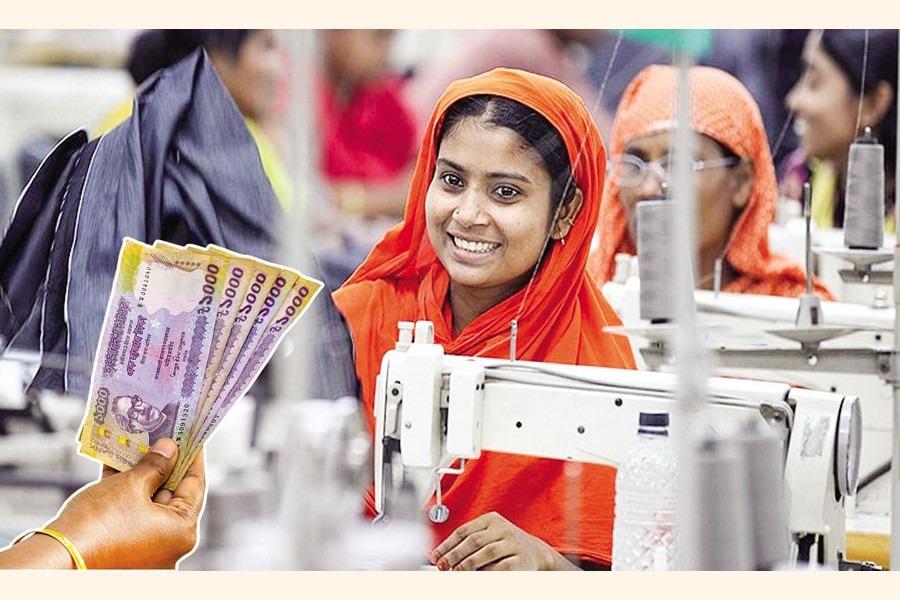
Almost all export-oriented garment factories registered with the Bangladesh Garment Manufacturers and Exporters Association (BGMEA) have disbursed February wages and Eid festival allowances, with only a handful still completing payments, BGMEA President Mahmud Hasan Khan said on Wednesday.
"About 99.91 per cent of factories have paid wages for February, while two units are in the process of making payments," he said at a press briefing at the BGMEA complex in Uttara.
Regarding Eid festival allowances, 99.81 per cent of factories have completed payments, with four factories yet to finalise the process.
Despite no legal obligation, around 64.03 per cent of factories have also provided partial advance wages for March, Mr Khan added.
The sector, Bangladesh's largest export earner, is navigating a challenging period amid a global economic slowdown, geopolitical tensions, and increased competition in international markets.
During the first eight months of fiscal 2025-26, garment export earnings fell by 3.73 per cent, while the opening of back-to-back letters of credit for raw material imports dropped by 6.79 per cent. Global economic forecasts
Average unit prices also declined by 1.76 per cent.
Rising energy costs and domestic financial constraints have added pressure on manufacturers.
Gas prices have surged by 286 per cent over the past five years, electricity tariffs have increased by 33 per cent, and uninterrupted supply remains elusive.
High interest rates, liquidity shortages in the banking sector, and working capital constraints have further strained factories.
Mr Khan acknowledged that some factories faced acute financial stress, but coordinated efforts by BGMEA, factory owners, banks, and labour federations ensured that outstanding wages and allowances were settled.
He also credited timely government support, including the disbursement of Tk 25 billion in cash and concessional loans, for easing liquidity pressures and helping maintain industrial stability ahead of Eid.
To reduce congestion during the holiday rush, factories are staggering Eid holiday schedules by region.
Around half of the factories began holidays on Tuesday, with the remainder expected to follow by Thursday, he said.
The BGMEA president also called on transport operators to prioritise passenger safety during Eid travel and urged authorities to strengthen highway monitoring to prevent the unsafe practice of carrying passengers in goods vehicles.
Meanwhile, hundreds of workers from 801 factories across the country did not receive their February wages until Wednesday, according to data released by the Industrial Police (IP).
Also, employees in 1,600 factories -- 16.44 per cent of the total -- are yet to receive their festival allowances. All these factories are under the jurisdiction of the Industrial Police.
Although the government instructed industrial units to pay wage by March 9 and festival bonuses by March 12, a significant number of workers in the textile, garment, and jute sectors are facing financial uncertainty just even as Eid holidays had already started.
A total of 10,100 industrial units operate under IP supervision across Dhaka (excluding Dhaka Metropolitan city), Gazipur, Chattogram, Narayanganj, Mymensingh, Khulna, Sylhet and Cumilla.
Of them, about 92.70 per cent, or 9,299 factories, had paid February wages, while 8,440 units disbursed festival allowances by Wednesday, according to IP data.
Data showed that only two factories under the Bangladesh Garment Manufacturers and Exporters Association (BGMEA) failed to pay February wages, while four others did not provide festival allowances.
Out of 834 members of the Bangladesh Knitwear Manufacturers and Exporters Association (BKMEA), some 98.67 per cent paid wages and 96.55 per cent paid festival bonuses.
Compliance is highest in export processing zones, as 100 per cent of BEPZA factories paid both monthly wages and bonuses.
When asked, Gazi Jashim Uddin, additional inspector general of Industrial Police, said the number of factories failing to pay wages and allowances decreased by late evening, with only "a small number" still pending.
He noted that several factories remained closed for various reasons but added that those yet to make payments were expected to do so on Thursday (today).
Responding to a question, he said there were no major labour unrest incidents, except one case where workers took to the streets after failing to contact the factory owner, who was at a bank arranging funds.
However, the owner cleared the wages later. He added.
Labour leaders, however, alleged irregularities outside the readymade garment sector. They said a number of non-RMG factories, particularly in Ashulia and Gazipur, failed to pay wages and bonuses before Eid.
Babul Akhter, a labour leader, said timely payment of wages and festival bonuses is a legal obligation, and any failure constitutes a violation of labour laws and deprives workers of their rights.
He urged the government to take punitive action against factory owners who delay payments without valid reasons, to prevent recurrence of such incidents.
He, however, said most garment factories paid wages and bonus. Beyond payment delays, job security has emerged as another pre-Eid concern. Labour leaders allege that a garment factory in Gazipur terminated some 108 workers before Eid.
Responding to these allegations, BGMEA President Mahmud Hasan Khan said while no one supports job termination, factories may take such steps lawfully for various reasons.
He emphasised that the primary concern must be whether the terminated workers receive their full lawful benefits, including compensation.
munni_fe@yahoo.com