


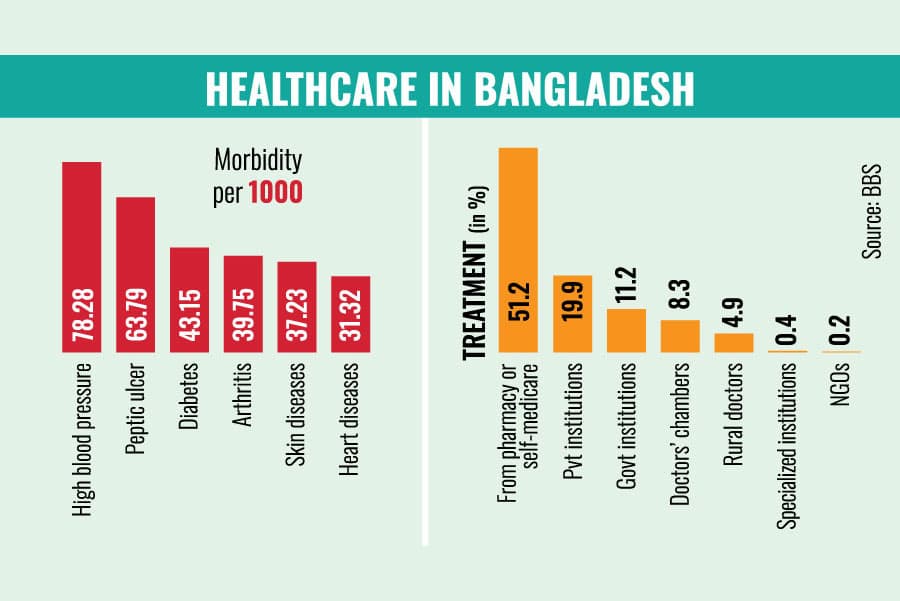
People pay through their nose for high health cost as government hospitals in Bangladesh serve only 11.2 per cent of the population by an official count.
Of the rest, more than half of the population depends on pharmacy or dispensary or rural doctors for treatment, Bangladesh Bureau of Statistics (BBS) survey unveils.
For taking treatment against their diseases, a Bangladeshi needs to spend Tk 9,948 per year, it shows.
Among the diseases, the morbidity rate for high blood pressure is the highest as 78.28 people out of 1,000 die for the impact of the illness.
Per 1,000 people, peptic ulcer is the second-highest in number for morbidity prevalence as 63.79 of them died for the disease, while 43.15 for diabetics, 39.75 for arthritis, 37.23 for skin diseases and 31.32 for the heart diseases.
The BBS findings come in its report on 'Health and Morbidity Status Survey (HMSS) 2025' published Sunday in Dhaka.
According to the survey, 51.2 per cent of the total population take treatment on their own or from the pharmacy and dispensary nearby, while 4.9 per cent from the rural doctors.
A total of 19.9-percent people go to the private institutions for getting treatment, while 11.2 per cent receive treatment from the government institutions, 8.3 per cent from doctors' chambers, 0.4 per cent from specialized institutions and 0.2 per cent from NGOs.
Meanwhile, the average maternal health expenditure is still very high in Bangladesh as most deliveries occur through cesarean section.
According to the national statistical agency, every Bangladeshi mother spends Tk 22,677 on average for her maternal-health treatment.
Out of the expenditures, a mother needs to spend Tk 21,630 for a cesarean section for giving birth to her child, the statistics show.
For normal delivery, a mother needs to spend Tk 4,657 on average in Bangladesh.
A total of 24.4-percent delivery takes place at home, 48.9 per cent in the non-government hospitals, 4.6-percent at upazila health complex, 1.1-percent at community satellite clinics.
Meanwhile, the report reads, "attendance of doctors at delivery has increased in Bangladesh remarkably, as 66.6-percent mothers go to the physician during the birth of their child. Eleven years ago in 2014, the rate was recorded at 36.9 per cent".
Besides, 15.9-percent mothers faced trained midwife in their delivery period, 11 per cent faced nurse and 1.9 per cent saw health workers. However, 4.1-percent mothers go to untrained midwife for their child delivery, the BBS report says.
The survey was conducted between November 2024 and January 2025. A total of 189,986 samples were selected for the survey across the country.