


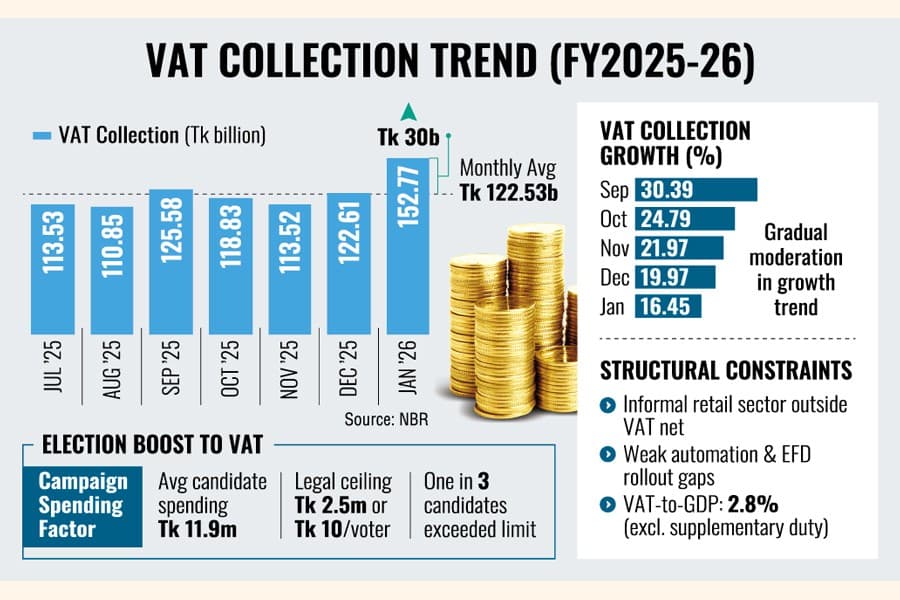
A surge in election-related spending in recent months appears to have provided a short-term boost to value-added tax (VAT) collection, with January 2026 revenue standing Tk 30 billion above the July-December monthly average.


Provisional data suggest campaign-driven economic activity injected liquidity into the system, temporarily lifting receipts.
Yet despite the monthly uptick, underlying weaknesses in VAT compliance and administration continue to weigh on year-on-year growth, pointing to deeper structural challenges in revenue mobilisation.
According to provisional figures from the National Board of Revenue (NBR), VAT collection in January rose 24 per cent compared with the average monthly intake in the first half (H1) of the current fiscal year.
However, the year-on-year trend presents a more subdued picture. Although FY2025-26 began strongly, with VAT growth of 32.46 per cent in July over the same month a year earlier, the momentum gradually weakened in subsequent months.
By January, year-on-year growth had declined to 16.45 per cent, down from 19.97 per cent in December, 21.97 per cent in November, 24.79 per cent in October and 30.39 per cent in September last year.
Syed Mushfequr Rahman, Member of the VAT wing at the NBR, said structural challenges in the VAT system continue to constrain collection performance.
"Election spending may generate higher revenue from sectors such as tobacco and mobile phone usage. However, vast segments, including restaurants and makeshift stalls, remain outside recorded transactions for VAT purposes," he said.
He stressed the need for integrated automation of the VAT collection process, covering both large corporations and retail businesses.
Explaining the stronger VAT growth in the first quarter, he attributed it partly to last year's policy uncertainty surrounding the bifurcation ordinance, under which the interim government sought to separate revenue policy from revenue administration.
While campaign spending visibly increased money circulation, he remarked, somewhat sarcastically, that cash transactions themselves do not attract VAT.
A study by Transparency International Bangladesh (TIB) found that average campaign expenditure per candidate reached Tk 11.9 million between December 4, 2025 and February 1, 2026.
Under the Representation of the People Order (RPO), candidates are allowed to spend Tk 2.5 million or Tk 10 per voter, whichever is higher. The TIB report noted that one in three candidates exceeded the legal ceiling even before the official campaign period concluded.
Despite heavy campaign outlays in December, the anticipated impact was not proportionately reflected in January's year-on-year VAT growth data.
Dr Fahmida Khatun, Executive Director of the Centre for Policy Dialogue (CPD), said election-related spending could translate into higher revenue collection if VAT compliance improves.
Field-level VAT officials acknowledged that repeated digitisation initiatives during the tenure of former prime minister Sheikh Hasina encountered implementation setbacks.
The NBR introduced Electronic Cash Registers (ECRs) in 2009 to strengthen retail-level VAT collection. Subsequent attempts, including the transition to the Electronic Fiscal Device Management System (EFDMS), have yet to achieve widespread adoption.
A recent national taskforce report on revenue reform, led by economist Dr Zaidi Sattar, noted that although VAT remains a major source of NBR revenue, it contributes only around 2.8 per cent of GDP, excluding supplementary duties.
The report cautioned that VAT can be regressive, imposing a disproportionate burden on lower-income households.
Given the equity-efficiency trade-offs involved, it advised against overloading VAT policy with multiple non-revenue objectives.
Overall, while election spending may have offered a temporary lift to monthly VAT receipts, experts say sustainable gains will depend on structural reform, improved compliance and more effective digital integration of the tax system.
doulotakter11@gmail.com