
The power sector is operating under a massive financial burden despite improvements in electricity supply, Minister for Power, Energy and Mineral Resources (MPEMR) Iqbal Hasan Mahmud warned on Thursday.
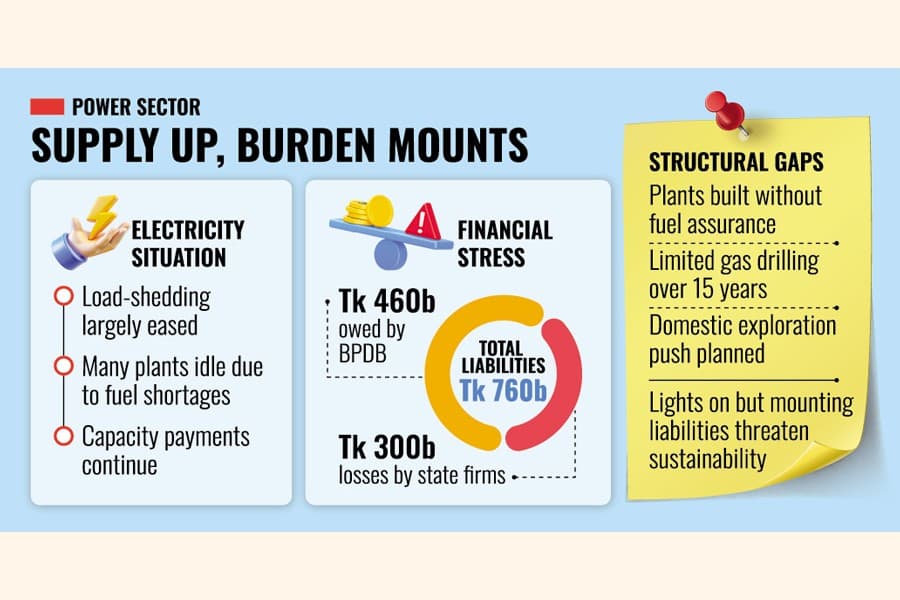
While load-shedding has largely eased, the sector now faces mounting liabilities, capacity payments and accumulated losses that threaten the sector's sustainability, he said.
"It is true that we left behind load-shedding, but we did not leave a burden on the nation's shoulders," he said, adding: "Now the lights are on, but the nation carries a heavy burden."
The minister was speaking as chief guest at the inception ceremony of the new executive committee of the Forum for Energy Reporters Bangladesh (FERB) at the ministry's conference room in the Bangladesh Secretariat.
Many power plants have been built without ensuring fuel supply, he said.
"As a result, many plants cannot generate electricity, yet capacity payments must still be made," he added, describing the situation as "a complete mess".
Reflecting on his earlier tenure at the ministry nearly two decades ago, Mr Mahmud said system loss in electricity was 6.0 per cent during his previous term.
"After 19 years, I now see it has risen to 10 per cent. Each 1.0 per cent equals Tk 50 million. Our target is to reduce it to 3.0 per cent," he said.
Initially, instructions have been given to bring it down to 5.0 per cent, he added. "If that can be done, losses will decrease."
Otherwise, liabilities will grow further and the International Monetary Fund (IMF) will exert pressure, he cautioned.
"We are considering negotiations with private power plants so that the interests of both sides are protected," he said.
Responding to a query, he said that when he was previously in charge of the ministry in 2004, he had formulated a policy stipulating 35 per cent private participation in power generation and 65 per cent government participation.
Subsequent governments did not follow that policy, he alleged.
"Now private participation has risen to 82 per cent. As a result, there is no control. The burden has been shifted onto the people. This is such a huge liability that it is difficult to manage. We cannot increase electricity prices. We are trying to create a win-win situation," the minister said.
Mr Mahmud also alleged that gas wells had not been drilled sufficiently over the past one and a half decades.
"We are emphasising domestic gas exploration. Rigs will be purchased and skilled manpower will be needed. Plans are being made, and time will be required," he said.
It is difficult to expect quality gas supply at present, the minister added. The event was presided over by outgoing FERB Chairman Shamim Jahangir, while newly elected Chairman M Azizur Rahman also spoke.
Commemorative tokens were presented to members of both the outgoing and newly elected committees. The programme was conducted by FERB Executive Director Serajul Islam Siraj.
Earlier, in a meeting with Economic Adviser Dr Rashed Al Mahmud Titumir, the minister discussed around Tk 760 billion in arrears and accumulated losses. Of this amount, Tk 460 billion is owed by the Bangladesh Power Development Board (BPDB) to various companies, while Tk 300 billion represents losses incurred by government-owned enterprises.
The meeting noted that without addressing these liabilities, uninterrupted electricity supply cannot be ensured.
azizjst@yahoo.com