

BANGLADESH TRANSITIONING INTO 15PC VAT REGIME
Rate high, rebate reduces overall tax incidence
Latest fiscal policies bundling out piecemeal ratings of value-added tax on industrial raw-material imports
Published :
Updated :
 For all latest news, follow The Financial Express Google News channel.
Bangladesh is transitioning into a ramped-up 15-percent VAT regime amid some concerns, but a redeeming feature is the provision for rebate meant for reducing the overall tax incidence.
Officials define it as a paradigm shift as latest fiscal policies are bundling out piecemeal ratings of value-added tax on industrial raw-material imports or purchases.
Officials at the National Board of Revenue (NBR) VAT wing have said the shift has become increasingly visible over the past two years, following policy changes aimed at bringing businesses under the standard 15-percent VAT regime.
The move allows firms to claim input-tax rebates and ultimately reduce their effective tax burden.
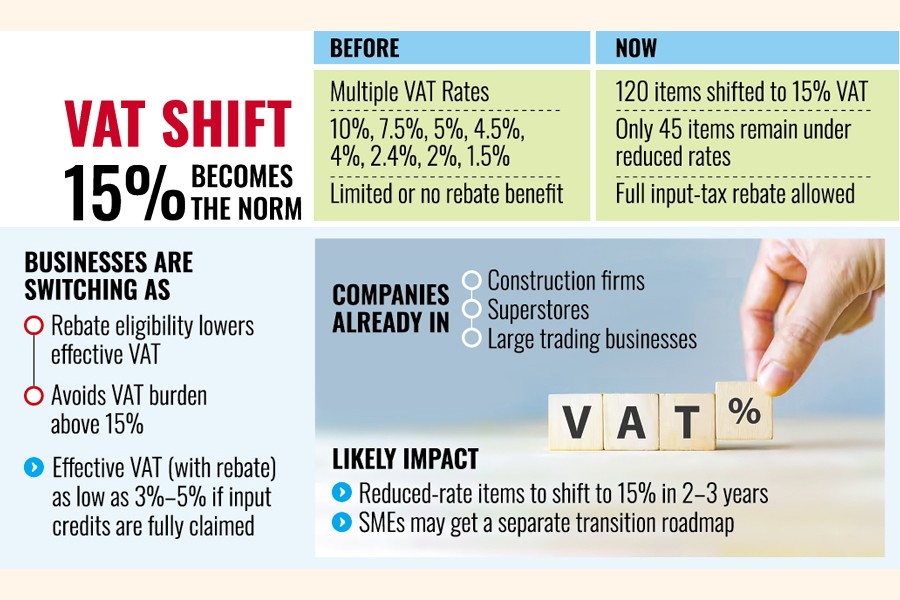
Currently, Bangladesh applies multiple lower VAT rates at 10, 7.5, 5, 4.5, 4, 2.4, 2 and 1.5 per cent.
However, to incentivise businesses to opt for the standard rate, the budgets of the last two fiscal years introduced measures that made reduced rates costlier than paying 15-percent VAT with rebate eligibility.
On January 9, 2025, and again in the budget for the current fiscal year, the NBR upgraded 120 items-covering both services and manufacturing-to the 15-percent standard rate from earlier reduced VAT rates on them, says a senior VAT official.
"Only 45 items now remain under reduced rates, and these are also on a roadmap to be brought under the standard VAT rate within next two years or three," the official told The Financial Express.
"We will not force businesses to move to a higher rate, but they will choose it automatically to reduce their actual VAT burden through rebate claims," he said.
The NBR has already observed several success cases. For instance, the increase in trading VAT to 7.5 per cent in the current fiscal year's budget has encouraged many businesses to shift to the 15-percent rate to claim rebates on raw-material purchases, otherwise their total tax burden would surge beyond 15 per cent.
Several sectors, including construction firms and superstores, have already phased out of reduced VAT rates, the official said.
Chairman of the International VAT Training Institute Dr Md Abdur Rouf says that if businesses properly claim input -tax credit, the effective VAT burden can fall to between 3.0 and 5.0 per cent.
"Maintaining a 15-percent VAT rate aligns with the government's heavy reliance on VAT revenue," he argues, adding that businesses often prefer reduced rates due to lower compliance costs.
However, Dr Rouf cautions that converting all pared-down VAT rates to 15 per cent at once would be challenging in Bangladesh's heterogeneous economy, given its diverse socioeconomic, political and cultural realities.
Responding to concerns over whether the standard VAT rate is too high for Bangladesh, he noted that VAT rates vary widely across countries -- from as low as 3.0 per cent in French Polynesia to as high as 27 per cent in Hungary -- while the global average VAT rate stands at around 18 per cent.
Out of 142 countries, 70 apply reduced VAT rates, including Austria, Belgium, Greece, Ireland, Italy, Luxembourg, Portugal, Spain and the UK, which have a 20-percent standard rate alongside a 5.0- percent reduced rate on the bottom tier.
LafargeHolcim Bangladesh Chief Executive Officer Md Iqbal Chowdhury says reduced VAT rates remain necessary for certain sectors that procure raw materials from informal sources where VAT collection is not feasible.
The government may frame a roadmap for SMEs on VAT and bring all other large businesses having commercial import, industrial establishments in to 15-percent rate, he suggests.
"Imposing the 15-percent rate too hastily could be damaging to the financial system, as many small traders lack the capacity to maintain proper books of accounts required to claim rebates," he told the FE.
Zinnia Tanzina Huq, Chief Financial Officer and Finance Director of Unilever Bangladesh Limited, says that under the Bangladesh VAT and Supplementary Duty Act 2012, the applicable VAT rate for Unilever's products is 15 per cent.
"The reduced rate of 7.5 per cent applies only to specific goods and services listed in the relevant schedules, and our products are not included in that category. Therefore, to comply with VAT law and remain eligible for input-tax rebate, we are required to pay VAT at the standard rate of 15 per cent," she adds.
Mr Iqbal Chowdhury, who is also Vice-president of the Foreign Chamber of Commerce and Industry (FICCI), reminds that high rate of VAT encourages evasion so the government must proceed rationally on standard rates.
doulotakter11@gmail.com