

Published :
Updated :
 For all latest news, follow The Financial Express Google News channel.
Experts have called for urgent reforms to Bangladesh's renewable energy procurement framework after a new study by the Centre for Policy Dialogue (CPD) revealed that many of the recently advertised solar power tenders received little to no participation.
The study, presented on Monday at a dialogue titled "Recent Procurement Initiatives of Renewable Energy in the Power Sector: CPD Study Findings", recommends a phased approach to re-tendering alongside structural reforms to improve transparency, efficiency, and investor confidence.
The dialogue held at BRAC Inn in the capital brought together senior government officials, industry leaders, academics, and development partners.
Speaking as the chief guest, Muhammad Fouzul Kabir Khan, adviser to the Ministry of Power, Energy and Mineral Resources, welcomed the progress made following the reinstatement of the Public Procurement Act (PPA) 2006 and Public Procurement Rules (PPR) 2008, but acknowledged the need for deeper reforms.
"While we have taken important steps, we need to ensure that our procurement processes are aligned with global best practices to foster both local and foreign investments in the energy sector," he said.
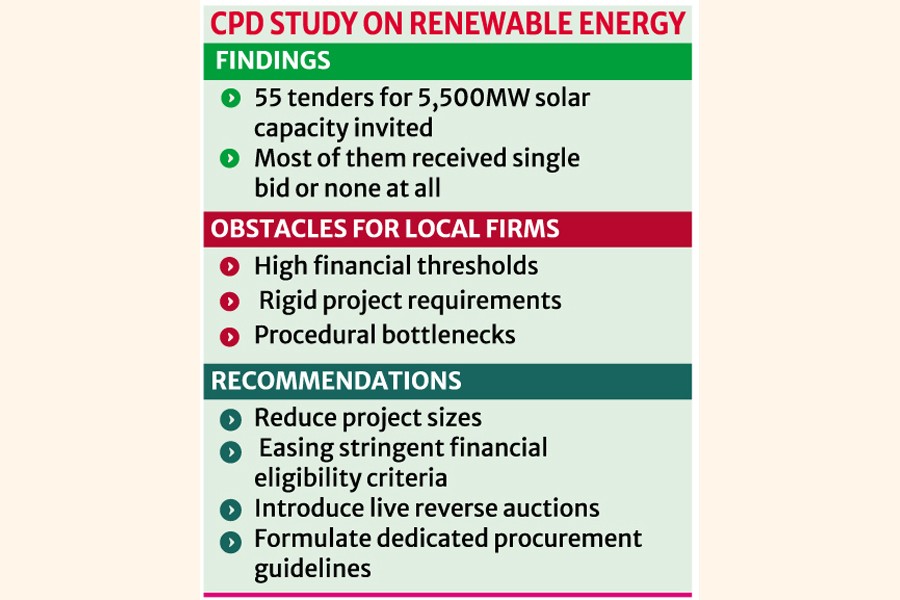
The CPD study revealed that despite the ministry's invitation of 55 tenders for 5,500 MW of solar capacity, a significant number received a single bid or none at all.
High financial thresholds, rigid project requirements, and procedural bottlenecks severely limited participation, particularly among local firms.
The think tank's recommendations include reducing project sizes, easing stringent financial eligibility criteria, introducing live reverse auctions, and formulating dedicated procurement guidelines for renewable energy projects.
From a grid management perspective, Professor Dr M Rezwan Khan, chairman of Power Grid Bangladesh, underscored the need for a more competitive system.
"The current procurement system has worked up to a point, but we now need a transparent and competitive market to ensure that we can meet Bangladesh's energy needs," he noted.
International development partners echoed similar sentiments.
Mr Clinton Pobke, deputy head of mission at the Australian High Commission, emphasised the importance of global cooperation.
"Australia is committed to supporting Bangladesh in this critical transition. These proposed reforms, if implemented, will ensure a sustainable and competitive renewable energy market," he said.
Moderating the discussion, Dr Khondaker Golam Moazzem, research director at CPD, said the procurement process must become more adaptive.
"The reinstatement of the PPA 2006 and PPR 2008 offers a solid foundation, but we must make the system more agile to accommodate the changing needs of the energy market," he argued.
Presenting the study findings, Atikuzzaman Shazeed, programme associate at CPD, highlighted the uneven playing field created by demanding financial qualification criteria.
"The disparity in financial capabilities between local and foreign firms is hindering the participation of domestic businesses," he said, stressing the need to reduce working capital thresholds and consider introducing live reverse auctions to improve competitiveness.
Industry leaders also expressed concern about the procurement system's complexity.
Mr Han Kun, president of the Chinese Enterprises Association in Bangladesh, said the lack of flexibility remained a deterrent to global firms.
"To attract more international players, we need to make the bidding process more transparent and inclusive," he said.
Echoing the urgency, David Hasanat, president of the Bangladesh Independent Power Producers' Association (BIPPA), cautioned that delays in implementing reforms risked undermining the country's energy ambitions.
"We are making progress, but the pace is too slow. To ensure Bangladesh remains competitive, we need to speed up the process and address the inefficiencies that continue to hinder the sector," he said.
The absence of dedicated renewable energy procurement guidelines was mentioned as another major concern.
Mostafa Al Mahmud, president of the Bangladesh Sustainable and Renewable Energy Association (BSREA), warned that ambiguity in the current framework created confusion among bidders.
"Without clear guidelines, companies find it difficult to navigate the tendering process," he said.
From an operational standpoint, Imran Karim, former president and director of BIPPA, stressed the importance of implementation.
"Policies are only effective when they are put into practice. We need a system that supports local firms and provides real solutions, not just theoretical frameworks," he remarked.
Academics also highlighted their role in guiding reforms.
Shahriar Ahmed Chowdhury, director of the Centre for Energy Research at United International University, said, "Collaboration between academia and the energy industry will lead to innovative solutions that can help streamline procurement and make the process more sustainable."
Engineer Naznin Akter, managing director of Solaric Bangladesh, and Ms Most Sultana Razia, deputy director (technical) at the Bangladesh Rural Electrification Board, emphasised the need for more inclusive tender specifications.
They noted that smaller local firms remained disadvantaged by current project sizes and financial conditions, underscoring the importance of greater flexibility and simplification.
bdsmile@gmail.com