

Rice imports surge amid local market volatility as prices continue to climb
Published :
Updated :
 For all latest news, follow The Financial Express Google News channel.
Rice imports surged sharply in the first five months ending November last amid persistent volatility in the staple food market, even as prices continued to climb.
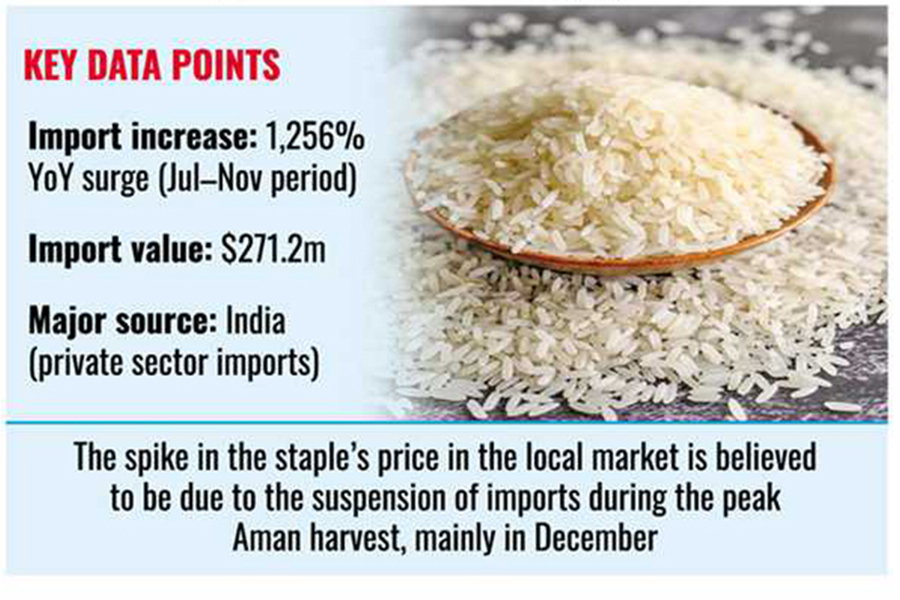
Imports jumped more than 1,256 per cent year-on-year to US$271.2 million during the July-November period, according to the latest Bangladesh Bank (BB) statistics.
The bulk of the overseas procurement came through the private sector from neighbouring India, where prices of the staple remained lower in recent months.
The importers capitalised on the lower international market and domestic supply concerns.
The spike in the staple's price in the local market is believed to be due to the suspension of imports during the peak Aman harvest, mainly in December, as the government wanted to protect the interests of the growers.
Officials at the Directorate of Food told The Financial Express that rice prices remained elevated for finer varieties, squeezing household budgets at a time when overall inflation is still high.
They also said food imports are likely to rise further, as the government has again moved to allow private imports in an effort to calm the rice market.
"The imports might begin this January, as the food adviser has signalled further imports because the local market remains high, hitting the poorer sections of the population," one official told the FE on condition of anonymity.
The Ministry of Food typically relies on private sector imports to manage short-term supply gaps.
But a section of economists warned that excessive reliance on imports could depress farmers' prices, impacting growers and undermining farmers' income.
"Actually, imports should be well-timed and rotational in order to protect growers and intervene in the market," said Dr Zahid Hussain, a former World Bank economist."
"Large inflows of rice soon after the harvest can hurt farmers, especially smallholders who are struggling with higher input costs."
Food directorate officials said that current price pressures are largely concentrated in finer varieties of rice, which are widely consumed.
The prices of coarse varieties of rice, however, they argued, remained comparatively moderate.
The country produces around 40 million tonnes of rice and has attained self-sufficiency in normal years.
But erratic weather, higher input costs, and market inefficiencies have made prices higher and less stable.
jasimharoon@yahoo.com