

Published :
Updated :
 For all latest news, follow The Financial Express Google News channel.
Bangladesh rues negative growth in garment exports to its major traditional destinations like the European Union and the United States and in emerging non-traditional ones so long this fiscal year amid external headwinds.
Exporters and trade officials say global trade and tariff tensions and wars cast dampers on demand for clothing all over the export market, throwing exports on a negative trajectory over the last eight months.
Germany, France, Italy, Denmark, Spain, the Netherlands and Poland are billion-dollar markets in the EU.
Shipments to those countries during the eight months of the current fiscal year 2025-26 recorded negative growth ranging from 8.0 per cent to over 12 per cent, save a few where marginal growth was recorded in Export Promotion Bureau (EPB) data.
Shipments to the Netherlands recorded a sluggish 0.24-percent, Spain 3.03-percent and Poland 7.03-percent growth respectively.
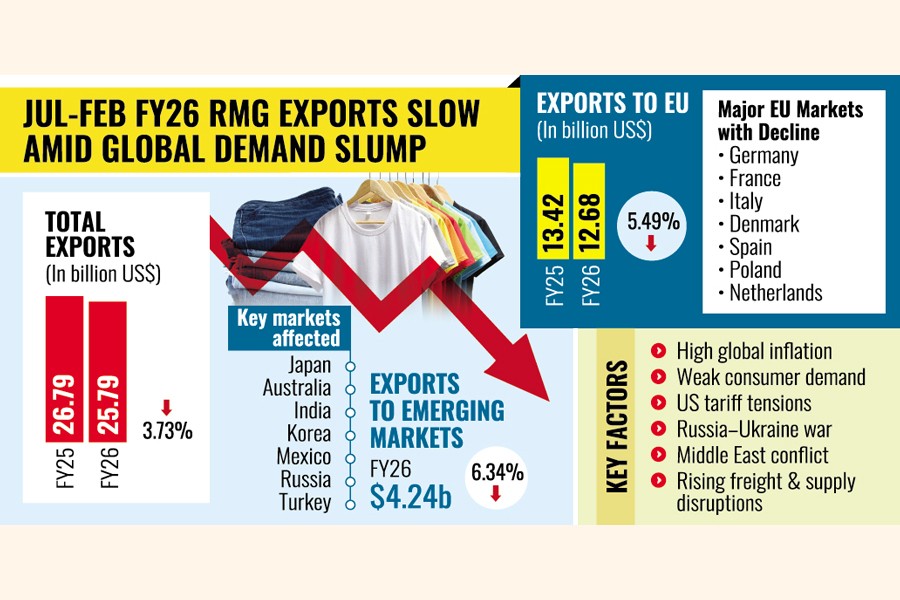
The downturn shown in 15 nations also resulted in a 5.49-percent negative growth in export to the 27-nation bloc of EU.
Bangladesh received US$12.68 billion in garment export to the EU during the July-February period of 2025-26 in a fall from US$13.42 billion in the corresponding period of the fiscal (2024-24", EPB data showed.
Out of the $12.68-billion earnings, knitwear accounted for US$ 7.54 billion, down from US$ 8.10 billion in a 6.86-percent decline.
Similarly, earnings from woven items during the period also marked 3.42-percent fall to US$5.13 billion, down from US$5.31 billion.
Readymade garment shipments to non-traditional markets also marked a 6.34-percent fall during the bygone eight months of fiscal 2025-26, reflecting persistent global demand weakness and economic uncertainty across key economies, data analysis showed.
Official counts show that exports to new destinations - including Japan, Australia, India, Korea, Mexico, Russia and Turkey, decreased by 5.38 per cent to 24.38 per cent year on year.
Earnings from non-traditional markets during the period stood at US$4.24 billion, which was US$ 4.52 billion.
Industry insiders attribute the marginal rise to weak consumer demand in advanced and emerging markets alike, driven by high living costs, sluggish global growth, ongoing geopolitical tensions and the raging US-Israel war on Iran.
Asked about the trade situation, Mohammad Hatem, president of Bangladesh Knitwear Manufacturers and Exporters Association (BKMEA), said the performance reflected a broader slowdown on the global apparel market and the impact is same for almost all manufacturing countries like that on Bangladesh.
"Uncertainty and disruptions, including the impact of new US tariff regimes, have dampened demand," he told The Financial Express, adding that the Iran war is further deteriorating the market scenario.
With an elected political government now in office, he expects a stable local environment. He foretells that negative growth might continue until June.
Talking to the FE writer, Inamul Haq Khan, vice president of Bangladesh Garment Manufacturers and Exporters Association (BGMEA), said the rising cost of living due to high inflation forced consumers to prioritise essential needs over clothing purchases.
"And following the slow demand, buyers are also purchasing less."
The Russia-Ukraine war, US tariffs, trade tensions have eaten up demand while Iran war's impact is severe, he said, adding that negative growth might continue for next six months.
He notes that India and Bangladesh are affected much while Vietnam and Cambodia are doing better despite all the challenges.
He, however, says the local currency is depreciating against the US dollar which is not 'bad'.
He expects that currency devaluation would further sustain after Eid.
Despite the overall weakness, two traditional destinations--Canada and the UK--showed some growth of 3.08 per cent and 1.22 per cent respectively during the period.
Exports to Canada and the UK stood at US$871.58 million and US$2.96 billion respectively, according to the EPB data.
Meanwhile, exports to the United States, Bangladesh's single-largest apparel market, increased by less than 1.0 per cent to US$5.02 billion during the period under review, up from US$ 5.06 billion in the same period a year ago.
Overall, Bangladesh's total RMG exports fell 3.73 per cent year on year to US$25.79 billion in the first eight months of FY2025-26, compared with US$26.79 billion during the same period of the last fiscal year.
munni_fe@yahoo.com