


Bangladesh's ready-made garment (RMG) exports to its largest destination, the United States, declined both in value and volume year on year in November 2025 as higher tariffs dampened demand and forced changes in work-order patterns.


Although overall apparel export growth during the January-November 2025 period still maintained double-digit expansion, shipments in November fell for the second consecutive month.
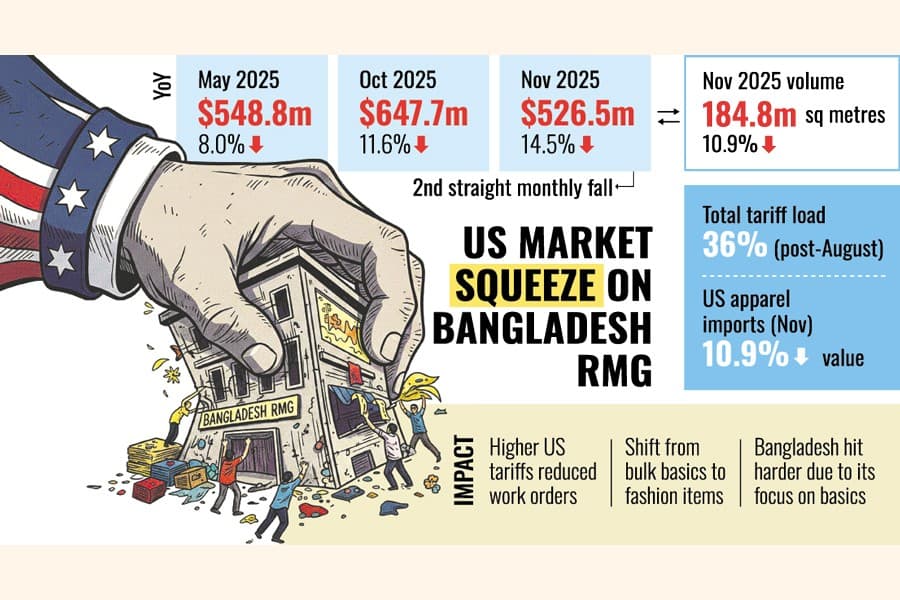
Exports declined by 14.51 per cent to US$526.51 million, down from $616.27 million in November 2024, according to the latest data from the Office of Textiles and Apparel (Otexa), published on January 28.
Bangladesh shipped 184.79 million square metres of garments in November 2025, down 10.91 per cent from 207.20 million square metres in the same month of 2024.
In October 2025, garment exports to the US declined by nearly 11 per cent to $647.73 million from $732.71 million a year earlier.
Earlier, in May 2025, exports fell to $548.84 million from $596.67 million in May 2024, according to data.
Overall US apparel imports in November declined by 10.87 per cent in value and 14.36 per cent in volume year-on-year, the data showed.
Meanwhile, US garment imports from Bangladesh slowed to 12.44 per cent growth, reaching $7.60 billion during the January-November 2025 period, compared with a 1.42 per cent negative growth in overall US apparel imports.
The US imported garments worth $71.90 billion during January-November 2025, down from $72.93 billion in the same period of 2024.
US garment imports from China declined by about 34 per cent to $10.06 billion from $15.24 billion during the first eleven months of 2024.
Vietnam retained its top position, registering 11.38 per cent growth to earn $15.34 billion during the January-November 2025 period.
India recorded over 6.06 per cent growth, earning $4.63 billion, while Cambodia posted the highest growth of 26.15 per cent.
Indonesia saw 9.80 per cent growth, earning $4.39 billion and $4.30 billion respectively, according to the data.
Exporters said all garment-producing countries, including Bangladesh, are facing the impact of the Trump administration's reciprocal tariff measures, as higher tariffs have reduced demand among US consumers.
Under the new US tariff regime effective from August, Bangladeshi apparel products are subject to an additional 20 per cent duty, taking the total tariff to 36 per cent.
Exporters noted that tariff rates are even higher for China and India, resulting in a sharper decline in exports from those countries.
Inamul Haq Khan, vice-president of the Bangladesh Garment Manufacturers and Exporters Association (BGMEA), said US consumption has fallen due to high inflation, which has pushed up prices.
Shovon Islam, managing director of Sparrow Group, said US buyers placed 10 to 20 per cent fewer work orders due to high tariffs, which have also eroded consumer demand. Besides, buyers are changing their order patterns, he said, adding that around 70 per cent, or Tk 20 billion, of his company's exports go to the US.
Earlier, buyers used to place bulk orders for products of the same design. Now they make small changes in design, style or wash to make products more fashionable and raise prices to adjust for tariff costs, he explained.
"Tariffs have forced buyers to shift from general to fashion items," he said, adding that Bangladesh, which mainly produces basic items, has been hit hard.
However, Mr Islam expressed hope that buyers would start placing higher-volume orders after the election, noting that many remained in a "wait-and-watch" mode between July and September to assess the tariff impact.
He also said some orders from China and India, particularly for fashionable items, could shift to Bangladesh.
What exporters need now is a stable political government and banking support to boost exports, he added.
Syed Arefin, managing director of American & Efird (Bangladesh), said buyers made advance shipments by July 2025 to avoid higher tariffs, which might be another reason for the recent decline in export earnings, both in value and volume.
He said both value and volume need to be considered to better understand the impact of tariffs. With the Christmas sales season ending, buyers' inventories are now close to depletion, and those who reduced purchasing earlier are expected to start placing new orders, he added.
Former Bangladesh Knitwear Manufacturers and Exporters Association (BKMEA) president Fazlul Hoque said a fall in quantity indicates that Bangladesh is not receiving the expected level of orders, as the overall market has experienced a downturn. Some orders may also have shifted to other countries such as Vietnam and India.
Due to high tariffs in India and China, both countries are aggressively exploring the EU market at lower prices, where Bangladesh has traditionally been strong, said ABM Shamsuddin, chairman of Hannan Group.
Bangladesh is facing stiff competition in the EU, and the situation could worsen after India signs a free trade agreement with the EU, he said.
India will then enjoy duty-free access, while Bangladesh will face up to 12 per cent duty after its LDC graduation and the end of the transition period in 2029, he added.
munni_fe@yahoo.com