

Published :
Updated :
 For all latest news, follow The Financial Express Google News channel.
An independent market study has found strong commercial demand for London-based Sonali Bangladesh UK (SBUK) to transition into a fully licensed UK bank, highlighting widespread support from the Bangladeshi diaspora in the UK as well as from Bangladeshi financial institutions engaged in international trade.
SBUK, a part-owned subsidiary of Sonali Bank PLC- Bangladesh’s largest state-owned commercial bank – commissioned the study as part of its application for a UK banking license. The study set out to assess whether there was genuine market appetite for SBUK’s proposed retail, business and correspondent banking services in both the UK and Bangladesh.
The findings indicate strong and measurable demand for SBUK’s services across multiple customer segments, including individual consumers, small and medium-sized businesses, existing SonaliPay customers and Bangladeshi banks involved in cross-border trade.
According to the report obtained by the Financial Express, there is “strong support across all audiences” for SBUK’s entry into the UK market as a locally licensed bank.
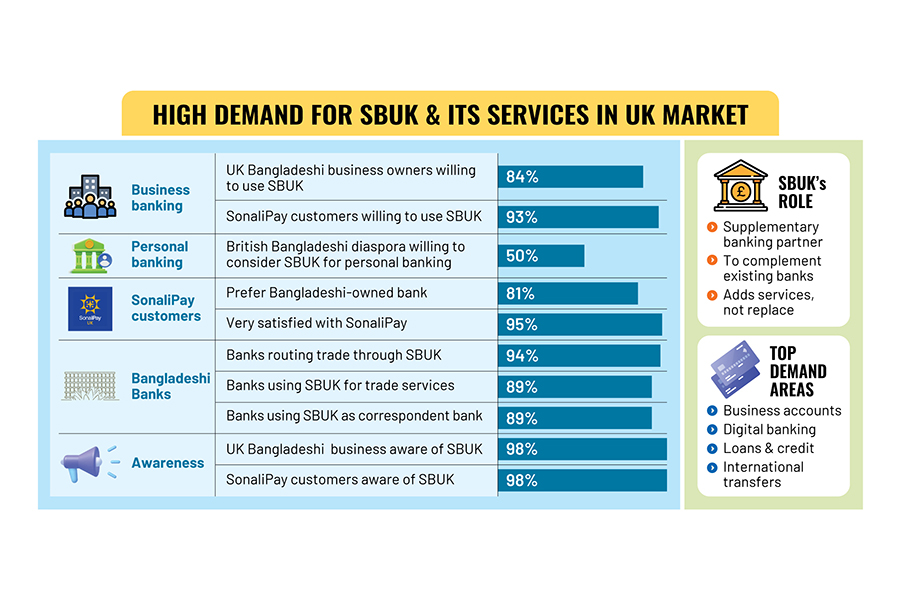
Interest was particularly pronounced among existing SonaliPay customers, the digital remittance and payment platform of SBUK’s sister concern, Sonali Pay UK Limited. Around 91 per cent of SonaliPay users surveyed expressed support for the firm’s expansion into full banking operations, and a further 94 per cent said they would use SBUK’s retail banking services. Awareness of SBUK was also found to be notably high within the UK’s Bangladeshi business community, whereby 93 per cent of SonaliPay’s business customers indicated they would use its business banking products if made available.
The survey further showed that 98 per cent of Bangladeshi-owned UK businesses, and a similar proportion of SonaliPay customers, described themselves as either “somewhat” or “very” familiar with SBUK’s services—pointing to a strong existing brand presence despite the firm’s current limited license status.
For many in the Bangladeshi community, banking is not only about convenience or pricing, but also about trust, familiarity and a sense of connection to their origins. Banks that reflect shared language, culture and lived experience often inspire a deeper level of confidence than purely transactional providers. As such, loyalty to Bangladeshi-owned banking solutions was significantly stronger among SonaliPay users. The study found that 81 per cent of SonaliPay customers prefer a Bangladeshi-owned bank for both personal and business banking. Key reasons for such preference included the ability to send money internationally with ease, trust and reputation within the Bangladeshi community, and access to culturally familiar banking experiences tailored to diaspora needs.
The study also examined institutional demand by surveying Bangladeshi banks involved in international trade and cross-border financial transactions. Of the 47 Bangladeshi banks surveyed—out of a total of 57 operating in the country—95 per cent said they route trade transactions through the UK, underlining the UK’s central role in Bangladesh’s international trade flows.
About 89 per cent reported that they already use SBUK for some form of trade-related activity. However, the report noted that much of this trade is currently channelled through non-Bangladeshi correspondent banks in the UK and Europe, further demonstrating the need for a Bangladeshi Bank operating in the UK.
While 89 per cent of surveyed banks said they use SBUK for limited correspondent services—such as letters of credit, treasury payments or cash transactions—many highlighted structural constraints. Nearly two-thirds of banks surveyed (64 per cent) said the absence of a fully licensed, Bangladeshi-owned correspondent bank in the UK—a key business ally of Bangladesh—acts as a limitation on international trade flows and the current system causes leakages of funds to foreign international banks. The study concluded that SBUK’s transition into a UK-licensed bank would clearly address this gap and meet unmet demand from both retail and institutional customers. It also noted that SBUK already benefits from high brand awareness, strong satisfaction levels among SonaliPay users and significant institutional backing from Bangladeshi banks engaged in trade finance.
The study was designed, hosted and analysed by Market Measures Limited, an independent research agency based in Hampshire. Fieldwork was conducted during April and May 2025 using a combination of qualitative and quantitative methods.
In total, the study surveyed 154 potential retail customers, 65 potential business customers, 644 SonaliPay customers and 47 Bangladeshi banks. Data collection was carried out through a mix of online surveys, telephone interviews and in-person interviews to ensure representativeness and robustness.
SBUK said the independent assessment was intended to provide evidence to UK regulators, shareholders and the Bangladeshi government regarding the commercial viability of its proposed banking operations, as it seeks approval for a full UK banking license.
The findings come at a time when cross-border financial links between the UK and Bangladesh continue to deepen, driven by trade, migration and digital payments. For many within the UK-based Bangladeshi diaspora, banking is closely tied to family, community and long-standing cross-border ties that extend far beyond simple transactions. The study’s findings reflect a desire for financial institutions that not only meet technical needs, but also understand lived realities shaped by international ties, trade and connection to home. In that context, SBUK’s proposed transition speaks to a broader aspiration for inclusion, trust and representation within the UK’s financial landscape.
jasimharoon@yahoo.com