

 For all latest news, follow The Financial Express Google News channel.
Local entrepreneurs have alleged that the four new guidelines formulated under the Telecommunications Ordinance favour foreign investors and telecom operators, sidelining domestic businesses.
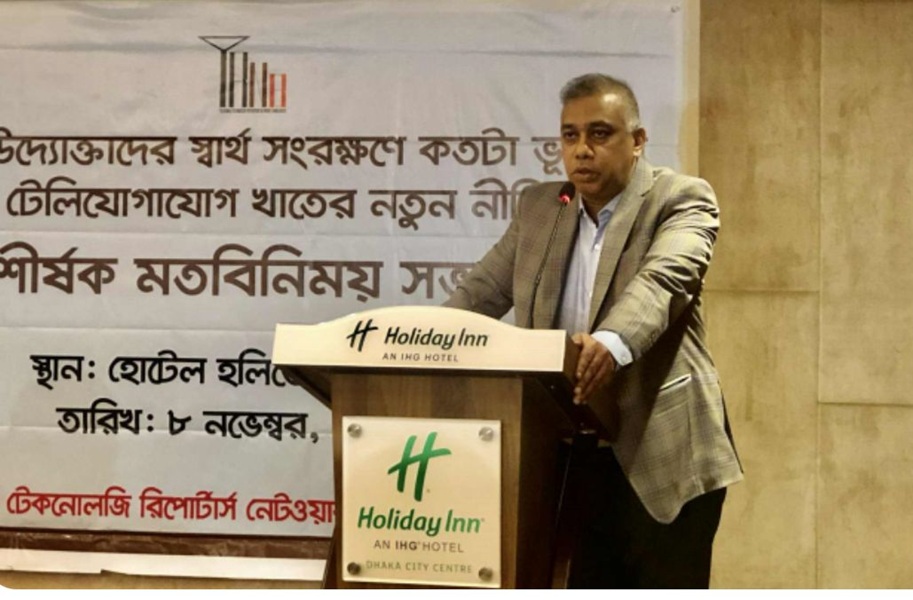
They made the allegations at a meeting organised by the Telecom and Technology Reporters Network Bangladesh (TRNB) at a hotel in the capital on Saturday, reports UNB.
Speakers at the meeting claimed that the guidelines provide cross-cutting licensing benefits primarily to foreign entities.
Senior journalist and political analyst Masud Kamal said foreign interests were being prioritised over local investment. “Foreigners are being protected, while domestic entrepreneurs are being ignored. There is no expectation from the interim government,” he said.
Aminul Hakim, president of the Internet Service Providers Association of Bangladesh (ISPAB), said they would take legal action if necessary to secure the rights of local investors.
He added that the government’s restriction on private submarine cable connections was holding back internet affordability. “If private submarine cables were allowed, we could offer customers double the current internet packages at the same price,” he said.
Entrepreneurs urged the government to address the issue immediately. Masud Kamal noted, “The problems raised at the meeting can only be solved by an elected government.”
Speakers questioned why the interim government chose to reform the telecommunications sector urgently instead of prioritising vital sectors such as education and health.
While welcoming the government’s reform initiative, local entrepreneurs expressed concern about several provisions in the guidelines. They highlighted that the licence fee for foreign companies like Starlink has been set at Tk 1.2 million, whereas local ISP firms must pay Tk 2.5 million — a discrepancy they claim favours foreign players.
Sumon Ahmed Sabir, Deputy Managing Director of Fiber@Home, said reforms were needed after the July changes in governance, but the new policy appears to have been drafted to benefit foreign companies. “The government must address these concerns,” he added.
Technology policy analyst Abu Najam Muhammad Tanvir Hossain criticised the government’s statement that the internet would “never be shut down” under the new policy, calling it a “public relations stunt.” He said, “If the internet is ever shut down, accountability must be ensured in the policy itself. The reform should not have been rushed.”
ISPAB General Secretary Nazmul Karim Bhuiyan said, “We believe the internet should remain unified — not divided into mobile, satellite, or other segments. Unequal competition will only grow.” However, he praised the Special Assistant to the Chief Adviser for indicating in a Facebook post that revisions to the draft policy were being considered.
M. Nurul Alam of ICX said the policy should prioritise domestic entrepreneurship, GDP growth, and employment. “Our concerns were ignored during the reform process. We are facing discrimination. While the government talks about open competition, small local firms cannot survive against large foreign investments,” he warned.
Summit Communications CTO K.M. Tarikuzzaman added that the new policy mainly protects mobile operators. “The barriers that were previously removed are now being reinstated — taking us back to the pre-2008 era,” he said.
Former TRNB President Rashed Mehedi presented a keynote speech titled “How much role will the new policy of the telecommunications sector play in protecting the interests of domestic entrepreneurs.”
TRNB General Secretary Masuduzzaman Robin delivered the welcome speech.