


Prime Minister's Finance Adviser Rashed Al Mahmud Titumir on Sunday pledged to dismantle what he described as the “poisonous” oligarchic grip over Bangladesh’s energy sector, alleging that the country had been deliberately pushed into an import-dependent system that undermined long-term energy security and drained public resources.
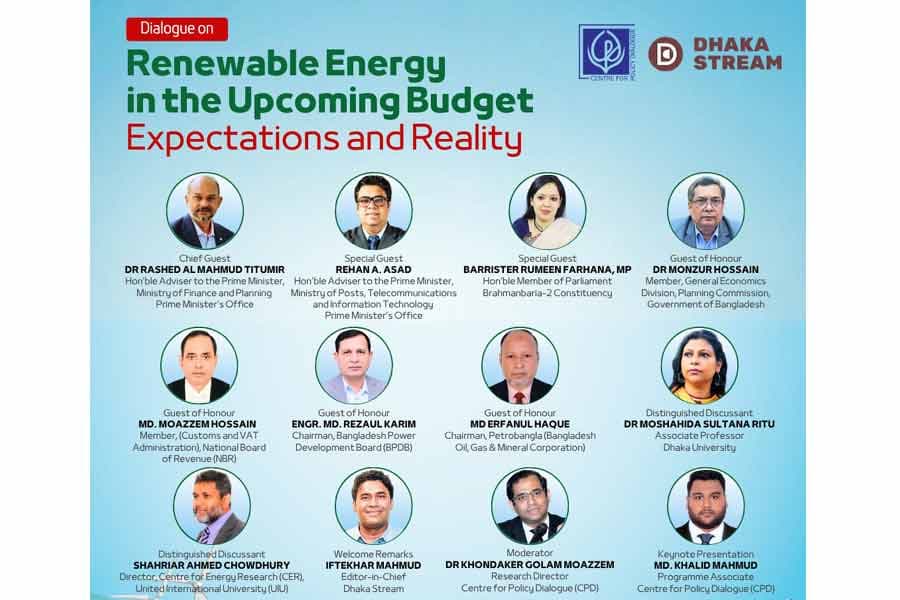
Speaking at a dialogue titled “Renewable Energy in the Upcoming Budget: Expectations and Reality,” organised by Centre for Policy Dialogue and Dhaka Stream in the capital, the adviser delivered a sharp criticism of the previous administration’s energy policies, accusing it of creating a structurally flawed system favouring a small group of powerful interests.
He said the country’s energy framework had evolved into an “oligarchic system” that was “completely dependent on imports”, preventing Bangladesh from achieving genuine energy autonomy.
“A few agencies, companies or individuals have tied up the Bangladesh energy sector,” he said, describing the entrenched structure as a “poisonous circle” and “structural poisoning” that had become a major obstacle to reform.
According to the adviser, the previous government had provided an “illegal legal cover” to contracts and agreements that bypassed standard regulations, leading to extensive misuse of public funds through capacity payments and other mechanisms.
He alleged that the existing model celebrated import dependency in the name of energy security while, in reality, leaving the country vulnerable to global market volatility.
Referring to recent geopolitical tensions in the Middle East, he said Bangladesh had been forced to bear heavy subsidy burdens and additional financial pressures due to fluctuations in global fuel prices, which subsequently contributed to inflationary pressures on the domestic economy.
“We want to ensure energy security through domestic means, by increasing renewable electricity and diversifying the portfolio,” he said.
The finance adviser outlined a five-point strategy aimed at transforming the country’s energy sector and reducing its dependence on imported fuel.
The first priority, he said, would be to significantly increase the share of renewable energy in the national energy mix.
Secondly, the government plans to formulate a strategic pricing policy that balances the interests of industrial investors with the purchasing capacity of ordinary consumers.
Thirdly, he stressed the importance of promoting local manufacturing of renewable energy equipment and related components in order to reduce import dependency and strengthen domestic industrial capacity.
The fourth milestone involves accelerating onshore and offshore gas exploration while strengthening the institutional and technical capacity of state-owned exploration agency Bangladesh Petroleum Exploration and Production Company Limited, widely known as BAPEX.
Finally, he said the government intends to establish clear energy reserve benchmarks, similar to strategic reserves maintained for food grains and fertiliser, to guarantee a minimum level of national energy security.
The adviser also announced that the upcoming national budget would include revenue benefits and fiscal incentives for companies investing in the manufacturing and production of renewable energy technologies.
He said the government was seeking to move away from excessive reliance on imports by building domestic capacity in renewable energy and strengthening local resource exploration.
Calling for wider public participation, he urged civil society organisations, researchers and citizens to support efforts to overcome the structural barriers created by vested interest groups within the energy sector.
He expressed hope that the new budget, which will come into effect from July 1, would reflect a strategic shift towards a more transparent, sustainable and self-reliant energy framework for Bangladesh.