

Published :
Updated :
 For all latest news, follow The Financial Express Google News channel.
Travel agencies are currently witnessing a major downturn in business as the ongoing Middle East (ME) war has severely disrupted international air travel, especially flights between Bangladesh and the Gulf destinations.
The crisis has affected airline operations, pilgrimage travel, migrant movement, and tourism bookings - sectors that form the backbone of travel agency income.
"It has become extremely difficult to manage our office expenses as business has dropped sharply amid the ongoing Middle East war," Abdul Salam Aref, a former president of the Association of Travel Agents of Bangladesh (ATAB), told The Financial Express.
Migrants bound for the UAE, Qatar, Kuwait, Bahrain, and Oman were cancelling or rescheduling their tickets unpredictably due to the ongoing situation, pushing travel agencies to a deep business downturn, he added.
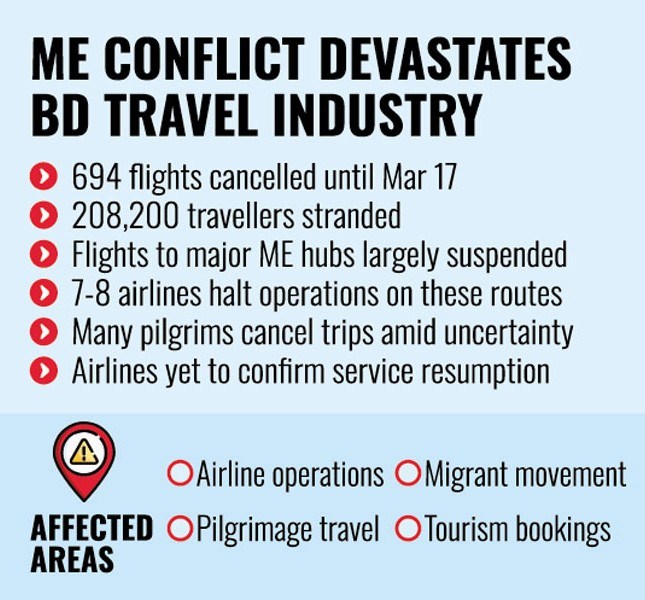
Flights to the major Middle Eastern hubs, such as Dubai, Abu Dhabi, Sharjah, Doha, and Kuwait, have been largely suspended, with around seven to eight airlines halting their operations on these routes.
As a result, a large number of passengers have been unable to travel, particularly migrants who were scheduled to return to their jobs abroad.
According to the Civil Aviation Authority of Bangladesh (CAAB), a total of 694 flights were cancelled on these routes until March 17.
With an average of around 300 passengers per flight, roughly 208,200 travellers are currently stranded in Bangladesh, creating a significant economic challenge.
These flight cancellations have had a direct impact on the travel agency business in Bangladesh as industry operators say around 70 per cent of their ticketing business involves Middle Eastern destinations.
Currently, only a limited number of flights to Saudi Arabia, particularly Jeddah and Medina, remain operational, allowing some Umrah pilgrims to travel.
However, due to the prevailing uncertainty and fear surrounding the conflict, many pilgrims who made bookings have cancelled their trips, significantly reducing passenger numbers.
Farid Ahmed Mazumder, secretary general of the Hajj Agencies Association of Bangladesh (HAAB), said the crisis had also affected Bangladeshi pilgrims who travelled to Makkah and Medina for Umrah before the conflict began.
"Many of the pilgrims travelled by airlines such as Qatar Airways, Emirates, Flydubai, and Air Arabia, which have now suspended operations. As a result, these passengers are struggling to return home through their original airlines," he added.
Meanwhile, the travel agencies say they are facing intense pressure from passengers seeking updates about their flights.
However, agencies themselves remain in the dark as airlines have not been able to provide clear schedules for resuming operations.
"We are in regular contact with our passengers, and they call us several times a day asking for updates. Unfortunately, we cannot give them any accurate information because the airlines themselves are uncertain about when flights will resume," said Aref.
The uncertainty has also complicated ticket management.
Many passengers purchased return tickets three or four months in advance, but numerous flights have since been cancelled.
Passengers now face the challenge of rescheduling their travel, and there are concerns that airlines may charge higher fares for new dates, adding further financial pressure.
Industry insiders warn that once the conflict situation improves and flights resume fully, there could be a sudden surge in passenger demand.
This may lead to ticket shortages, sharp fare increases, and possible syndication in ticket sales, particularly toward the end of March.
To mitigate such risks, travel sector stakeholders are calling for government intervention.
They suggest ensuring transparency in air ticket distribution and pricing, closely monitoring airlines and ticketing systems to prevent artificial shortages.
Industry representatives have also proposed increasing flight availability and, if necessary, declaring an open-sky policy so that airlines from neighbouring countries can operate flights to Bangladesh and help clear the backlog of passengers.
bikashju@gmail.com