

Women's participation shrinking across key sectors amid structural barriers
Garments, migration and politics see declining female representation
Published :
Updated :
 For all latest news, follow The Financial Express Google News channel.
For decades, women have been central to Bangladesh's economic and social transformation, from powering the garment industry to seeking jobs abroad and entering politics.
Yet recent data suggest that women's presence across several of these key sectors has been steadily shrinking.
Experts say a combination of workplace pressures, technological change, family responsibilities and social barriers is quietly pushing many women out of the workforce and limiting their participation in public life, raising fresh concerns about gender equality and inclusive growth.
The number of female workers in the readymade garment industry, the largest foreign currency earner, has been falling.
Sector insiders and different studies attribute this mainly to childcare responsibilities, pregnancy and discrimination related to pregnancy, age considerations, difficulty in balancing work and household duties, and rising household incomes.
Besides, long working hours, low salaries, limited education, negative health effects, work stress from high production targets, challenging working conditions and little opportunity to rejoin the workforce are also among the factors forcing female workers to leave the sector, they noted.
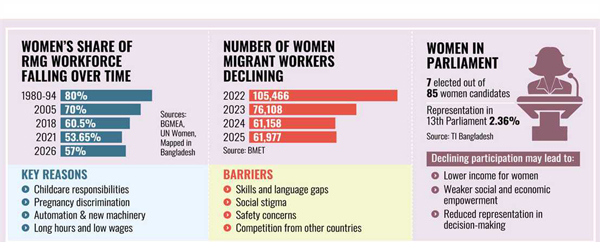
In 2026, according to Mapped in Bangladesh (MiB), a digital mapping platform of export-oriented garment factories, the proportion of women workers stands at 57 per cent, down from the earlier widely believed level of around 80 per cent.
The Bangladesh Garment Manufacturers and Exporters Association (BGMEA) reported that from 1980 to 1994 the proportion of women in the labour force was about 80 per cent. However, in 1995 it fell to 76 per cent and further declined to 70 per cent in 2005.
According to separate reports by UN Women, the proportion of women garment workers was 63.4 per cent in 2010 and 60.5 per cent in 2018.
A study by the Centre for Policy Dialogue (CPD) found that the proportion dropped to 58.4 per cent and 53.2 per cent in 2012 and 2016 respectively.
In 2017, however, South Asian Network on Economic Modelling (SANEM) reported that the proportion rose to 61.17 per cent.
Later, the Ethical Trading Initiative (ETI), GIZ and BRAC University conducted a joint study published in early 2023, which found that the share stood at 53.65 per cent in 2021.
Mohammad Hatem, president of the Bangladesh Knitwear Manufacturers and Exporters Association (BKMEA), said the industry has undergone extensive technological upgrades, including the installation of new and automated machinery, which has also negatively affected women's participation.
During the Covid-19 lockdown in 2020, many workers were forced to leave the city and a significant number did not return. Many female workers went back to their villages after saving some money, he noted.
Talking to the FE, Nazma Akhter, president of the Sammilito Garments Sramik Federation, said childcare responsibilities remain one of the main reasons female workers leave their jobs.
Female workers who have no option but to continue working often send their two- or three-month-old children to villages because childcare facilities in the sector are scarce, she noted.
She also said the influx of automation and technological upgrades has contributed to the decline, as female workers often do not receive the necessary training from manufacturers or the government, while male workers are preferred due to prevailing social norms.
According to the ETI report, about 89 per cent of those who left the sector said their departure was voluntary, as their contracts had not been terminated by factory management.
Around 77 per cent of the reasons cited by former workers were linked to family conditions, including childcare (26.67 per cent), pregnancy (17.89 per cent) and age considerations (11.93 per cent).
On the other hand, 19.29 per cent of the reasons were related to working conditions such as heavy workloads, long working hours and low wages, the report said.
The report also identified several implications of this decline, including reduced income, weakened social networks and diminished agency and voice for women workers.
Export earnings from the sector stood at US$39.34 billion in fiscal year 2024-25, compared with US$19.08 billion in 2011-12, and the industry has set a target of earning US$100 billion by 2030.
Overseas migration
Female migration from Bangladesh has also witnessed a significant decline in recent years, mainly due to lack of skills, language barriers, social stigma and concerns about dignity and safety.
According to the Bureau of Manpower Employment and Training (BMET), a total of 1,128,641 people migrated to 142 countries in 2025, of whom 61,977 were women.
In 2024 the number of female migrants was 61,158, compared with 76,108 in 2023 and 105,466 in 2022.
Sector insiders said female migration from Bangladesh has declined as workers struggle to compete with those from the Philippines, Sri Lanka, India, African countries and Nepal.
Recruiting agencies also point to high migration costs, while rights activists cite increasing allegations of rights violations.
When asked, Marina Sultana, programme director of the Refugee and Migratory Movements Research Unit (RMMRU), said most female migrants are sent to the Middle East, mainly to Saudi Arabia, for housekeeping and domestic work, while others go to countries such as Jordan for garment jobs and to Lebanon and Mauritius.
She attributed the declining trend to social stigma, political factors and the lack of required skills.
Women's representation in politics also remains limited. The 13th Parliament has begun its journey with women making up only 6.0 per cent of the cabinet, while just 2.36 per cent of elected parliamentarians are women.
A total of 85 women contested the election, but only seven were elected from their constituencies.
munni_fe@yahoo.com