


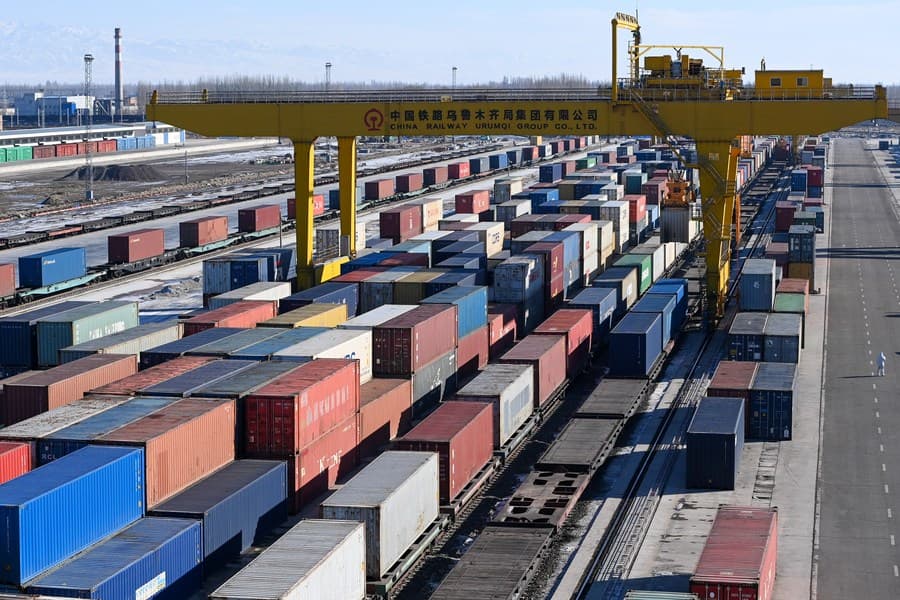
Xinjiang, the western province of China, has turned into a communications and logistics hub to facilitate China's trade with Europe and Asia.


To do so, the Chinese government has poured billions of dollars into huge logistical infrastructure in Urumqi, the main city of the province.
The province, which has the highest number of Muslim population in China, has borders with eight countries, including Russia, Mongolia, Kazakhstan, Tajikistan, Pakistan, India, Kyrgyzstan and Afghanistan.
Urumqi is at the centre of the ancient Silk Road and now it becomes the hub of the Belt and Road initiative, which also has a link to Bangladesh, Yunan and Myanmar.
The state-of-the-art land port in Urumqi was built with an eye to achieving high-quality development in the new era.
The authorities here have been optimising the business environment to promote the 'one port and five centres' in the core area of the Silk Road Economic Belt.
According to officials, focusing on promoting the construction of 'one port and five centres', Urumqi is strengthening overall planning and is attracting domestic and foreign resources.
In realising the 'opening up' vision, the authorities gather and promote the overall improvement of the core area by building the Urumqi International Land Port Area, Airport Economic Zone, and International Textile and Garment Trade Centre.
The authorities make good use of policies to accelerate the construction of an international comprehensive transportation hub, a land-port-type national logistics hub, and a national cross-border e-commerce comprehensive pilot zone, according to officials.
The Urumqi International Land Port Area is a landmark project in the construction of the core area of the Silk Road Economic Belt.
Due to these 'five major platforms', including the China-Europe Express (Urumqi) assembly centre and express centre projects, Urumqi is becoming the multimodal transport collection area and grain and oil trading centre.
Officials said the Land Port Group would organise multimodal transport, bulk commodity supply chain, park (station) development and operation, comprehensive financial services, data information services and such.
The main business is to build an ecosystem integrating "logistics, trade, industry, finance and data".
The Inland Port Group will further improve the supporting facilities in the international inland port area and fully promote the construction of functional infrastructure, basic facilities for the assembly centre of China-Europe Railway Express, and information transformation and upgrading projects.
There are nine investment projects, and the annual investment is about 390 million yuan.
According to reports, a number of major landmark projects in the core area, such as the Urumqi Airport Reconstruction and Expansion Project, the International Textile Center Textile Fiber and Yarn Industrial Park, and Jingdong Asia are on way to completion.
Since its inception in 2015, more than 6,500 China-Europe (Central Asia) freight trains departed from the Urumqi International Land Port Area in Xinjiang Uygur Autonomous Region until June.
The Urumqi International Land Port Area has launched 21 rail routes accessing 19 countries and regions in Europe and Asia, with over 200 categories of goods carried by trains.
In 2022, more than 19,000 freight trucks passed through the port, double that of 2021, along with more than 1,165 China-Europe railway express trains, an increase of 16.5 per cent year on year.
Officials further said that with a planned area of 67 square kilometres containing the Urumqi China-Europe Railway Express Hub and a comprehensive bonded zone, the port area stands as a landmark project in the construction of the core area of the economic belt.