


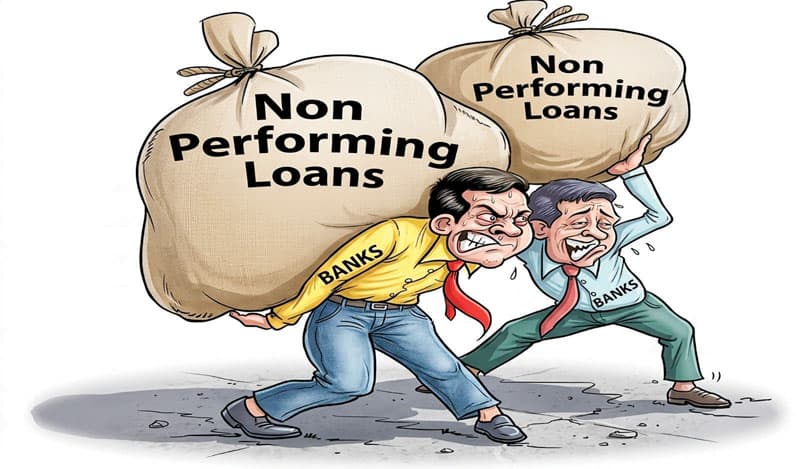
It is always a big challenge to get information of the actual amount of non-performing loans [NPLs] of commercial banks in Bangladesh. In most of the cases, the published data does not reflect the true scenario of bad assets. By definition, NPLs include three types of classified loans viz. Substandard (SS), Doubtful (DF) and Bad & Loss (BL). But under the central bank guidelines and special policy support from time to time, a huge amount of bad loans are being regularised by way of Rescheduling, Restructuring and applying qualitative judgment (QJ). Moreover, a good number of borrowers used to keep their loans regular by obtaining stay orders from the honourable court. Again some bad loans have been washed out as they have been written off and separated from the balance sheet. A significant part of these regularised loans has little chances of recovery. If we add up all these stressed and non-performing assets, we may find the actual NPL figures far above what is being reported. Unfortunately, no credible research work is found in our country that portrays a clear and complete picture of NPLs of the banking industry.


So, against the crisis of data sufficiency and data integrity, we can just apply some rational and prudent assumptions that the actual rate of non-performing assets in the banking sector must not be below 50 per cent of total loans. Actually, whatever might be the figure, it is beyond argument that at present NPls are the biggest problem in the banking sector that has already created a huge amount of microeconomic imbalances leaving the entire financial sector vulnerable and unstable.
There are many causes behind the mountain-like bad loans. But the fundamental reasons are the absence of Corporate Governance, weak loan assessment and approval system, lapses in loan documentations, lack of monitoring, inconsistent policy and regulations, weak and ineffective laws and judiciary, political influence and economic sluggishness in the last couple of years.
There are several legal and non-legal measures of recovering NPLs. But, for various reasons, the usual recovery techniques applied by the banks are not working well and the average rate of recovery is below expectations. This article will mainly focus on an alternative approach (non-traditional method) through which banks can manage this crisis more effectively and escape the debacles.
Establishment of a "Bad Bank" is a classic strategy to clean up a country's financial system. A Bad Bank is an Asset Management Company (AMC) that buys all bad assets from the banks at some discounts. This may be a state-owned or private sector company that is dedicatedly engaged in recovery of bad loans by adopting various traditional and modern techniques. It cannot be ignored that now-a-days commercial banks have to engage in multi-functional activities. Bankers have to deal with the core banking activities like business development, dealing with deposits and loans, rendering customer services, assisting foreign trade and foreign exchange functions. Likewise, they are engaged in rendering many ancillary services, like foreign and local remittance, fund transfer, clearing of cheques, collection of utility bills. Many government services are delivered through the banking channel. So, it becomes quite burdensome for the banks to concentrate fully on recovering a huge amount of bad loans.
Establishment of the Bad Bank can be a solution to this. Banks can clear their bad assets and reconstruct the balance sheet with fresh booking of good assets. On the contrary, the Bad Bank will be equipped with expert recovery officers and use all tools in recovering the loans. They will be empowered and authorised to initiate all legal measures where applicable.
In the early 1990s, Sweden faced a massive real estate bubble collapse. The government took an extraordinary strategy to curve down bad assets by establishing bad banks in public ownership and managed to recover a significant portion of the value. The ultimate cost to the Swedish taxpayer was almost zero once the banks were later reprivatised. Bad Banking measure was also successful in South Korea in the era of Asian financial crisis during 1997-98 when their NPL ratio soared. The government used an existing agency to spearhead the cleanup. The AMC named KAMKO purchased NPLs at a steep discount using a dedicated fund. They used advanced techniques like Asset-Backed Securities (ABS) to sell those debts to national and international investors. KAMCO became a global model for NPL resolution, successfully disposing of nearly all acquired assets and helping the Korean economy rebound rapidly. We also see a successful record of Malaysia who took a triple-action approach that is still studied for its efficiency. The AMC named 'Danaharta' worked alongside two other agencies who had special legal powers to override certain foreclosure delays, allowing it to resolve 100 per cent of its acquired loans by 2005 with a recovery rate of over 58 per cent.
But unlike the successful examples in Sweden, South Korea or Malaysia, Bangladesh may face some major hurdles. A large portion of Bangladesh's NPLs is concentrated among a small number of very powerful borrowers who are basically wilful defaulters. A Bad Bank only works, if it has the political independence to face these individuals. If the AMC is influenced by the same people who defaulted, it simply becomes a "parking lot" for bad debt rather than a recovery tool. Secondly, the current Artha Rin Adalat -2003 (Money Loan Court) system is backed up with thousands of cases. Without a Special Law (similar to Malaysia's Danaharta Act) that allows the Bad Bank to bypass traditional court delays, the assets will just sit in the AMC for decades without being recovered.
So, the Bad Bank must be managed by independent professionals, not political appointees. At the same time new laws and regulations need to be passed that allow the fast-track seizure of assets from wilful defaulters.
Finally, to get rid of the long-persisting default loan culture, Bangladesh can strongly think of establishing Bad Banks and take necessary initiatives for legal and infrastructural reforms to make it functional and successful.
The writer is a banker & columnist.
kzamanabbl@gmail.com