

Published :
Updated :
 For all latest news, follow The Financial Express Google News channel.
Bangladesh's economy is now very big. After 55 years, the size of the country's economy has increased a lot. Our population has also increased. In 1971, the population was only 75 million, now it stands at more than 180 million. As the economy has grown, so has corruption and various disasters. On the other hand, various natural disasters have also increased. The fear of a terrible earthquake is the foremost of them.
After long 18 years, people had the right to cast their own votes on February 12, 2026. A new government has now taken over. However, new challenges await this new-look government. The World Economic Forum's (WEF) recent global risk assessment identified crime and illicit economic activities and geo-economic conflicts as the first and second biggest risks respectively to Bangladesh's economy this year.
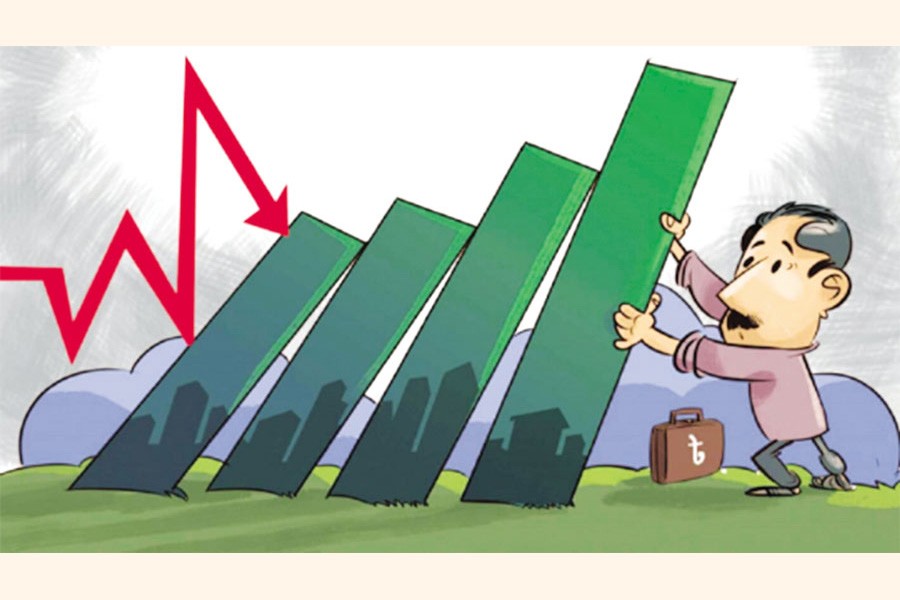
According to the National Empowerment Fund (NEF), the third risk to the country's economy is inflation. Due to inflation, the cost of living of people has increased but real income has decreased. The cost of producing industrial goods has gone up.
Production costs have increased excessively. Banks in the country also have increased interest rates in tandem with the like policy rate. But this does not seem to have much impact on the price of goods in the market. The overall inflation rate last month rose above 9.0 per cent.
This slows the country's economic growth. After the fall of the dictatorship August 05, 2024, the economy suffered a major setback. There is practically no investment in the country. On the other hand, the government is faced with huge foreign debt. Bad debts, rising interest rates, worker dissatisfaction, new credit shortage, and shortage of skilled workers have brought the country's economic activities to a near standstill.
The interest rate on loans is excessive. The previous governments took foreign loans for various domestic and foreign projects, and repayment of those loans along with interest has emerged as a big challenge today. The new government will have to deal with this additional debt pressure efficiently, otherwise the country's development and people's aspiration will be in disarray.
Corruption is a major problem in this country. To do this, tangible reform must be there at all levels. On the other hand, strict enforcement of law against corruption, bribery and irregularities must be ensured. The new government must accept this challenge. For this, the implementing agencies must be made very neutral and effective. They must be given the opportunity to work independently. Only then will it be easy to face this challenge.
The police force in the country needs to be reorganised. New police personnel need to be appointed. In the case of appointment, qualified, honest, skilled and patriotic youths should be recruited into the police force quickly after verification.
International market restrictions, tariffs and investment restrictions have affected the country's exports and investments. This is weakening the country's economy and will bring new challenges for the new government. All these problems must be identified and steps must be taken in advance.
Every year, more than 1.0 million educated youths in the country are entering the job market. Currently, millions of young men and women are unemployed. It can be said that there has been no domestic or foreign investment for the past 2 years. Banks are empty of money. They have lost the ability to invest and the country's money has been taken abroad by the autocratic government. Therefore, the challenge for the new government is to create employment for skilled youths. Due to the shortage of gas and electricity, investors have lost their enthusiasm for investment. Many industries are sick today due to the lack of gas and electricity. Many industrial establishments are closing down due to the lack of cooperation from banks. To face this ongoing challenge, the government has to come up with prudent policies.
Controlling and managing bureaucrats is a big challenge for the government. Saifur Rahman, was the finance minister of Khaleda Zia-led government, introduced the VAT system. They are not new with us today. But they have prepared the foundation for the country's economy. The government has taken over at a time when many reforms need to be implemented. A vested interest group has destroyed the banking sector. The new government must be very careful so that the blood suckers do not get the opportunity to destroy the country's economy again. The banking and financial sectors must be kept away from politics. Politics and the economy must run in sync. However, they must extend their hands of cooperation without hindering each other's pace.
On 5 August 2024, the autocratic Prime Minister Sheikh Hasina fled to Delhi, India in the face of student-led uprising. On 8 August 2024, the interim government led by Dr. Muhammad Yunus took over the responsibility of running the country.
The statecraft must be steered in the right direction as aspired by the July martyrs. Implementing the reform initiative is the main and foremost challenge of the new government.
The writer is Founder Chairman of Eastern University and Islamic Finance and Investment Ltd., and Former Vice President of FBCCI. aghaider@youthgroupbd.com ,