

Published :
Updated :
 For all latest news, follow The Financial Express Google News channel.
Political hegemony often imposes language and cultural hegemonies. The dismantling of colonial power following the World War II may have withdrawn the political stranglehold across the continents but the influence of the two others refuses to go. This subcontinent and the French colonies in Africa bear testimony to this fact. While the countries there have become independent politically, they are yet to successfully defend their linguistic and cultural freedom. Rather in many cases, these nations imitate their once masters in dress, etiquette and language. Particularly the educated class has a propensity to speak the foreign language in order to prove their superiority to the rest of the native people. The rich and privileged section of society mostly shuns the native education and opts for the languages of the colonial power.
Thus in the capital city, English medium schools have endorsed O Level and A Level curricula for a select breed of students. Their primary goal is to study abroad on completion of the two levels. The learners here can mostly speak English fluently and naturally are considered a better crop in terms of this particular ability. Even those who hold higher positions in government service can hardly speak Bangla without interpolating English words in a sentence. This is to show their superiority from others. In short, people wonder in awe how easily half sentences or admixtures of words convey the sense better. Use of such sentences has become a trend.
When this bankruptcy of mentality is the rule, the very exercise of enriching the mother tongue stumbles abruptly. In this context, the infiltration of English words in the conversation of uneducated ordinary people may be quite intriguing. Languages that can incorporate foreign languages quite easily have nothing to lose but everything to gain. People no longer bother about how words like 'glass' 'chair' have been inducted in Bangla. But when 'dish washer' or 'floor cleaner' have no easily understood Bangla alternatives, a nation allows itself to fall into a linguistic hegemonic trap.
One of the reasons for this is the advertising freedom companies often take these days. Half Bangla half English sentences, albeit used to make fun, so randomly used have every chance of influencing unsuspecting children. Even little educated adults can err in considering this a norm. Language is a strong tool for conveying feelings and emotion but the way it is being abused to encourage a culture of undermining does not bode well for the nation. These small aberrations lead to larger and more serious issues of the capacity of the mother tongue in scientific and technological research.
Today people dismiss the idea of conducting serious research works in mother tongue. This claim can be made only because in this age of convenience, no one likes to take pains to update linguistic development. Bangla is a rich language and it could be richer still if serious research and experiments were carried in this language. When tertiary education suffers because of limited Bangla books, it is only natural that PhD or doctoral dissertations are mostly pursued in English.
Here the process of incorporation of materials or ideas of common use does not happen as it does in case of 'glass', 'class', 'chair' etc;. Any language follows an evolutionary process but its speakers have to pen down their fundamental great ideas and thoughts in their own language. When there is a dearth of appropriate words, there is a need for creation of some new words for the purpose. Rabindranath did it quite effectively. For example, when bougainvillea was turned into 'baganbilas', it retained all the quality of the word and still conveyed the proper sound and meaning.
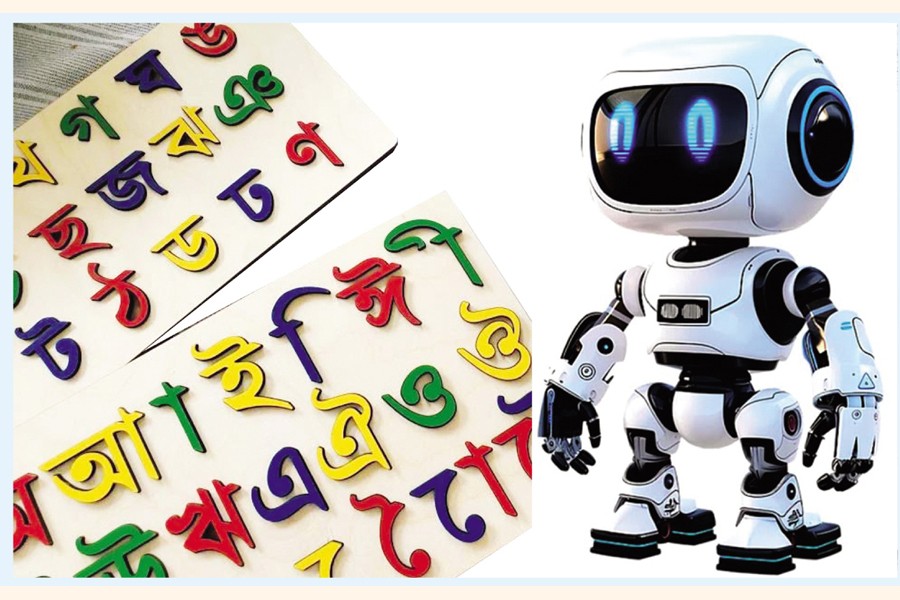
Now that technology rules the roost driven by the AI (artificial intelligence), Bangla is facing serious challenges. How can the language cope with the contents of social sites and this exceptionally powerful tool for automation? When the majority of the population struggle to adapt with the fast-paced technological leaps, the AI-driven digital devices will ask for better and improved understanding of the systems. If the mother tongue is not updated to accommodate conceptually such technological advancements, it will fall behind.
The techno-savvy young people now engaged in different areas of digital compatibility are little interested in making the mother tongue compatible with the digital journey. So, the challenge is far graver than it looks from a cursory glance. Bangladesh should prepare a team of linguists, scientists and technologists to carry forward the task of expanding the range and scope of Bangla aimed at making it digitally compatible.