

Published :
Updated :
 For all latest news, follow The Financial Express Google News channel.
GENERAL EXPERIENCE OF DRIVING IN FOG
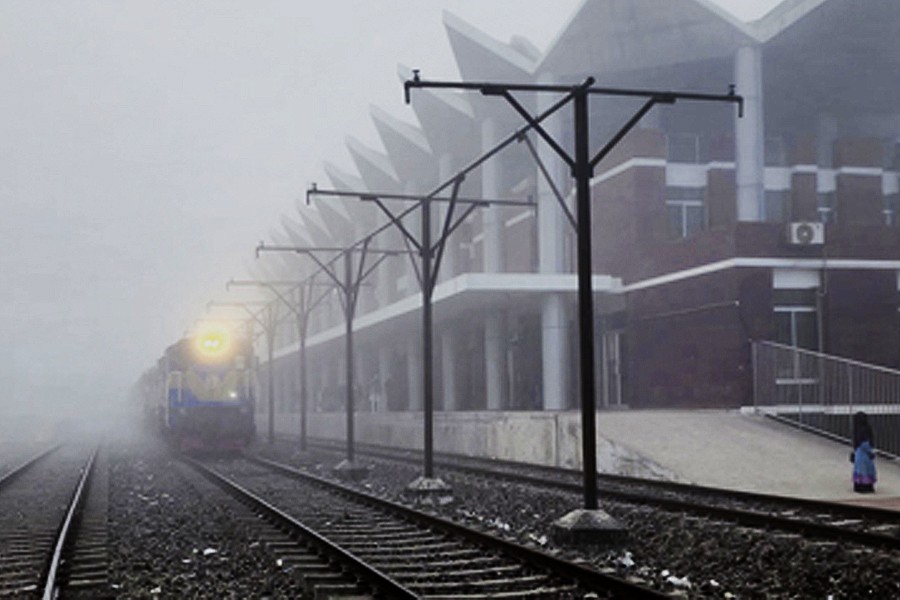
From the cab, we do not see the tracks ahead. It just looks like a white wall, and we drive through that. Navigating fog is like driving blindfolded. We sound the whistle frequently, at least four times in a minute. Depending on fog density, we drive at reduced speed. We also slow down before approaching a station. Sometimes we cannot even see the mileposts or signals. So we rely a lot on trackside landmarks, such as trees, buildings, markets, and other structures, to guess where we are. The station master places two fog signals on the tracks at least 100 yards before the station's outer signal. These are small detonators that create a bang when the train runs over them, alerting us.

Rashedul Islam
Position: Locomaster (Grade 2)
Locomotive shed: Lalmonirhat
When thick fog combines with a cold wave, dark patches sometimes appear in addition to the usual white wall that we see ahead. It feels like darkness is descending. That is scarier.
To navigate the routes, I do not depend on a single trackside landmark. A landmark I see today may not be there a week or a month later. I keep multiple landmarks in memory so that if one of them is gone or I miss it somehow, I will still recognise the place.
The fog problem worsens in old locomotives because most of their wipers do not work properly. The windscreen fogs up and sometimes looks like it has been smeared with mud. During halts, I sometimes get out of the cab and clean the window from outside with rags, but that also becomes difficult depending on the situation.
One winter night, I was driving the Lalmoni Express from Dhaka to Lalmonirhat. On the way to the Jamuna Bridge after Tangail, the train was running parallel to the highway. There was scattered fog, and the headlight did not help much.
I suddenly noticed a shadow on the tracks, and it grew larger as the train got closer. By the time I realised it was a truck and hit the brakes, a collision occurred on the side where assistant locomotive master Mizanur Rahman was. I later learned that the truck’s front part had fallen onto one side of the tracks after a crash on the adjacent highway.

Saiful Azam
Position: Locomaster (Grade 1)
Locomotive shed: Parbatipur
Driving in fog can be frightening. Thinking about the safety of so many passengers escalates the tension. Every trip in winter is like fighting a battle, and I remain worried about whether I can win.
Even though fog often envelops the signals, I still have to obey them and ensure a safe journey. I usually maintain the normal speed and throttle down around two kilometres before a station. If I am always moving at a low speed, there will be significant delays.
Apart from trackside landmarks, I also rely on sounds. This comes with experience. Having driven the same routes year after year, a locomotive master can guess where he is by listening to the sound of the moving train.
The Natore-Parbatipur section has semaphore signals. Seeing them in fog is difficult. There have been times when I was within inches of the signal or right under it, but still could not see it due to heavy fog.
Many preventable accidents occur in fog, and I watched one while working as an assistant locomotive master on the Barendra Express long ago. The train ran over a girl near the Rajshahi University station when she was talking on the phone and walking on the tracks. She could neither see the train nor hear the hydraulic horn. The next day, we came to know she was a student of applied physics at the university.

Shahabul Islam
Position: Locomaster (Grade 2)
Locomotive shed: Parbatipur
Let us say I am driving on a 10-minute section. For seven to eight minutes, I drive at the normal speed and then slow down. I have to exercise maximum caution so as not to overshoot any signal.
The railway does not officially impose any speed limit for winter. Plus, the density of fog is not the same everywhere. For instance, the fog is usually thicker in beel areas.
So how slow I will go depends on my degree of comfort and judgment. If necessary, I will drive at walking speed, so to speak. I communicate with the control office for instructions if the situation turns too hazardous.
The new locomotives have better heating systems. Their wipers are also better. This helps keep the windscreen somewhat clean, but that is not enough during dense fog.
One winter day, I was driving on the Santahar-Akkelpur section. Before the Akkelpur station, there is the Halhalia Bridge on the Tulsiganga River. Anticipating the bridge ahead, I decelerated.
But when the bridge did not appear even after the estimated time, I was worried. Soon I realised I had already crossed the bridge but could not see it because the fog was too dense.