

Published :
Updated :
 For all latest news, follow The Financial Express Google News channel.
As I sit in my office, the familiar hum of a university campus filtering through the door, I am struck by a quiet realization. This International Women's Day, as the world rallies behind the theme "Give to Gain," I find myself looking at my students through the dual lens of an educator and a daughter of this delta who has navigated almost sixty years of its changing seasons.
In my four decades in the academia, I have seen the "image" of the Bangladeshi woman transform. But as I look at the young women filling my lecture halls today, I cannot help but compare them to the women who raised me. I grew up in a Bangladesh where identity was not a battlefield of "either/or," but a beautiful, seamless braid.
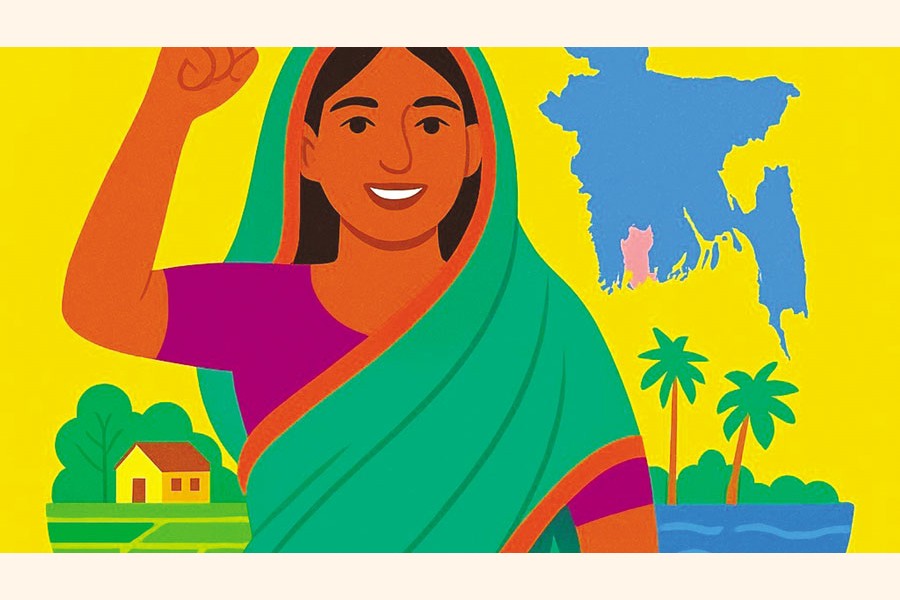
The Women of the Cotton Saree
My mother and my aunts were the moral anchors of our home. They were devout, practicing Muslims who never missed a Salat or a fast. Their faith was their internal compass, providing a quiet, steadfast discipline. Yet, they were also the fiercest guardians of our "Bengali-ness."
In their wardrobes, the saree was not merely a garment; it was a manifest of belonging. They wore the forehead tip (bindi) with an effortless grace, seeing it not as a religious transgression, but as a mark of thousand-year-old cultural heritage. They celebrated Pahela Baishakh with the same sincerity with which they approached the holy month of Ramadan. For them, there was no contradiction between being a "good Muslim" and a "proud Bengali." Their identity was rooted in the soil they walked upon and the language they spoke-a language we literally bled for.
Changing Profile of 2026
Today, that profile has undergone a tectonic shift. Walk through any university in Dhaka today, and the visual landscape is markedly different. The vibrant cotton sarees and the traditional kamiz are increasingly being replaced by the black abaya, the hijab, and the niqab.
While I am a firm believer in a woman's right to choose her attire, as a scholar of literature and culture, I recognize that clothing is never "just" clothing. It is a language. The shift we see in 2026 is a move toward an identity defined almost exclusively by religion, often at the direct expense of our cultural history.
Our very vocabulary is being "cleansed"-traditional greetings like Khoda Hafez have been replaced by Arabized alternatives, and the celebratory spirit of our folk festivals is often met with a new, somber suspicion.
I recall a recent moment in my department during a cultural programme. A brilliant student of mine, a young woman with a sharp command of Keats and Shelley, hesitated to join the traditional dance. "Ma'am," she whispered, "my family says this isn't who we are anymore. We are Muslims first."
It broke my heart to see her feel like a foreigner in her own culture. By forcing a choice between faith and heritage, we are creating a fractured generation.
Give to Gain: Reclaiming the Middle Ground
The theme "Give to Gain" is an invitation to invest in the future. In the context of the Bangladeshi woman, what must we "give" to "gain" a resilient society?
We must give women the space to be multifaceted. When we pigeonhole a woman's identity into a singular religious box, we lose the "syncretism" that was once the hallmark of our nation. If we give the younger generation permission to reclaim the saree, the tip, and the songs of our land without the fear of being labeled "un-Islamic," we gain a society that is grounded and authentic.
The practical consequences of this identity crisis are visible. When identity becomes narrowly defined by conservative interpretations, women's public spaces inevitably shrink. We see it in the digital vigilantism on social media, where a woman's "piety" is judged by her profile picture. We see it in the subtle pushback against women in the arts and sports.
After navigating nearly 60 years as a woman who has spent her life in the pursuit of knowledge, I know that Bangladesh's progress was written by women who stepped out of the cocoon. It was written by women in sarees who led NGOs, who taught in schools, and who worked in the garment factories. If we "give in" to the forces that wish to erase our cultural markers, we gain nothing but a loss of self.
The Pedagogy of Identity
In my role as Department Head, I strive to infuse into my students that critical thinking which will give them the ability to hold and respect multiple truths. You can be a woman of deep faith and a woman of the arts. You can be a global scholar and a daughter of the Shitalakshya river.
To "Give to Gain" in 2026 means giving back the legitimacy of our cultural symbols. We must stop viewing our heritage as an affront to our religion. We must return to a middle ground where my mother stood-where one could be a scholar, a devotee, and a lover of Rabindra Sangeet all at once.
A Legacy of Grace
I often look at the old, sepia-toned photographs of the women of my youth. Their faces were bright with the confidence of knowing exactly who they were. They did not need to borrow an identity from a distant land to feel secure in their devotion to God.
This Women's Day, let us commit to giving the next generation of Bangladeshi women their entire inheritance. Let us head towards a future where our daughters are not forced to choose between their faith and their grandmother's songs.
The saree may be six yards of cloth, but the identity it represents is the very fabric of our nation. As an educator and a citizen, I refuse to watch that fabric be unraveled. Let us give our women the freedom to be their whole selves-for in their strength, the entire nation gains its soul.
(The writer is the Chair of the Department of English at Canadian University of Bangladesh).