

Published :
Updated :
 For all latest news, follow The Financial Express Google News channel.
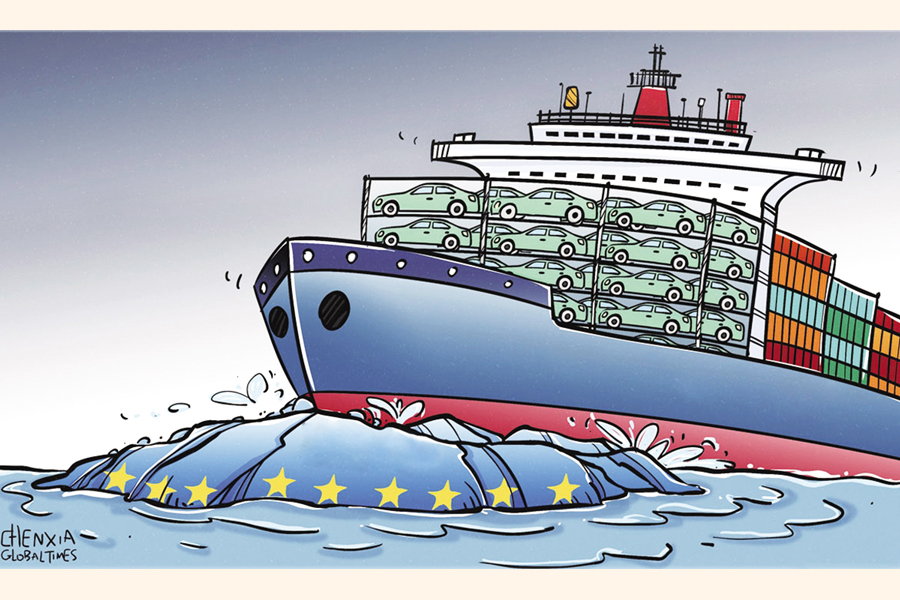
The global trading system is undergoing a profound transformation. What was once a relatively predictable, rules-based order -- governed by multilateral disciplines and anchored in the assumption of gradual liberalisation -- has given way to a far more volatile, transactional reality. Tariffs, once applied within known parameters, are increasingly deployed as political leverage, bargaining chips, or punitive tools. This weaponisation of tariffs marks a structural rupture in the international economic environment, and countries like Bangladesh -- deeply reliant on a narrow export portfolio and concentrated markets -- stand to lose the most if they fail to adapt.
The shift is neither cyclical nor temporary. Major economies have normalised the use of tariffs as instruments of geopolitical pressure, strategic competition, and domestic political signalling. The aftershocks of the tariff escalations initiated in the late 2010s continue to reverberate across supply chains. What many dismissed at the time as tactical disruptions have consolidated into durable policy frameworks. Even changes in political leadership have proved insufficient to reverse the broader protectionist logic now embedded in global trade governance.
Bangladesh must therefore prepare for a world in which tariff exposure is not a risk at the margins, but a central axis of economic vulnerability. Addressing this challenge demands not just defensive measures, but a structural repositioning of the economy and its institutions.
Bangladesh's export-led growth model has delivered impressive outcomes over several decades, but its foundations remain fragile. The country is highly dependent on a single sector -- ready-made garments -- which accounts for more than four-fifths of merchandise exports. Its market concentration in the EU and North America further magnifies vulnerability. In a world of tariff unpredictability, such concentration is a liability.
Moreover, Bangladesh's accession to lower-middle-income status and its impending graduation from LDC status mean that several preferential market access schemes will be curtailed. The combination of reduced preferences and rising tariff weaponisation creates a risk exposure that cannot be mitigated by incremental reforms alone.
Structural weaknesses exacerbate these vulnerabilities. High logistics costs, congested ports, and an energy system marked by unreliability and high import dependence erode competitiveness. Standards compliance remains inconsistent across industries, making exporters susceptible not only to tariff shifts but also to the growing arsenal of non-tariff barriers that major markets deploy.
Without a strategic intervention, Bangladesh may find itself navigating an external environment characterised by rising compliance costs, shifting tariff differentials, and sudden market disruptions -- while contending with domestic limitations that reduce its responsiveness.
Bangladesh urgently needs a coherent, forward-looking trade strategy that recognises the end of the old order. The new framework must rest on three core principles: diversification, resilience, and strategic alignment.
First, export diversification must become a national priority, not a recurrent policy slogan. Diversification is often discussed in sectoral terms, but in the era of tariff weaponisation, market diversification is equally critical. Expanding beyond traditional partners into Asia, Africa, and Latin America is no longer optional. Markets such as Japan, Korea, ASEAN economies, the Middle East, and parts of Africa offer opportunities for risk-spreading.
Sectoral diversification requires targeted industrial policies that identify specific value chains where Bangladesh can realistically compete. Electronics assembly, pharmaceuticals, medical devices, light engineering, agricultural processing, and IT-enabled services are viable candidates. But diversification will not occur spontaneously; it requires coordinated policy support, investment incentives, skills development, and infrastructure tailored to sectoral needs.
Second, Bangladesh must build systemic resilience against external shocks.
This means streamlining customs procedures, lowering logistics costs, investing in modern ports, and upgrading energy infrastructure to ensure reliability and cost predictability. The ability to pivot quickly in response to tariff changes will depend on removing bottlenecks and building institutions that can anticipate and respond to evolving trade risks.
A credible regulatory overhaul is essential. Standards and quality assurance systems must be strengthened to meet increasingly stringent global rules. Weak compliance capacity can expose Bangladeshi exporters to de facto barriers that function much like tariffs. Modernising testing labs, accreditation bodies, and regulatory agencies should be treated as strategic investments rather than administrative reform.
Third, strategic alignment with key economic partners is critical.
In a fragmented global landscape, bilateral and regional economic partnerships will play a central role. Bangladesh needs to negotiate trade agreements not simply to secure tariff concessions, but to integrate into supply chains strategically. Well-designed CEPA or FTA frameworks can provide stability, reduce uncertainty, and open pathways to technology transfer and market diversification.
Tariffs are only one part of the emerging landscape. Major economies now deploy a wide array of non-tariff instruments -- environmental standards, labour requirements, carbon border adjustments, digital trade rules -- that function as sophisticated tools of strategic influence. For Bangladesh, the implications are profound.
The coming enforcement of climate-linked trade mechanisms, such as the EU's Carbon Border Adjustment Mechanism (CBAM), will increase compliance costs for carbon-intensive exports. Labour-related conditionalities in major markets will introduce new layers of scrutiny. Sustainability reporting requirements will become more complex.
Meeting these standards will require industrial transformation rather than cosmetic adjustments. Energy efficiency, renewable energy adoption, waste reduction, circular economy practices, and traceability systems must be built into production processes. Exporters will need digital platforms to track environmental and social compliance across supply chains.
Bangladesh's regulatory institutions must evolve to provide guidance, enforce compliance, and support firms during the transition. Without such evolution, the country risks being squeezed out of high-value markets -- not by tariff hikes alone, but by regulatory exclusion.
Addressing tariff weaponisation requires more than technical reforms; it demands policy credibility. Uncertainty stemming from political instability or inconsistent economic policies undermines investor confidence and deters long-term planning. A modern trade strategy cannot function without predictable governance.
Bangladesh needs institutional mechanisms that insulate trade policy from short-term political cycles. A permanent trade policy council -- comprised of policymakers, economists, private-sector leaders, and regulatory bodies -- could help provide continuity, conduct risk assessments, and coordinate responses to global shifts.
Transparent policymaking, unified regulatory structures, and improved data systems are essential for building the credibility needed to attract investment into high-value sectors.
While tariff weaponisation poses considerable risks, it also presents an opportunity for Bangladesh to accelerate long-delayed reforms and reposition its economy. The country's favourable demographics, strategic location, and competitive labour force provide a strong foundation. But without structural transformation, these advantages will be insufficient.
By adopting a forward-looking strategy -- diversifying exports and markets, improving infrastructure and compliance, entering strategic trade partnerships, modernising institutions, and rebuilding policy credibility -- Bangladesh can shift from passive vulnerability to purposeful resilience.
The time to act is now. The global trading order that once sheltered Bangladesh is fading. A new, more volatile era has begun -- one in which preparedness, agility, and strategic vision will determine which economies thrive and which fall behind. Bangladesh must choose its path with clarity and urgency, for the cost of delay will only grow in a world where tariffs and regulations have become weapons of geopolitical competition.
mirmostafiz@yahoo.com