
Despite the popular perception that Bangladesh as an agro-based country has immense potential for exporting agro-processed foods, the reality is hardly encouraging. The country has yet to make any significant headway in harnessing its advantages in this promising field. While agriculture continues to form the backbone of the economy, the leap from raw agricultural production to high-value agro-processing has remained stunted, with export earnings falling way short of expectations.
Industry insiders point to several obstacles holding back the sector. These are a lack of logistic support, insufficient research and development, high cost of investment and limited product diversification. These challenges are neither unique nor insurmountable; countries around the world have faced similar hurdles in developing agro-processing. What makes Bangladesh's case more worrying is that the underlying issue appears to be weak macroeconomic planning and policy support.
Experts are of the opinion that agro-processing with its deep linkages to millions of farmers' livelihoods holds more promise than most other sectors for simultaneously catering to domestic demand and expanding export earnings. Yet, despite being declared a thrust sector in the Industrial Policy, it has not received the focused policy attention, financial incentives or the strategic direction needed to transform it into a driver of export-led growth.
Declaring agro-processing a thrust sector has so far failed to bring about any meaningful shift. The numbers speak for themselves: export earnings from agro-processed products currently stand at just over US$300 million-a modest figure when compared to the sector's potential and the size of the country's agricultural base. The growth in export receipts is too meagre to suggest any structural expansion.
At present, Bangladeshi companies export processed food items to more than 140 countries, including major destinations such as the United States, Canada, the United Kingdom, Saudi Arabia, the UAE, China, Japan, and Australia. The product range includes spices, fruit juices, biscuits, pickles, potato chips and flakes, nuts, and fruit-based drinks. However, a closer look reveals that the primary consumers of these exports are Bangladeshi migrants living abroad. Their demand for familiar tastes keeps the trade afloat, but it also exposes a weakness: the industry has largely failed to diversify its consumer base or penetrate mainstream markets abroad.
The domestic market, however, tells a different story. With changing lifestyles, urbanisation and rising incomes, demand for ready-to-cook and ready-to-eat foods is expanding rapidly. More than 200 food processing firms currently operate in the country, with the industry estimated to be worth US$2.5 billion. Yet, only around a dozen of these companies are engaged in exporting, according to the Bangladesh Agro-Processors' Association (BAPA). This imbalance shows that the industry has grown primarily to satisfy domestic needs while struggling to establish itself globally.
There is little doubt that domestic growth lays the foundation for competitiveness abroad. Modern technology is being adopted by many firms, enhancing production capacity and quality. With the right push, these same companies could tap into the overseas markets more aggressively. Even within the diaspora consumer base, scope for expansion is large, while beyond them lies the vast market of other South Asian and sub-continental migrant communities who share similar culinary tastes. But this will not happen automatically; it requires deliberate efforts in market research, branding, and product adaptation.
One of the glaring gaps in the industry's current approach is its reliance on the domestic market model for exports. The same products designed for local consumers are sent abroad without sufficient adaptation to market-specific needs. In competitive overseas markets, this strategy cannot hold for long. To succeed, exporters must go the extra mile by conducting targeted market research, complying with country-specific regulatory and sanitary standards and innovating to match local tastes and preferences.
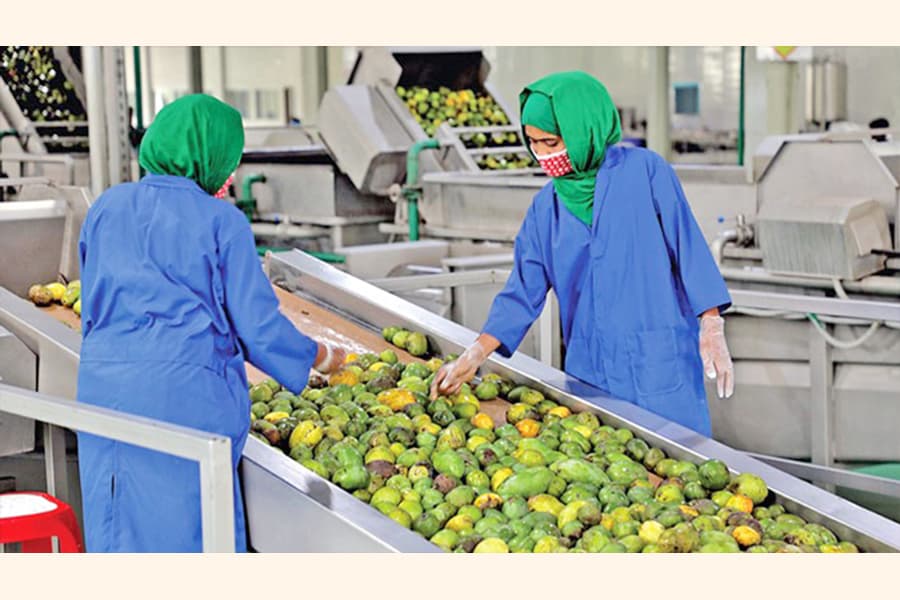
Product diversification is equally important. At present, Bangladesh's agro-processing industry has yet to fully capitalise on the abundance of seasonal fruits and vegetables. Pineapples, bananas, mangoes, and jackfruits, for example, are highly suitable for processing into juices, dried fruit, and other value-added products. Countries that have pursued this path with an emphasis on quality and compliance have achieved remarkable success.
The sector's capital constraint remains a critical bottleneck. Agro-processing is investment-intensive, requiring modern machinery, cold storage, quality testing labs, and packaging facilities. Many small and medium enterprises which dominate the industry cannot afford these investments. Facilitating the sector through targeted incentives, particularly soft credit and low-interest loans, could transform its trajectory. Similar strategies have worked in the apparel and pharmaceutical sectors, helping them become globally competitive.
Moreover, institutional support for research and development is almost absent. Without continuous innovation, both in product formulation and processing technology, the industry risks stagnation. Government, academia, and the private sector must work together to strengthen R&D infrastructure, focusing on food safety, packaging innovations, and shelf-life extension.
Export growth requires a long-term, coherent strategy-one that prioritises market diversification, branding, and quality assurance. Policy frameworks must not only provide financial incentives but also address infrastructure gaps, streamline regulatory procedures and create dedicated facilities for agro-processing clusters.
Bangladesh's agro-processing sector sits at a crossroads. On the one hand, it enjoys a strong agricultural foundation, growing domestic demand, and a ready consumer base among the diaspora. On the other hand, it suffers from fragmented efforts, policy neglect, and a lack of forward-looking strategy. Without corrective measures, the sector is likely to remain a largely domestic industry with limited export contributions.
wasiahmed.bd@gmail.com