


Over the past thirty years, Global Value Chains (GVCs) have played a critical role in international trade and growth. Many countries have tried to increase their participation in GVCs to stay competitive in production and trade. As a result, GVC-related trade has become a key focus of trade policy. GVC-related trade measures the value of exports that cross multiple borders, whereas traditional trade measures exports between just two countries. In 2023, GVC-related trade fell by 5.35 per cent, while traditional trade rose by 0.18 per cent. In 2024, both grew, by 3.87 per cent and 4.6 per cent respectively. Still, the share of GVC-related trade in total trade dropped from a high of 48 per cent in 2022 to 46.3 per cent in 2024.
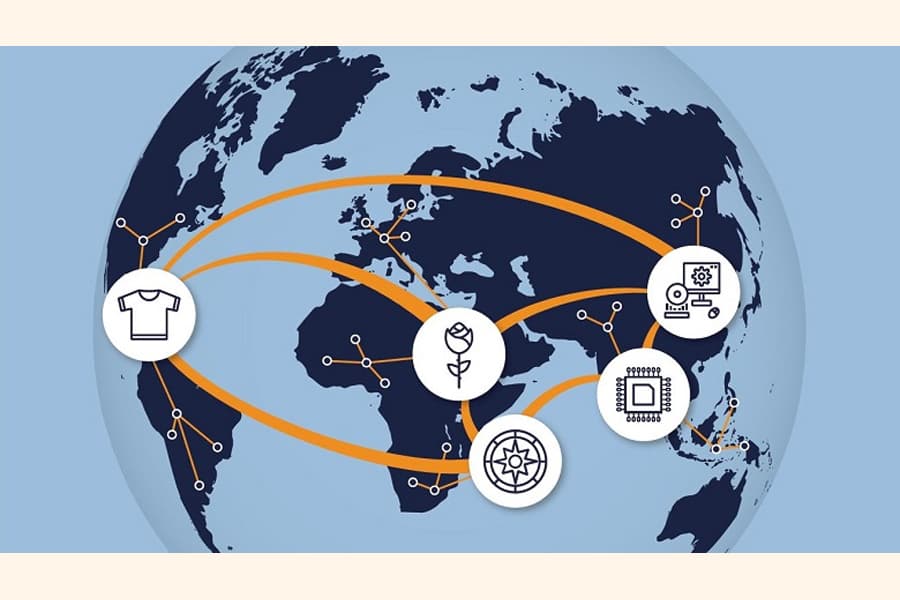
GVCs involve sharing production across countries, where different tasks and activities are done in different places. The United Nations Industrial Development Organization (UNIDO) explains that a global value chain covers all steps like design, production, marketing, distribution, and customer support, divided among many firms and workers in different countries. In the past, companies mostly made products in one country. Now, a finished product is often made and assembled in several countries, with each stage adding value (World Bank). This makes labels like 'Made in Bangladesh' or 'Made in Vietnam' less meaningful. For example, a T-shirt made in Bangladesh might use fabric from China, cotton from the United States (US), and buttons from India. Even though the T-shirt is shipped to the European Union (EU) as a finished product from Bangladesh, it includes value added in three other countries. This is an example of GVC trade.
However, Bangladesh still lags behind most countries in GVC-related trade, according to the Global Value Chain Development Report 2025. The report published last week jointly by the University of International Business and Economics, the Asian Development Bank (ADB), the Institute of Developing Economies-Japan External Trade Organization, the World Economic Forum (WEF), and the World Trade Organization (WTO). This fifth edition looks at how GVCs are changing due to new technology, the shift to greener practices, and changing global politics.
The report found that services now play a bigger role than goods in GVC participation. This shows that services, especially those delivered digitally like finance, telecommunications, and IT, have been more resilient after the pandemic. The shift highlights the growing importance of services in global trade and how they are less affected by physical supply chain problems.
The report lists 19 countries, including Bangladesh, as low-GVC traders. Other countries in this group are Bhutan, the Maldives, Nepal, Sri Lanka, Cyprus, Estonia, Latvia, Malta, Brunei Darussalam, Cambodia, and the Lao PDR. In 2010, these economies made up 0.69 per cent of global gross exports and 0.66 per cent of GVC-related exports. By 2024, these shares increased to 1.26 per cent and 1.24 per cent.
The report also showed that high- and upper-middle-income GVC traders mostly export value-added goods to other high-income GVC traders. In contrast, low GVC traders send their exports to a wider range of destinations, with their top ten markets spread across high, upper middle, and lower middle GVC traders.
A key finding is that while high-value chain trading economies still make up most of global GVC-related trade, their combined share fell from 76 per cent in 2010 to 63.6 per cent in 2024. This shows that more economies are gradually joining GVCs.
Between 1995 and 2022, as the report noted, production has become more focused in technologically advanced, regionally connected hubs. Many countries that joined GVCs later, including Bangladesh, remain on the edge of global production networks. During this time, Bangladesh's participation in both backward and forward GVCs grew by less than two per cent.
Two years ago, a joint report by the Asian Development Bank and the Islamic Development Bank Institute found that Bangladesh's GVC participation rates are lower than most other economies. From 2000 to 2021, Bangladesh's trade-based total GVC participation ranged from 22.6 per cent to 26.01 per cent, much lower than the world average of 40.6 per cent to 46.0 per cent. The report, titled Transforming Bangladesh's Participation in Trade and Global Value Chains, stated, "Bangladesh only fared better than Pakistan in trade-based total GVC participation rate and ranked last based on production-based GVC forward participation rate."
In Bangladesh, the textiles and clothing sector leads both export production and GVC participation, which limits export diversification. The sector also shows low levels of forward and backward linkages. This means the domestic economy captures little added value, and local sectors play a small role in supporting production. Such heavy focus on textiles brings risks to the economy.
The ADB-IsDBI report pointed out that moving out of Least Developed Country (LDC) status, higher wages, and changing global trends are key risks. The report added, "Thus, diversification into the other sectors to supplement RMG manufacturing will be important in the economy's thrust to promote export-led growth."
According to the WTO Global Value Chains Sectoral Profiles, the foreign value-added content in Bangladesh's textile and clothing sector stood at around 21 per cent on average in between 2017 and 2022. The 'value added' means the increase in value that is created at each stage of the production of a good or services. So, it is the difference between the cost of inputs (raw materials, labour) and the selling price of the product.
The net export earnings of the ready-made garments (RMG) also reflect the use of foreign content. Bangladesh Bank, in its latest Quarterly Review of RMG, showed that the import value of raw materials (raw cotton, synthetic/viscose fibre, synthetic/mixed yarn, cotton yarn & textile fabrics and accessories for garments) was US$ 3.83billion in July-September of FY26, accounting for 38.66 per cent of total RMG export earnings. So, net exports from the sector stood at US$ 6.09 billion in the period under review.
The ADB-IsDBI report suggested that Bangladesh could diversify its exports by joining more GVCs. This would let the country focus on specific tasks within value chains, without needing to invest heavily in building entire chains at home. With LDC graduation coming up in November, the country's post-graduation plans should take this advice seriously.
asjadulk@gmail.com