

Published :
Updated :
 For all latest news, follow The Financial Express Google News channel.
Dhaka, the capital city of Bangladesh, has been bearing the stigma of being one of the worst livable cities in the world. Dhaka's ranking, as determined by the Economist Intelligence Unit (EIU), goes one notch up or one notch down year after year. The city is unlikely to come out of the bottom rung of the table within the foreseeable future.
The reasons for the city carrying the unwanted stigma are quite many. The first and the foremost reason is that it is one of the most densely populated cities in the world. Its air quality is also one of the worst. The city does not have proper drainage and sewerage systems. A sizeable population of the city lives in slums. And its power and water supplies are erratic and not dependable.
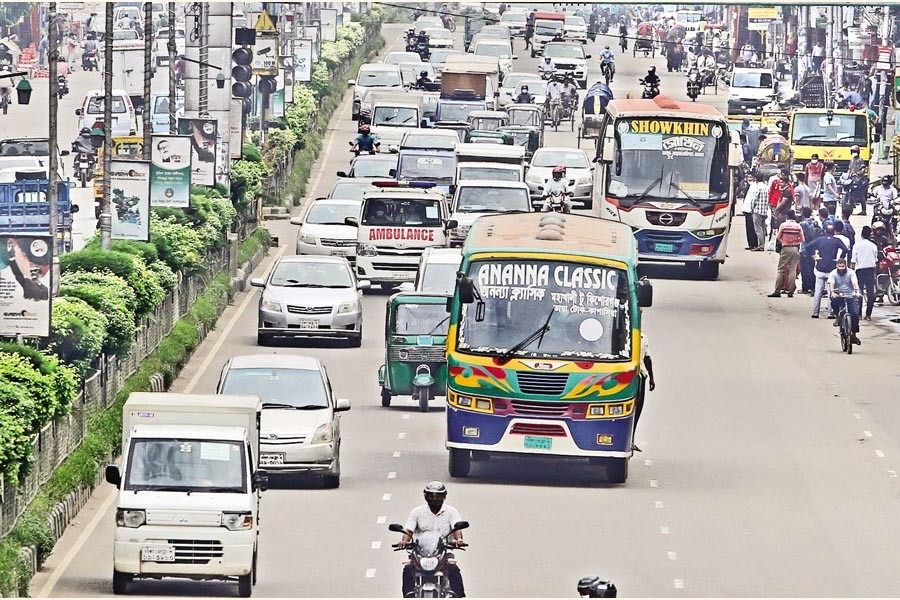
What troubles the city residents most is its transport system. Several agencies, including city corporations, Bangladesh Road Transport Authority and the traffic department of Dhaka Metropolitan Police (DMP), are there to take care of the system. But, in reality, it's nobody's baby. Almost every transport owner/driver enjoys freehand on the streets. The plying of vehicles without registration numbers or driving licences is also a common phenomenon. If one procures or assembles a three or four-wheeler and starts operating the same in the city streets without valid documents, all the relevant agencies unlikely to ask any question provided he or she meets one particular requirement -- greasing palms of some groups of people regularly.
Even the BRTA which is in a better position to detect unlicensed motor vehicles does not know the actual number of illegal motor vehicles plying the city streets. At times, the BRTA employs mobile courts to penalize undocumented motor vehicles or their drivers. Usually, such drives fizzle out after a couple of days with the net output being almost zero. Often, authorities issue diktats asking ramshackle and discoloured buses to withdraw from roads, but transport owners usually give a damn about those orders and continue their operations. The BRTA, however, overlooks such defiance. The reasons behind such deliberate violation of government directives are more political and financial than anything else. A section of transport owners toeing the ruling party line is always in control of things. The transport workers too are also found submissive to the will of these owners. The main reason for such submissiveness is the oversupply of transport workers, who fear losing jobs anytime.
When large motor vehicles show little respect for the transport act and rules, smaller ones are found to be no less defiant. Three wheelers, popularly known as CNGs, do not use fare meters and force commuters to pay more than the fares fixed by the authorities concerned. Both CNG drivers and passengers are unaware of the existence of any fair chart. The plying of small human hauliers (1.5-tonne pickups converted into passenger vehicles) is another addition to the chaotic city traffic. The reason/s behind allowing these vehicles by BRTA remains a mystery. The very look of these tiny transports would evoke surprise in many. A good number of human hauliers do not even have side mirrors.
The most dreadful addition to the city's transport system is the battery-run rickshaws. In keeping with the rise in the number of manually-driven rickshaws, the battery-run rickshaws are also swarming some areas of both city corporations. The slow-moving pedal rickshaws are environment-friendly, but they are very much prone to accidents. The battery-run rickshaws are relatively faster than pedal rickshaws, but they are very unsafe for plying the city roads.
The city corporations bother least about the proliferation of rickshaws, manually driven or otherwise. None is aware of the actual number of these three-wheelers. When Dhaka was under one city corporation, it issued licences to nearly 90,000 pedal rickshaws. Now the number of two types of rickshaws could be half a million or more. These rickshaws are thought to be one of the key reasons for the unabated migration of rural poor to Dhaka city. The city corporations frequently made public statements expressing their resolve to eliminate battery-run rickshaws. However, for reasons best known to them, they have not tried to eliminate those from the city streets. Some uniformed and ununiformed people having political connections are earning a hefty sum every month from the battery-run rickshaws.
One can well see the state of the city's traffic situation from the fact that the roads that are off-limits to rickshaws and human hauliers remain clogged with vehicles most of the time during weekdays. The situation on the roads where everything is allowed to operate is just indescribable.
Experts and relevant others have said and written volumes about the terrible traffic situation in Dhaka city, but the agencies concerned and the people manning them have remained unmoved. There is no sign that they ever will be. Some people are pinning hope on introducing metro rails, elevated expressways, Bus Rapid Transit etc. Pessimists are also there. The latter feel that any notable change in the scenario on the city streets is unlikely since the number of vehicles, motorized or otherwise would continue to grow and agencies would ever be interested to discipline those.