


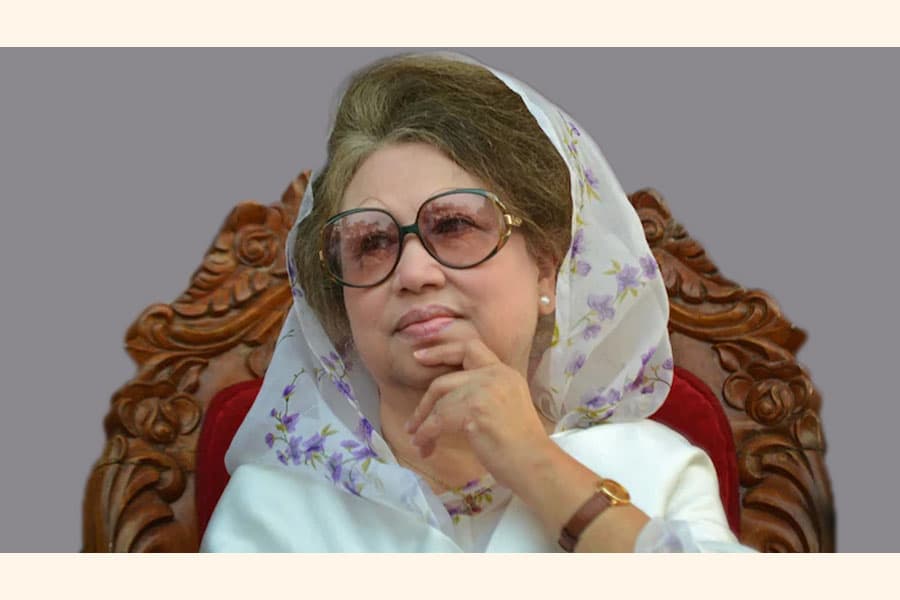
As an ending, it was the height of dignity. Hundreds of thousands of Bangladeshis from across the country gathered to pay their last respects, alongside foreign delegates, as she was laid to rest with full state honours beside her husband. This collective act of homage stood as a final testament to the deep and lasting regard she held in the public imagination. Yet just two years ago, such a moment of national reverence would have seemed almost unimaginable, especially given the relentless political persecution she had endured.
Before the interim government rose to power following a popular mass uprising, she was effectively a prisoner of the state. Despite serious health complications requiring advanced treatment abroad, she was denied permission to leave the country by the regime. The home where she had lived since 1981, legally acquired after her husband's assassination, was seized by force. This eviction was orchestrated as a public spectacle of humiliation. A teary-eyed Khaleda Zia later told reporters that security personnel assaulted her household staff, removed her from her bedroom and forced her into a car. She also witnessed her son Tarique Rahman being driven into exile in an ambulance after enduring severe physical torture. Her party's leaders and activists were imprisoned or trapped in case after case while much of the media remained silent or tightly constrained. Even her husband's burial site where she has now been laid to rest was not spared from controversy. At that stage, almost every instrument of the state appeared to have been deployed to erase her presence, her memory and her political legitimacy.
The fact that she was later honoured by the state and mourned across political divides highlights not only how circumstances had changed but how artificial that earlier erasure truly was. In her final years, Khaleda Zia witnessed a Bangladesh gradually returning to democratic norms after fifteen years of authoritarian rule. She lived to see a freer media environment in which journalists and commentators could evaluate her records openly and discuss about her virtues and failures alike. In death, she left a political culture that was, perhaps for the first time in years, at least permitted to attempt a more honest conversation.
For the Gen-Z generation that unleashed the mass uprising, Khaleda Zia was not a governing figure they experienced directly, as her years in office and her street leadership as opposition belonged to an earlier era. Older generations, however, remember her for the remarkable decency and graciousness she displayed throughout her political career. Even amidst intense provocation, she was never known to resort to vulgarity or undignified language against opponents. Tellingly, following the 2024 uprising that toppled the previous regime, she uttered no bitter recriminations or calls for retribution, demonstrating that true triumph lies in civility rather than vengeance. In a political culture where invective has long been mistaken for strength, her restraint was exceptional. It showed that political struggle need not be anchored in hatred and that dignity itself can be a form of resistance.
If civility defined her temperament, firmness defined her politics. Khaleda Zia was known above all for her uncompromising decision-making, earning the epithet "the uncompromising leader." In 1986, when some opposition leaders opted to participate in elections under military ruler HM Ershad, she refused to lend legitimacy to the authoritarian rule. She chose confrontation over accommodation, a decision whose wisdom became clearer with time. A similar resolve emerged during the military backed caretaker government of 2007. Arrested and imprisoned amid speculation that both major political leaders would be exiled, she refused to leave the country. According to widely circulated accounts, she declared that she had no address abroad and would rather die on her own soil than live in exile. That refusal is widely believed to have played a critical role in frustrating plans to implement "minus two formula" aimed at removing both female leaders from politics.
Like her late husband President Ziaur Rahman, Khaleda Zia cultivated a personal image of integrity despite operating in a political environment rife with corruption. Prolonged investigations by rival governments which held power for nearly two decades produced only weak cases including the notorious Zia Charitable Trust case, indicating a scarcity of substantive evidence against her personally. Yet this personal probity contrasted with broader governance challenges during her tenure, including unchecked corruption among party associates and public servants, which contributed to Bangladesh being ranked among the world's most corrupt nations for several years. Militant violence also marked one phase of her administration, though her government later implemented policies that significantly curtailed extremism. These shortcomings remain part of her record and must be acknowledged candidly.
Her tenure as the country's first woman prime minister was consequential for women's advancement. As the country's first female prime minister, she expanded access to education by making schooling compulsory for girls up to the eighth grade. Her administration took an unusually assertive stance against child marriage, empowering magistrates to intervene directly. Legal measures addressing domestic violence were strengthened through specialised tribunals that led to the precautionary jailing of many accused husbands. Crucially, because it originated from a leader trusted by conservative constituencies, it faced less backlash than it might have otherwise, making their impact deeper and more enduring.
Khaleda Zia possessed the wisdom to recognise that leaders cannot be experts in every field. She valued capable individuals and took expert advice seriously when making decisions. This willingness to defer to knowledge, while retaining ultimate responsibility, enabled her to compensate for an unconventional political entry and to manage crises that might have overwhelmed a less adaptive leader.
The journey of Khaleda Zia mirrors the tumultuous course of modern Bangladesh itself. It spanned the heights of power, the depths of persecution and finally culminated in a dignified farewell of national respect. More than a record of offices held or battles fought, her life demonstrated that politics grounded in resolve, restraint and respect can withstand even the harshest attempts to undermine it. Her name is not inscribed on many buildings or monuments, but the quiet dignity with which she conducted herself has a lasting impact. That's something people will always remember.