


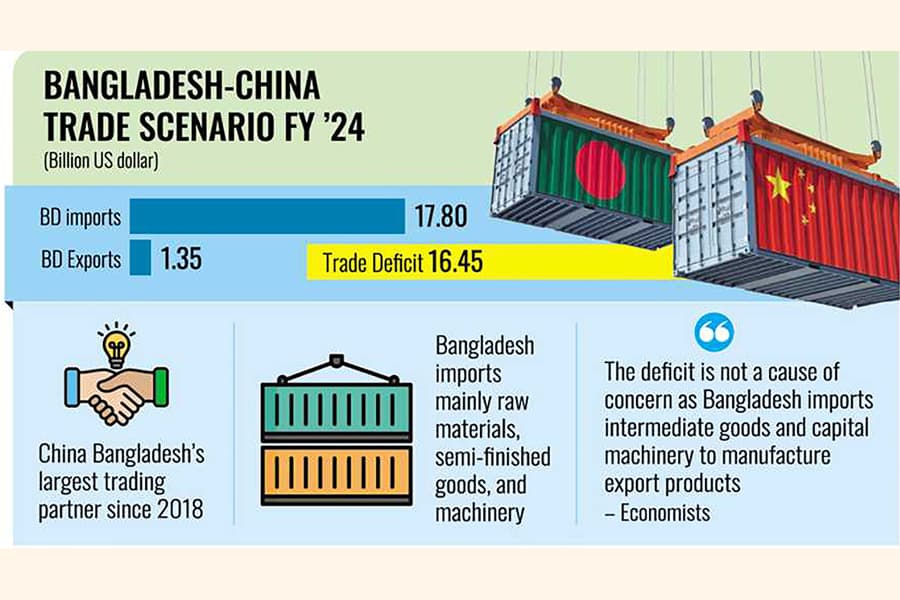
Bangladesh's trade imbalance with China has continued to rise over the past decade, driven mainly by high imports of industrial goods from its single largest source. While Bangladesh's export earnings from China have remained largely stagnant despite enjoying duty-free access for 98 per cent of its tariff lines, imports have surged to fuel local manufacturing, infrastructure building and industrial expansion. This widening gap has inevitably raised a pressing question: why has Bangladesh been unable to capitalise on its almost fully duty-free status in the vast Chinese market?
The answer, however, is more complex than it appears at first glance. The link between export performance and duty-free access is far from linear. Market entry-even with tariff advantages-depends on a range of factors that go beyond trade preferences. A closer look at Bangladesh-China trade dynamics helps illuminate the structural realities shaping this outcome.
At present, China accounts for roughly 22 per cent of Bangladesh's total imports, dominating the supply of industrial raw materials, intermediate goods, chemicals, fabrics, yarn, accessories, and capital machinery. This heavy import footprint has, over the years, created a deep industrial reliance on Chinese inputs, which traders and analysts say is driven by competitive pricing, consistent quality and reliable availability. From textiles to electronics, leather to construction, Bangladeshi industries depend heavily on Chinese supply lines to keep production running.
Central bank statistics covering FY2019-20 to the first quarter of FY2025-26 show how significantly Bangladesh's import bills from China have outpaced its export receipts. Imports ranged between US$ 11 billion and US$ 20 billion annually, while exports remained confined to around US$ 500-600 million. Imports rose sharply from US$11.49 billion in FY20 to a historic peak of US$ 20.88 billion in FY22, supported by strong domestic manufacturing growth and major infrastructure projects. However, the trend reversed as macroeconomic pressures mounted. Foreign exchange shortages, currency depreciation, and subdued industrial activity pushed imports down to US$ 17.83 billion in FY23 and US$16.64 billion in FY24. The cautious stance continued in FY25, with import LC openings registering US$ 15.48 billion. During the first quarter of FY26, imports stood at US$ 4.04 billion, reflecting restrained industrial demand and a more conservative purchasing outlook.
In stark contrast, Bangladesh's exports to China have shown minimal movement over the same period. Yearly export earnings fluctuated mildly: US$ 595.39 million in FY20, US$ 680.50 million in FY21, US$ 674.62 million in FY22, before dipping to US$ 580.40 million in FY23 and then rising modestly to around US$ 670 million in FY24 and FY25. In the first quarter of FY26, exports reached US$ 190.89 million-consistent with past patterns, but nowhere near the scale required to narrow the deficit meaningfully.
This stagnation persists despite China's duty-free access for 98 per cent of Bangladeshi products. Tariff concessions alone cannot overcome the deeper structural challenges that constrain Bangladesh's export capacity. Several factors lie behind this limited utilisation of market access.
First, Bangladesh's export basket remains narrow. The country relies overwhelmingly on ready-made garments (RMG), a sector in which China itself is a global manufacturing powerhouse. Competing in China's domestic apparel market is very difficult, given its scale, cost efficiency and advanced industrial ecosystem. Beyond garments, Bangladesh has yet to develop diversified, high-value products that resonate with China's evolving consumption patterns.
Second, supply-side constraints weigh heavily on export performance. Bangladeshi firms face limitations in production capacity, quality consistency, product design, and technological sophistication-areas where China excels. Logistics, port efficiency, customs procedures, and transport systems in Bangladesh remain significantly behind Chinese standards, limiting the speed and reliability required for export-oriented supply chains.
Third, Bangladesh has struggled to leverage duty-free access effectively. Without diversified products and strong supply capabilities, preferential tariff access alone cannot stimulate a meaningful increase in exports. Many Bangladeshi firms lack the market intelligence, branding strength, compliance readiness, and long-term export strategies needed to enter and sustain operations in a competitive market like China.
Fourth, there is a clear mismatch between Bangladeshi export offerings and Chinese market demand. China's import preferences have shifted towards higher-value items-technology-infused apparel, specialised textiles, high-grade agro-products, electronics components, machinery parts and advanced materials. Bangladesh is yet to build competitive capacity in these sectors.
Fifth, China's domestic supply chains are exceptionally strong. With efficient manufacturing clusters, cheap logistics, and economies of scale, Chinese producers enjoy inherent advantages. Even when Bangladeshi products enter the market duty-free, competing against China's own low-cost producers becomes extremely challenging.
Adding to these structural barriers are domestic challenges. Political instability, business uncertainty and periodic disruptions in transportation and logistics exacerbate export constraints. Investors-both domestic and foreign-often prefer to maintain a cautious stance, slowing down capital formation in industries that could otherwise diversify Bangladesh's export base.
Experts note that the Bangladesh-China trade imbalance reflects more than just a numerical deficit-it is symptomatic of deeper industrial dependence. Currently, 30-35 per cent of Bangladesh's industrial raw materials and machinery originate from China. This reliance, while difficult to avoid given pricing advantages, makes it harder for Bangladesh to build a competitive manufacturing base capable of producing a broader array of exportable goods.
To reduce the imbalance in the long term, Bangladesh must diversify its sourcing network, encourage local backward-linkage industries and upgrade manufacturing capacities. At the same time, developing new export-oriented sectors-IT services, agro-processed goods, pharmaceuticals, specialised textiles, light engineering and leather goods-can help tap into China's vast and dynamic market.
wasiahmed.bd@gmail.com